
Choo, Choo!
Believe it or not – Irvine once at the heart of the region’s rail traffic
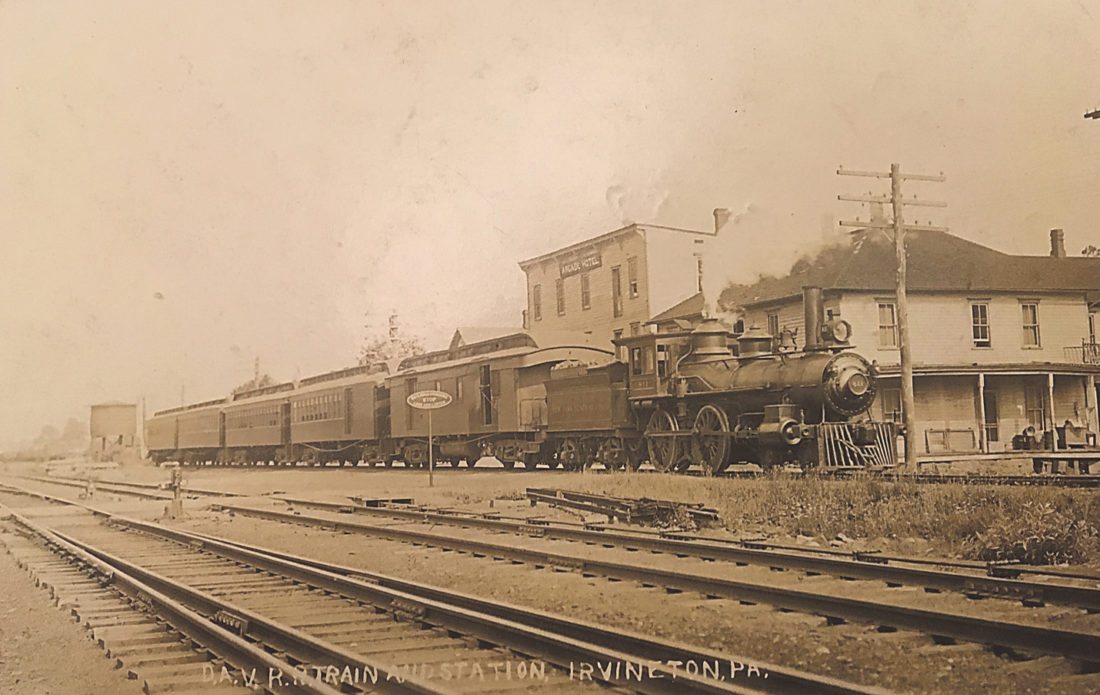
Photo courtesy of the Warren County Historical Society An image of the Irvineton stop on the Dunkirk and Allegheny Valley Railroad.
Imagine a time when Irvine was a hub of regional transportation activity.
Don’t laugh.
I’m not kidding.
It’s just been a while.
A looong while — the railroad era.
While the town has always been known as Irvine — named after the Revolutionary War general William Irvine – the railroad stop was always known as “Irvineton.”
And there was never a shortage of railroads coming through Irvine in the 19th century.
It started with potentially being a stop on the Sunbury and Erie Railroad on the way to Philadelphia.
Discussed as early as the 1830s, the completion was delayed by a banking panic which ultimately knocked out the Bank of the United States.
It took until the 1850s for the initiative to move ahead and “Dr. William Irvine was elected a director and help sell stock,” according to information found in a brochure in the Times Observer archive.
“The first railroad station was on the northeast corner of Brokenstraw Creek crossing, just across from the Cornplanter Hotel, which Dr. Irvine had built in 1841 in anticipation of the earlier completion of the railroad.”
“The station was built on what is believed to be the site of the first cabin built by Callender Irvine, destroyed by the Pumpkin Flood of 1805.”
The 1860s saw the completion of the Warren and Franklin Railroad, which ran from Irvine to Oil City, and was designed to reach the provide a link to oil fields in the area. It was later merged as part of the Oil Creek and Allegheny branch of the Pennsylvania Road.
“The W&F R.R. carried 65,000 passengers in the first five months after completion,” the brochure states. “On March 31, 1866, the Warren Mail printed an item that Irvine was one of the busiest places in the County. The Tidioute R.R. (part of the Warren & Franklin) was connected with the P&E on the flats near the residence of Mr. H. Horn in Irvine.”
The leadership of some of these railroads was actually local to Irvine.
“Alexander Cassatt was resident engineer at Renovo in 1864. By 1866, at age 27, he became superintendent of the Warren & Franklin R.R. and was living in Irvineton. He was entertained frequently by the Irvine family and the friendship continued after he became president of the Pennsylvania R.R. His family joined him in 1866 and they set up temporary housekeeping in an Irvine hotel. This was also the year his more famous sister, Mary Cassatt, left for Paris.”
The 1870s brought additional railroad development into Irvine.
“The Dunkirk and Warren Railroad was completed in 1871 and the Warren-Titusville section in 1872 and became the Dunkirk, Allegheny Valley and Pittsburgh the same year (known locally as the Dolly Varden R.R.) and later became part of the New York Central Railroad. Its tracks were north of the P&E lines. The DAV&P ticket office was in the front part of the Junction Hotel on the north side of the tracks between what is now Johnson and Depot Streets.”
That ticket office was destroyed by fire in 1893 which also destroyed the Irvine Hotel, Commercial Hotel and a house.
“A railroad car was modified and placed on the north side of the tracks at Depot Street and was used as their station until the passenger service was discontinued in the 1930s. However, the locally famous ‘Doodle bug,’ a motor train, provided passenger service between Dunkirk and Titusville until 1937.”
“There is mention of a Union Depot located on maps of 1866 and in the atlas of 1878 on the south side of the tracks at the foot of Depot Street. This may have been built to replace the station across from the Cornplanter and one source states it was built in 1870. Not much information has been found regarding this station and it is not known what happened to it.”
Whether by fire or a need for a station closer to the center of town, the depot was rebuilt.
“On Nov. 14, 1871, the Warren Mail had an item stating that double tracks were ordered between Warren and Irvine. This was done in part to accommodate the DW&P and the Allegheny Valley railroads. When it was finished, cars on the Allegheny Valley were to stop at Warren instead of Irvine. Oil business was so heavy that the continuous line was necessary.”
The station represented in the drawing was built sometime between 1890 and 1900.
“It was located at the eastern end of the triangle formed by the P&R and Warren and Franklin tracks. It was a yellow brick and wood construction with a slate roof. It contained baggage, ticket and waiting rooms, and a small restaurant at one end of the building, operated for many years by Mrs. Dailey.”
Community
Drake Well Museum “Seeing Double” with new exhibit
TITUSVILLE – Grab a pair of 3D glasses and head to Drake Well Museum and Park for a unique exhibit experience ...
Briefs
Russell UMC to host breakfast Saturday Russell United Methodist Church, 17 N. Main St., Russell, will host a ...
Bike-Hike Trail to receive award at County Commissioners meeting
The County Commissioners will consider approving a $243,673 contract tied to the Bike-Hike Rehabilitation project ...
Youngsville Post Office gets customer stamp of approval
Youngsville Life
Please email community news to Colette Nelson at Colettenel.ypl@gmail.com by Wednesday of each week to be included ...
Briefs
Outdoor Club to hike Sunday On Sunday, April 12, members of the Allegany Outdoor CLub will hike on part of the ...