Back to the future: Sheffield students use old texts as part of lesson on Braille
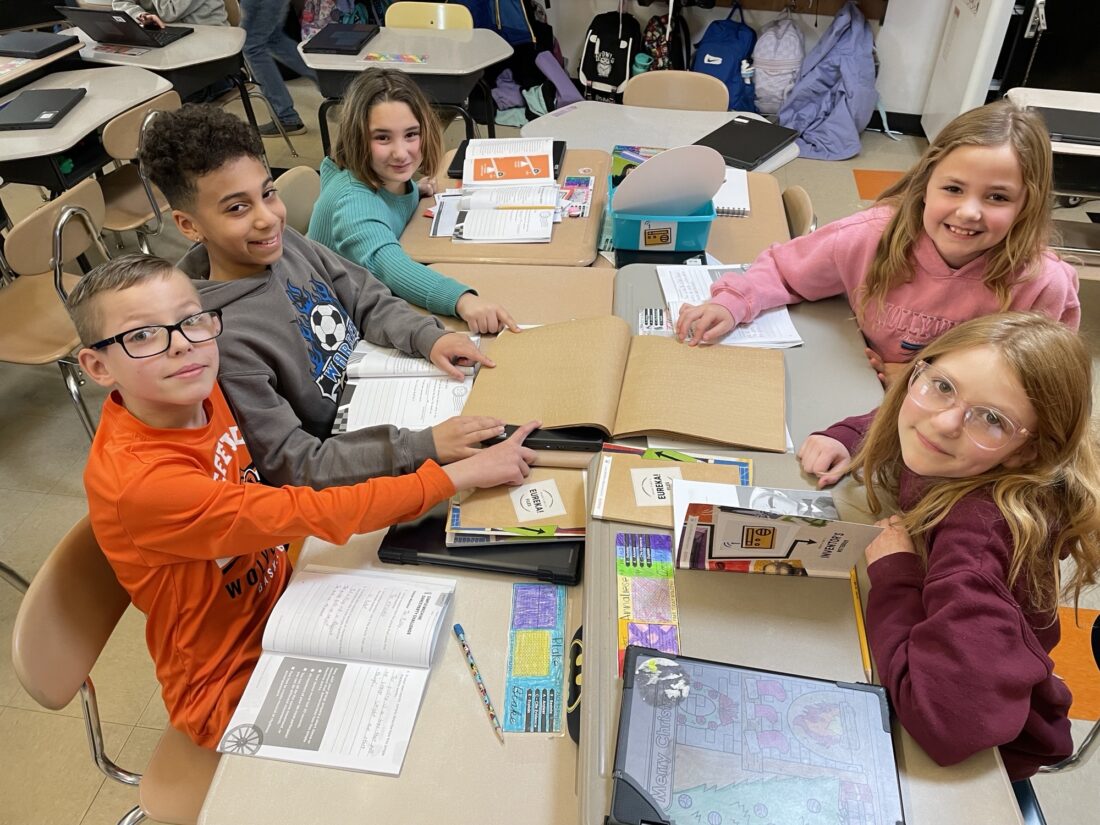
Photo submitted to the Times Observer Sheffield fourth-graders are pictured using braille during a recent lesson.
SHEFFIELD – Fourth grade students at Sheffield Elementary School have found a way to connect a game show, a book for the blind, and the exploration of inventors into one educational experience thanks to teacher Patrick Mulligan and staff member Jenny Rose.
In February, Mulligan’s class delved into the Eureka! Game Show Unit of the Core Knowledge Language Arts (CKLA) curriculum, where students were split into teams to compete while learning about inventors and their inventions in order to complete their Wheel of Inventions Challenge.
“Students have been learning how to collaborate, brainstorm in groups, design various inventions of their own to move objects in the classroom, like a ping pong ball and a wadded-up piece of paper, learn the importance of making mistakes in design, and revamping plans,” said Mulligan. “Students will also be brainstorming and creating their own invention drawings to end the unit.”
Students studied world renowned inventors such as Thomas Edison, Jacques Cousteau, George Washington Carver, Hedy Lamarr, Ruth Wakefield, Bette Nesmith Graham, Alexander Fleming, and Louise Braille.
When Rose discovered Mulligan’s class was studying Louise Braille, she approached Mulligan with an opportunity to introduce them to two mid-20th century books that had belonged to her aunt, who was one of 13 children and had suffered a brain injury affecting her in many ways, including vision.
One of the books, published in July 1952, titled, “The International Lions Juvenile Braille Monthly” came from the Cincinnati, Ohio based Clovernook Printing House for the Blind.
“The reaction from the students was extremely surprising,” said Rose. “Most of the students have only seen braille on the little sign outside the classroom with the room number with the braille underneath. Touching the pages of the book with their fingertips brought awareness of how important our senses are to us.”
Rose is hopeful her contribution to the class and the unit helped provide students with valuable insight and understanding as well as giving them the opportunity to grasp, value, and respect how people live with varying backgrounds, cultures, abilities, and identities.
“It can inspire students to be innovative and creative when finding alternative ways to access information and communicate,” said Rose. “I enjoy all the students and try to make learning an exciting experience. They are our future.”
Local News
WCSD board to discuss window safety improvements
The Warren County School District will touch on several topics including the approval of the proposed estimates ...

EHS Marching Band to perform at Veterans Parade in Washington, D.C.
Naming application, ordinance OK’d by Planning Commission
The Warren Planning Commission held a brief meeting Wednesday morning, unanimously approving both a naming ...

WAHS senior leaves mark in musical, theatrical community
Barnes, Pa., readies for 2028 bicentennial