
Board of Election adjudicates ballots, processes write-ins Monday
Trending
The vast majority of the votes cast in last week's General Election can be counted without a second thought.
But some require further review.
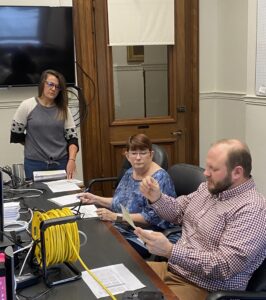
The Warren County Board of Elections met Monday morning to adjudicate those ballots and also process all of the write-in votes cast in the election.
Over 50 mail-in ballots – 54 to be exact – were received after 8 p.m. on Election Day and thus can't be counted. One was postmarked on Nov. 1 but wasn't received at the courthouse until the day after the election.
"There is not much we can do on our end," Pam Matve, a member of the county's Board of Elections said.
Mail-in and absentee ballots, however, did get to voters later this year than last year. Commissioner Ben Kafferlin said the ballots were mailed two days later than normal. That's because of an error on the absentee ballots that told voters to vote for the wrong number of county commissioners.
Elections Director Krystle Ransom said that issue prompted the delay as the county thought it better to stop, fix the issue and then mail everything rather than mailing ballots piecemeal. The process of reviewing write-in ballots was a time-consuming one given the number of offices, especially at the municipal level, that had no candidates.
Only a sampling of the write-in ballots were reviewed, though, as write-ins that clearly won't affect a race – the state judgeships, county offices, etc. – were not reviewed in detail. Many of the write-ins are what you would expect – Mickey Mouse, Donald Dunk and Marty McFly received votes. As did "Speedy G" and Bugs Bunny for seats on Warren City Council.
The less-original "Anyone but him" appeared as did Donald Trump, who received votes for city council, county auditor and magisterial district judge. Mr. Magoo nabbed a vote for county auditor while the most unique may have been "Peanut Butter Jelly Time."
A total of 35 mail-in ballots fell into one of five categories for errors – no date, an invalid date, no signature, a "naked ballot" without the secrecy envelope and a catch-all "other" category. Those first four categories – approximately 30 ballots were rejected based on "past practice and the law," Kafferlin said.
It appears some of those errors were very simple mistakes. Solicitor Nathaniel Schmidt said two were dated "11/31/2023" while one was dated "10/1/23" – the voter appeared to simply write the wrong number for the month.
"Unfortunately we cannot accept them," Kafferlin said. Those are irritating…. We had them at the election. We know they were filled out."
"My default," he added, "if we can count it, we should."
The challenge of whether to accept or reject though can be seen in the five ballots flagged at pre-canvassing in the "other" category. The first of those five had an unsealed secretary envelope. Matve noted she has sealed letters to have them unseal themselves the next day.
"It looks like there was an attempt to seal it," Kafferlin said.
The board accepted that ballot.
A ballot where someone initialed a correction they made was also accepted. The challenge for the board was whether the initials could be used to reveal the voter's identity.
"The voter secrecy has been kept," Matve said.
One voter put their name and date on the secrecy envelope. That secrecy concern fell the other direction with that ballot, which was rejected.
"I don't see how we could accept that," Kafferlin said. "(It) violates the whole purpose of the secrecy envelope."
Someone wrote what looked like a line as a signature.
Ransom said that since 2020 officials can't compare signatures but Kafferlin said it "could be a signature from my perspective…. For all I know, that's a signature." The board decided to accept the ballot.
The fifth ballot had a posted note affixed to the secrecy envelope that had the voter's name on it.
Ultimately, they decided to remove the post-it note and count the ballot.
Once the note was removed, the decision was easier.
"Everything is secret," Matve said, noting that they "could not pick this ballot from all the other thousands."