District picks top three reconfiguration options
-
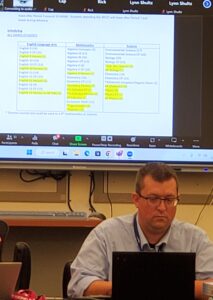
- Times Observer photo by Brian Ferry Warren Area High School Principal Josh Vincent presents information about course offerings available to Sheffield and Warren high school students if the board chooses a reconfiguration option that would send Sheffield students to Warren for three periods each day.
-
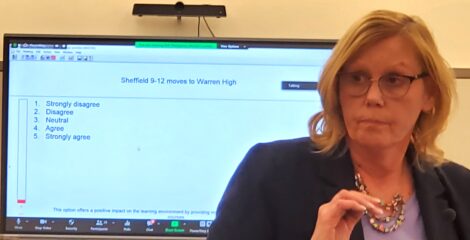
- Times Observer photo by Brian Ferry Strategy Solutions President Debra Thompson prepares to lead the Warren County School Board through an evaluation of high school reconfiguration options based on board-assigned criteria on Monday.
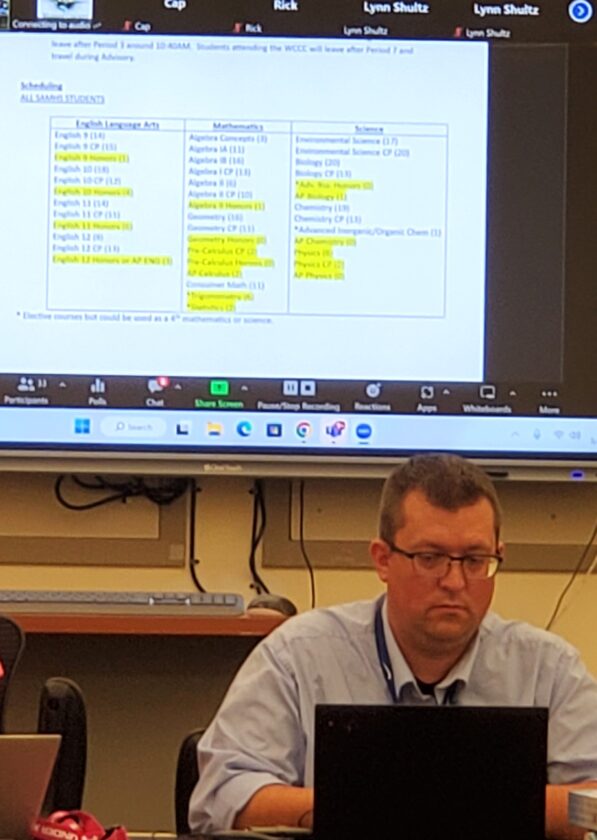
Times Observer photo by Brian Ferry Warren Area High School Principal Josh Vincent presents information about course offerings available to Sheffield and Warren high school students if the board chooses a reconfiguration option that would send Sheffield students to Warren for three periods each day.
The Warren County School District Board of Education has narrowed its high school reconfiguration options to three.
On Monday, Strategy Solutions President Debra Thompson guided the board through an evaluation — listing each of the board’s four chosen criteria for each of the seven remaining options. Board members assessed each option by the criteria on a one (worst) to five (best) scale. The criteria were: improving the learning environment, improving student well-being, bringing class sizes in line with district targets, and improving teacher workload.
Their top choice, with an average score of 18.4 out of 20, was one that would have high school students from the Sheffield attendance area take three core classes — English language arts, math, and science — at Warren Area High School every day, then return to Sheffield for the remainder of their programming. Those students would remain Sheffield Area High School students. They could participate in athletics and other activities at Sheffield.
“Sheffield students would be permitted to stay at Warren if they desired, (but would be) unable to participate in sports with Sheffield… if they stayed longer than the three periods,” Superintendent Amy Stewart said.
Students who are enrolled in the Warren County Career Center would remain members of their sending school even if they spend their entire days at the Warren campus. One of the main selling points for board members is that Sheffield students, and to a lesser degree, Warren students, would have more options for core classes.
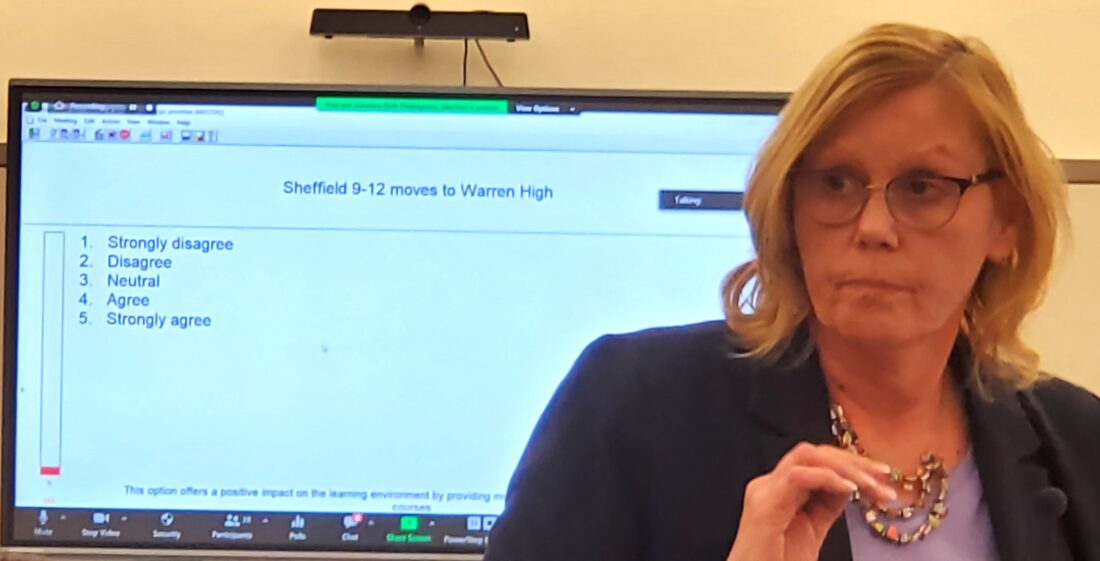
Times Observer photo by Brian Ferry Strategy Solutions President Debra Thompson prepares to lead the Warren County School Board through an evaluation of high school reconfiguration options based on board-assigned criteria on Monday.
“We see it on these course request sheets,” Board Member Arthur Stewart said. “We see six and eight students who want something as fundamental as physics. It’s criminal. Eight students at Sheffield want physics, but won’t get it short of this. It’s unacceptable for us not to provide easy access to physics … and there are others. The numbers are dwindling to the point that we can’t afford to provide it. We can’t keep asking our teachers to do six preps.”
Josh Vincent, Warren Area High School principal, was asked to present a probable list of class offerings if the hybrid merger were to take place.
He said the schedule would be created to make sure each level of a core subject is offered at the same time. If a student were to move up or down a level, it would not impact the rest of their schedule. In addition to having sections of physics for all students who want it – already in place for Warren students – the change would allow students at both schools to take trigonometry. Without the change, neither school has enough interested students for the district to offer trig, he said.
“I’m very impressed to see students coming out and saying they want these classes,” said Jeff Dougherty, board member. “To me, that’s a very good thing.”
“It’s hard to see kids not getting the courses they want,” Amy Stewart said. “This is one of the most important things that a principal does.”
She addressed a possibility raised during public comment that students from Sheffield might be more enthusiastic about attending Warren for part of the day if they took electives during their time there.
“If I had a choice, giving a child a full gamut of cores is more desirable,” Stewart said.
She said there would be little impact to the number of courses taught by teachers already at Warren, and a reduction in the number of different lessons teachers coming from Sheffield would have to prepare.
Arthur Stewart summarized that the hybrid plan probably does not cost the district money – perhaps generating a savings – offers more academic opportunity for students, preserves the community school in Sheffield, and might help alleviate the teacher shortage.
There were disadvantages to the idea.
Sheffield students would have to have longer school days or they would be traveling during their advisory periods – often set aside for students to work on district college and career readiness graduation requirements. Students would not be in their home schools for half the day.
The district’s transportation budget would go up by about $25,000 after reimbursement for the year, plus an additional $5,000 if more mid-day runs from Warren to Sheffield were required.
OTHER OPTIONS
The board’s second option, with a score of 15.3 out of 20, was moving Sheffield’s high school students to Warren full-time.
The third, at 14.8 points, was creating a K-12 center at Youngsville.
Board members said they want to keep that option on the table, even though it could take time to make the necessary renovations.
Dougherty explained that the master facilities plan is a living document and the immediate reconfiguration is just a part of it.
“We’re making a decision now,” he said. “I’m very much in favor of looking at Youngsville K-12. Keeping it as a living document and having that option available down the road is a very good option.”
“For every reason that the parents of the Youngsville community stated… proximity to police, fire, public utilities is huge… moving students farther north doesn’t make any sense to me,” Board Member Joe Colosimo said. “They are the geographic center. It would make more sense to bring students south. The fly in the ointment is the multi-million dollars that we put into Eisenhower. We’re not talking about closing schools.”
He suggested that renovating Youngsville High School – which would be required under any situation other than closing it completely – would give the board the flexibility to offer the hybrid option with Eisenhower students going to Youngsville.
“We’re talking about the Sheffield option with Warren – we know we’re going to have to replicate that in some form with Youngsville/Eisenhower,” he said.
Arthur Stewart pointed out that the district is already paying off $74 million in debt.
Amy Stewart added that there is not currently government assistance – PlanCON nor QZAB – that the district had previously used to help offset the costs of major projects.
The first two options that did not make the cut were moving all Youngsville students to Eisenhower and Warren and moving all Eisenhower students to Youngsville and Warren. The scores, respectively, were 12.2 and 11 out of 20.
The options at the bottom of the list were keeping things as they are (5.8 out of 20) and adjusting attendance boundaries to beef up enrollment numbers at Sheffield, Youngsville, and Eisenhower (4.8).
Local News
Council sets hearing on liquor license for eatery
Warren City Council will hold a hearing Monday to gather public comment on a proposed transfer of a liquor ...
Victim Impact Panel awards scholarships

K9 Complex building effort starts in Sherman
Shapiro’s first TV ad about free school breakfast, what about lunch?
On Thursday, Gov. Josh Shapiro released his campaign’s first ad as he seeks a second term in office. The ...
Fire department equipment program passes House
A $30 million grant program to help fire departments buy equipment has passed the state House of ...