
Locals recount Speed Week at Salt Flats in Utah
-
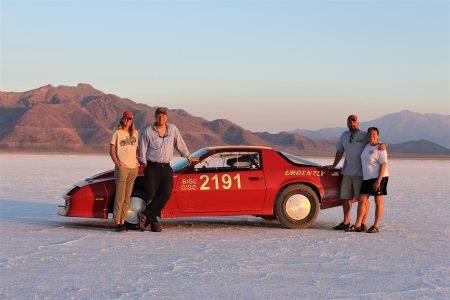
- Photo submitted to Times Observer Team Urgently (from left) Emily Wiggers, Lane Wiggers, Todd Woodin, and Elizabeth Feronti at the 2021 Speed Week at the Bonneville Salt Flats in Utah.
-

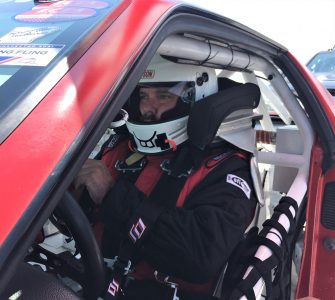
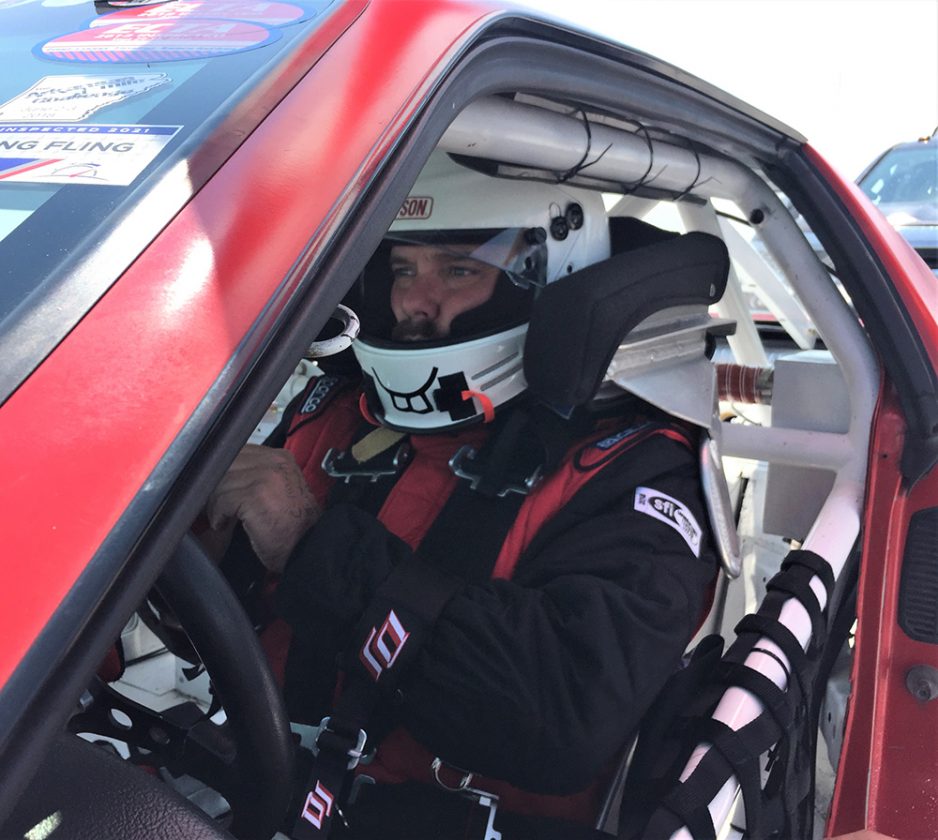
- Photo submitted to Times Observer Todd Woodin earned his Class A license — average speed of over 200 miles per hour for one measured mile — at the 2021 Speed Week at the Bonneville Salt Flats in Utah.
When it’s time to slow down, most people hit the brakes.
At Speed Week, they do that, but they pull the chute, too.
Team Urgently, featuring drivers Todd Woodin and Lane Wiggers, and crew members Elizabeth Feronti and Emily Wiggers, took some significant steps in the world of land speed record racing at the recent Speed Week at the Bonneville Salt Flats in Utah.
They set up their pit area — by screwing a tarp onto the salt — on Friday, Aug. 6, and set to work getting Urgently to go as fast as possible. The salt keeps salt out of equipment and parts and pollutants out of the salf.
The salt was smooth (a relative term) and dry. “It is without question still an off road race,” Woodin said. “It is an off-road surface with significantly less traction than asphalt/concrete and, contrary to appearance, is not billiard table smooth.”
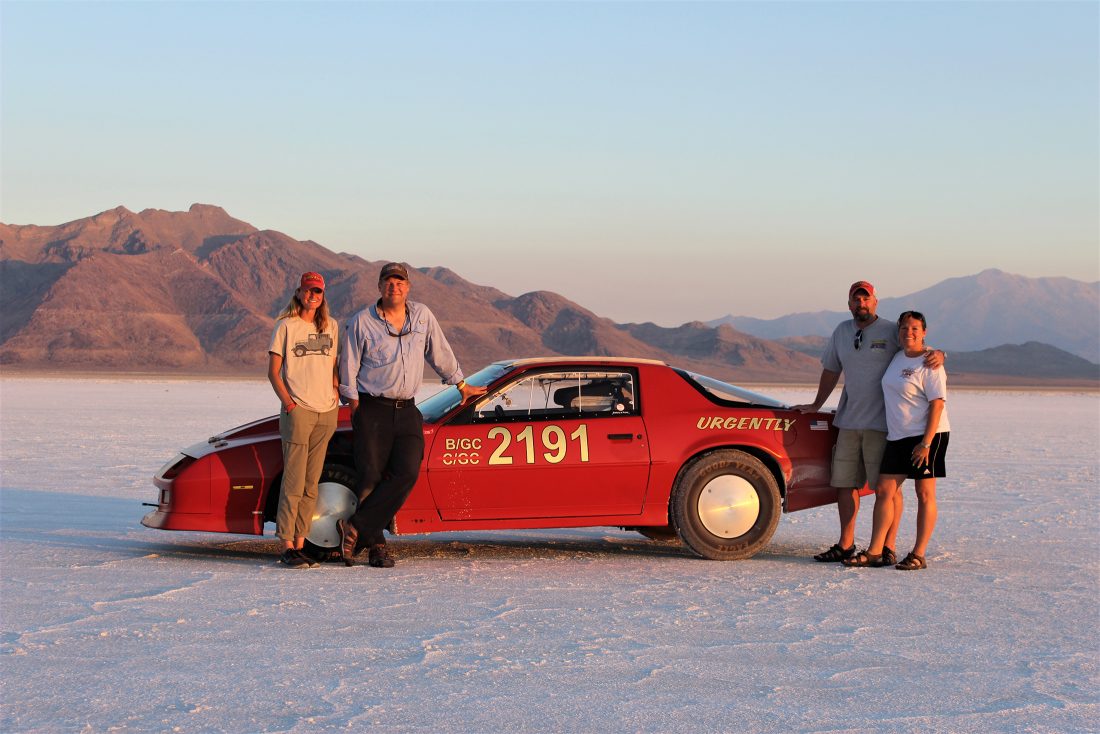
Photo submitted to Times Observer Team Urgently (from left) Emily Wiggers, Lane Wiggers, Todd Woodin, and Elizabeth Feronti at the 2021 Speed Week at the Bonneville Salt Flats in Utah.
So, they added some extra weight — about 1,000 pounds of ballast — half in the front, half in the back.
With racers reaching high speeds — Speed Demon won the 2020 Hot Rod Magazine Trophy with a top speed of 481 miles per hour last year — the pre-race inspection is rigorous — “the most thorough inspection in all of land speed racing,” Woodin said.
“Bonneville is the gold standard,” he said. “The officials comb the car to make sure it will not be a crash hazard and that in the event of a wreck, it will keep the driver alive.”
“We passed without any suggested modifications and any further drama, a testament to Lane’s skills as a builder,” Woodin said.
The drivers have to be suited up to survive some pretty unpleasant possibilities.
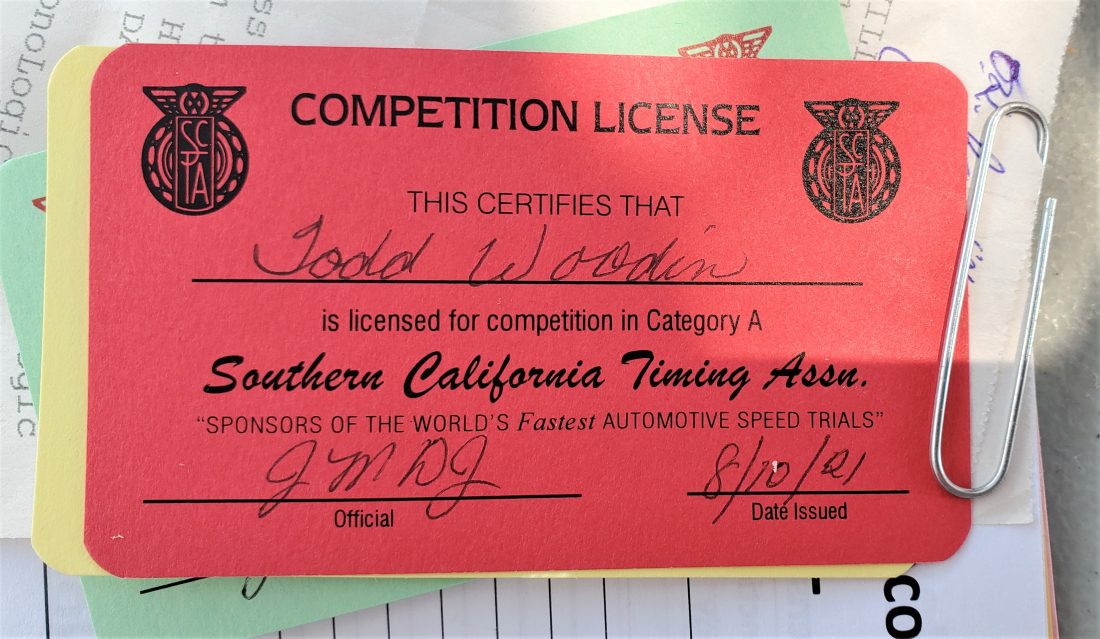
Photo submitted to Times Observer Todd Woodin earned his Class A license — average speed of over 200 miles per hour for one measured mile — at the 2021 Speed Week at the Bonneville Salt Flats in Utah.
“Drivers wear fireproof socks, racing suit — effectively a fireproof snowmobile suit — head sock, racing shoes, helmet, HANS (head and neck support) device, and fireproof gauntlets (gloves),” Woodin said. “Underneath is a ‘cool shirt’ with a rubber hose zigzagging across it that is plugged in to a swamp cooler in the rear of the car that circulates cold water through the hose to keep the driver cool in the oven-like heat of Bonneville.”
They put on all that gear long before they put the car in gear.
“About three cars back from the front of the line the driver squeezes into the cramped confines of the roll cage where the head is effectively locked in a forward facing position by the racing seat head bolsters,” he said. “The crew chief fastens the five-point harness together with arm restraints which limit the arm movement of the driver to operation of the necessary controls. The harness is tightened to an uncomfortable level and the driver is locked in position until the run.”
Any delays make the team consider the driver’s ability to remain in the car, he said.
“Just before the run a door net is fastened into position and safety pins are extracted from fire bottles and the parachute,” he said.
With all that high-tech gear, the start of the race is handled by a truck literally pushing the car up to 15 to 20 miles per hour where the gearing of the cars is able to take over.
They had to compete for driving time with a record number of racers.
But, their time on the track was fruitful.
“We were fortunately able to make three licensing runs on Saturday,” Woodin said.
Drivers have to show their abilities.
On Saturday, Wiggers was licensed at 175 to 199 miles per hour (B licence) and Woodin for 150 to 174 miles per hour (C license) based on their speeds at 2.25 miles.
An A license requires that a driver average 200 to 249 miles per hour for any measured mile of the course.
On Sunday, after taking care of a minor issue, Urgently waited.
“We prepped the car and got in line only to wait through four serious crashes (none fatal) that shut the meet down while the track was cleaned up and the drivers sent by Life Flight to Salt Lake City,” Woodin said. “Each crash represents a one- to two-hour shutdown. We ended up waiting all day in line and never were able to run.”
Woodin earned his 174 to 199 mile per hour license early Monday.
“Later in the day, Lane exceeded 200 miles per hour for the first time in the car with a top speed of 207 at around three-and-a-quarter miles,” Woodin said. “The car was stable and the team was ecstatic.”
The team ended its annual assault on the speed record for their class on Tuesday with Woodin reaching a top speed of 210 miles per hour and holding an average of 201.5 miles per hour from mile marker two to three — the A license requirement. “Urgently is officially a Bonneville certified 200 miles-per-hour-plus car,” Woodin said. “The car became long-course certified” by exceeding 175 miles per hour before reaching two and a quarter miles.
“The car handled well at speed… as well as can be expected,” he said. “Any street-based car that travels 308 feet per second (210MPH) is going to provide a stimulating ride — ‘dancing around.'”
“There was a fair bit of lateral movement at speed likely caused by air disruption over/under the car and the unfinished off-road surface,” he said. ” At 200 miles-per-hour-plus, a massive amount of air needs to be shoved out of the way to continue forward at that speed.”
“It takes a lot of horsepower and traction,” Woodin said. “Future plans include potentially lowering the stance of the car for even better stability.”
Good news, the car has the horsepower to push closer to the class record of 237.045.
“The engine data was also encouraging,” Woodin said. “It appears the engine had not even reached it’s peak power at 200 miles-per-hour-plus. Review of run videos provide visual confirmation that the car was still pulling (making power) when the 200-plus runs were terminated.”
With the discovery of a discrepancy between the tachometer readings and the computer records, the team decided to end on a high note and start the 2,000 mile trip home … at much lower speeds.
“We traveled well over 4,000 miles, over 60 hours of driving,” Woodin said. “We cooked in the oven-like heat, wrestled heavy and awkward ballast plates to the car, prepped, prepped and prepped. We sat in lines waiting for hour upon hour.”
“We did all of this for six opportunities to take a 70-second ride,” he said. “Once that starter gives the signal and you signal the push truck to go, you are committed to go as fast as you dare or as fast as the car will let you. When the run starts, fear immediately changes to a combination of exhilaration and concentration on driving the car to whatever goal you set for that run, kinda like a test pilot.”
“It seems crazy on paper, but allow me to reassure that there is nothing to compare to the stimulation of 200-plus mile per hour ride off-road followed by the reassuring thump-jerk of a deploying parachute,” he said. “As a driver, the turnout from the track, the slow rolling stop with the salt crunching under the tires, the amplified silence after the screaming roar of a race engine at 7,000 RPM, all followed by a few minutes of solitude alone on the salt while you wait for the push truck to catch up is the most unique experience one can imagine.”
“Relief, satisfaction, and knowledge that you are a part of a small but historic group that have sought speed on the salt for over a century,” Woodin said. “Incomparable. It was all worth it.”
Local News
Democrats make choices in state in primary
Democratic voters in Pennsylvania picked their nominees to flip four Republican-held seats seen as critical for the ...

Spirit of America
Council approves removal of mid-block crosswalk
City Council voted this week to approve an ordinance removing the mid-block crosswalk in the 200 block of ...

District discusses Virtual Academy programs
Teacher Awards Night set for Friday
Garrity set to challenge Shapiro for governor
The race for Pennsylvania governor is set between Gov. Josh Shapiro and State Treasurer Stacy Garrity. Shapiro ...