
Foot soldiers
Warren County citizens joined march on Washington

Trending
At least 470,000 people.
That's the number of people who marched on Washington according to a New York Times article dated Jan. 22, which cited the estimates of Marcel Altenb
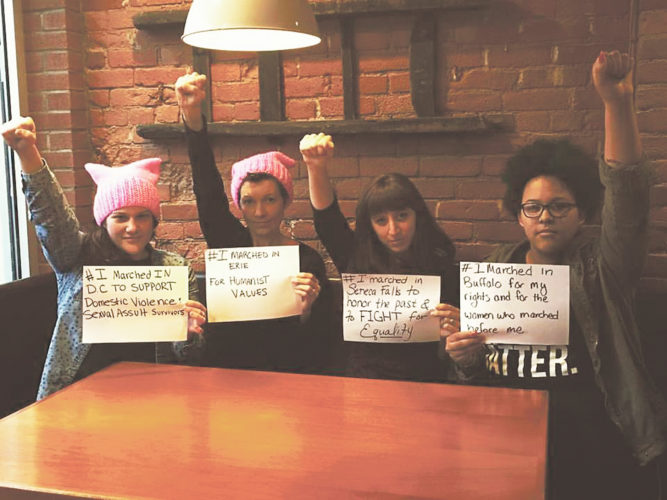
Photo submitted to Times Observer
From left, Mary Hetrick, Karen Hansen, Vanessa Weinert, and Brianna Harris.
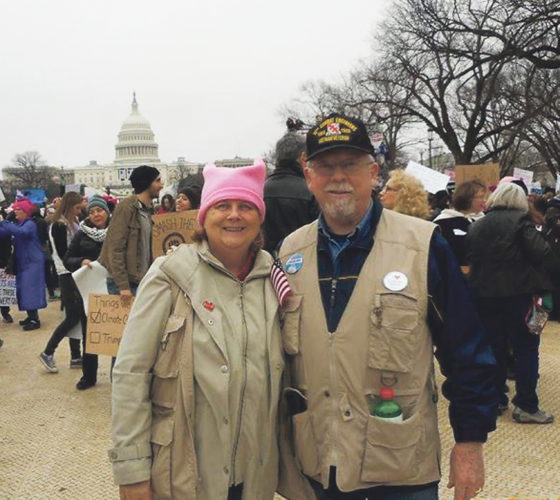
Photo submitted to Times Observer
Marge and Neil Himber in Washington D.C.
urg and Keith Still, Manchester Metropolitan University of Britain crowd scientists.
That 470,000 person group was not only women, but families, including men and women, boys and girls, of all ages. The number of issues represented at the march were as varied as the people who brought them to the foot of the newly inaugurated President Donald Trump.
The same wide demographics were represented at marches on all seven continents, in cities large and small. Many local men and women were present at one or another of those marches. Here's what they had to say:
Mary Hetrick, a sexual abuse advocate and soon-to-be Warren resident, said that initially she went to the Women's March on Washington emotionally. While the march wasn't intended as an "Anti-Trump protest," said Hetrick, many people were initially motivated by emotions of anger, fear, or disdain. When she got there, though, on a chartered bus of 50 others, Hetrick said that she was struck by the mood of the crowd. It wasn't an atmosphere of anger or threats, Hetrick said. "There are no demands," said Hetrick of the Women's March movement. "No one was saying Trump is not my president there. Trump is our president. He won. But we do feel like he's not on our side. As a leader," said Hetrick, "you've got to listen to all the people. Good leaders are diplomatic."
Hetrick said that to those who say that the Women's March was an attempt to divide people, she would respond with "we've been divided, and Trump brought that to light." Hetrick also said that she feels that a person's character informs their actions, and that the character displayed by Trump is concerning to marginalized groups such as women and minorities. "Looking at what he's said," said Hetrick, "certain people feel like they're not being heard." And while many argued that no rights were violated as of the day after Trump's inauguration, Hetrick said that the point of the Women's March was to bring to the forefront and protect "rights that we've already fought hard for. If the suffragettes didn't do this," said Hetrick, "any woman who voted for Trump wouldn't have been allowed to vote at all. It's okay if you feel like it's not your march," said Hetrick to the women who have chosen to distance themselves from the march and the movement behind it. "I'm marching for you, too."
Hetrick said that she does acknowledge that Trump is the new President, but said that "just because he won doesn't mean that we're canceled out. You wanted to lead us, you have to acknowledge us," Hetrick said was her message to President Trump. "That's the job description." Hetrick said that physically being in a crowd so large was not chaotic or angry, two things she'd been expecting to experience before arriving. But, said Hetrick, the amount of people alone at the Women's March left her awestruck. As to those who said that the men and women participating in the marches aren't giving the new President a chance, Hetrick simply said "we want to give you a chance but there are certain things we will stand our ground on."
Margie and her husband Neil Himber, of Youngsville, attended the march in Washington as well.
"We drove to Pittsburgh Friday and met up with friends and boarded a bus at 2:30 a.m.," said Neil. "We arrived in Washington about six hours later where we discovered that more than 1,200 busses were expected to arrive that day. We exited the bus at RFK stadium and walked three miles the Capital where we joined in a sea of humanity. We later heard that over a half million people were present to express their concern for people threatened by the authoritarianism embodied by Donald Trump. The march was an empowering and energizing experience of the people peaceably assembled," added Neil. "People along the way shouted support from porches, and gave thumbs up from living room and office windows. As we walked through a residential neighborhood of row houses, from RFK to the Capital, we noticed a young father with a baby girl on his lap, sitting on his porch. In the yard in front of him stood a young boy of about four years holding a sign that said 'I am marching for my sister.' We gave him a hearty cheer and a thumbs up, which delighted him. Along the walk, signs with quotes from Dr. Martin Luther King Jr. were posted in yards. As we walked we changed what democracy looks like."
Indeed it is. We will see if that continues to be the case as this administration settles in.
"At the march we were delighted to see Catholic nuns in the School Sisters of Notre Dame, and members of Veterans for Peace (Neil is a member, himself), teachers, students, people of so many ethnic backgrounds, union members, a great diverse gathering of Americans. These are sons and daughters, grandchildren, and great-great-great-grandchildren of immigrants. After marching to the White House we took the Metro back to RFK stadium. We were packed in so tightly we could barely move. We were tired after walking six to eight miles, but elated. DC Police reported that there were no arrests or incident during the march."
Alan Yelvington, of Russell, went to the March in Erie, Pa. with his wife and daughter, meeting up there with other friends from the Warren and Jamestown areas. "I come from a family of activists," said Yelvington, "but I tempered my enthusiasm while I was in the service. Both of my parents served in the military in WWII. I served for 33 years before retiring as an 0-4. I spent my last seven years in Washington, D.C. and I got a fairly good look at how our democracy should function for better or worse. I'm a strong advocate for representing issues constructively. It's a regrettable tragedy when the only way to affect change is through civil disobedience, and I've never been put in that position. I'm also an advocate for ethical behavior and accountability from elected officials. I understand how and why money and corporations impact their votes, and it's not all evil. But there do need to be limits, and there does need to be oversight," said Yelvingon.
"I believe that diversity makes this country stronger and that the new administration is undermining that strength, by intent or ignorance I don't know. I believe that we have the right to free speech that does not muzzle the opposition. I believe that free speech also includes speaking your native language without being considered 'illegal' or a terrorist. I lived in New York City for seven years, so you get used to it quickly. I moved to Pa. for the first time when I retired in 2009. We all have our filters and I'll simply share what I saw and felt in Erie. Yes, there was an understandable anti-Trump atmosphere, but it did not overpower the larger issues that were pro-women, pro-children, pro-human rights, pro-diversity, and pro-environment. Health care for women was a large cry, and I consider that a human right. Some singing, some chanting, lots of hugging. It was a well-behaved group that did a good job of representing their causes with many men there, too. I guess that women led the charge, and the dutiful followed. I didn't stay for the speakers. Gatherings like this really aren't how I get new information. Rallies and marches like this serve as affirmation of belief and community. I like to think of them as a secular choir practice. It gives people that feel disenfranchised a chance to see that they aren't alone, that there is strength in numbers. Folks have an opportunity to meet, greet, and come up with strategies to move their concerns in front of key decision-makers. I hope that there are more rallies like this for a very long time. It's part of the American experience," concluded Yelvington.
Dr. Karen Black and Debbie Hornburg, both of Warren, attended the Women's March in Erie as well.
Said Dr. Black, who's got two DC marches under her belt, "some say marches accomplish nothing; true in itself, but they're a powerful impulse to action." Black said that she and one other woman went to Erie because, "I first intended to go to DC, but reflecting on my age and my memory of the drain that those long-distance events involved, I opted for Erie instead." Black said that she and her friend "met a number of other Warren people there (in Erie), some from the League of Women Voters and some on their own."
As to why she went, Dr. Black – a student of the Russian language and culture who lived in Russia and spent a significant amount of her life with Russians – had plenty of reasons, many of which reflected in the variety of signs displayed at the event. "Like so many," said Black, "I had reached a point of such frustration with the mostly awful goals and the general ineptitude and corruption of the shaping Trump organization. There are, of course many issues as the protest signs show women's rights, especially government meddling in women's reproductive issues; the deliberate ignoring of climate change problems in the face of the world's best evidence; efforts to roll back LGBT protections; the Betsy Devos nomination for Secretary of education; neglect of the problems of public schools; the stupid wall and generally poorly thought-out policies on immigration; an increasing disgust with Trump himself, who more and more people believe is on the edge of derangement; threats to the ACA and Medicare; the persecution of Planned Parenthood, an organization that has done more to REDUCE the number of abortions than any other institution in the US, besides providing the only health care that thousands of women have access to; neglect of the neediest in favor of padding the pockets of the top two percent; Trump's unsettling courting of Russia, and more," Black said.
For those who criticize the march and the movement behind it, Dr. Black said "you should have been there, and you would understand. Some of those critics, I have heard, say they resent the implication that they are second-class citizens and that none of this relates to them, and that this is all just so disrespectful. As to the last, I would have to say that there is a big segment of the population that does not respect the President, and feel that he is a loose cannon, an ignorant man at the mercy of his own impulses who might well get us all nuked. If the way we must get his attention is to fill the streets and yell a lot, well, so be it. You have another such march next week and I'll be there."
Debby Hornburg, a Times Observer columnist, also attended the Erie march with her grandson. The march in Erie was expected to draw a crowd of 600 and ended up being estimated at around 2500 many of whom Dr. Black and Hornburg both said consisted of families, men, and children.
Said Hornburg, "I have been looking around in absolute bewilderment since this election. I don't understand why everyone around me is not horrified at the path we're on. I feel as if the America I thought I knew vanished. There were a diverse group of people, all there with our own concerns for our collective future. At one point, a Trump supporter drove by screaming out the window 'he is your President get used to it,' and in the corner of the march I was in in, surrounded by teachers, clergy, social workers, mothers, fathers, grandmas, grandpas, it came: quietly at first, a tittering which became a collective belly laugh. It felt good to laugh at the ridiculousness of it. It felt good to be with people who all saw the ridiculousness of it. In that moment I felt as if I had rediscovered the America I knew and loved."
One Scandia resident, Julie Boozer, participated in the march in Naples, Florida, with her son Wes.
Said Boozer, the atmosphere was "peaceful enthusiasm amidst a rally of 2500 marchers, as estimated by the local paper, the Naples Daily News. It was an affirming experience for me to see that so many people in our country are concerned about equal rights for women, which I see as just a basic civil right as described in the Constitution and beyond the exclusive territory of either political party. Equality for women is an issue that has deep roots in our area of the United States because the first gathering for women's suffrage was held in nearby Seneca Falls, N.Y. in 1848 and organized by Elizabeth Cady Stanton and Susan B. Anthony. Seventy yeas later in 1920, the 19th amendment to the Constitution was passed granting women the right to vote. This achievement, however, was well behind New Zealand (1893), Australia (1902), Finland (1906), Norway (1913), Denmark (1915), Canada (1917), and Austria, Germany Poland, and Russia (1918). Today, America still trails behind many other developed countries in our recognition of the rights of women.
As I look back, I find this to have been a struggle throughout my lifetime. I participated in the national rally for women's rights in the early 1970's. I spoke on restoring rights to women and families in the delivery rooms of hospitals providing maternity care services, as well as providing guaranteed maternity leave for women in the workforce, with provisions similar to those provided by other developed countries in Europe, particularly Scandinavia. That was almost fifty years ago and here I am, still marching for equal rights for women. We have much more to do and so little time!" Boozer quipped.