
Mapping a state plan
Lt. Gov. candidate outlines energy, education and regulation priorities
Trending
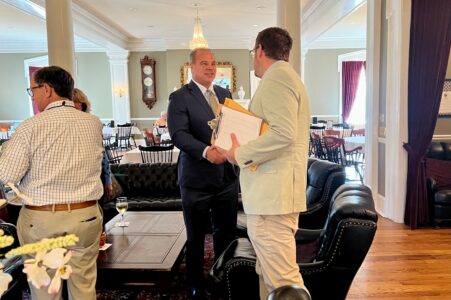
Jason Richey, candidate for Pennsylvania lieutenant governor, says economic revival in Western Pennsylvania hinges on expanding energy production, increasing school choice, and reducing government regulation.
In an interview during a stop in Warren last week, Richey described growing up in Aliquippa, a former steel town, calling it "a pretty gritty, poor place where I saw people needing food, families breaking up." That experience, he said, shaped his outlook and resilience.
"I worked in the last remaining steel mill in the summer in 130-degree heat," Richey said. "So it taught you a lot of grit."
Richey, now an attorney with decades of experience in energy and construction law, said he was not initially seeking the role. "This lieutenant governor spot was not anything I was looking to do. This was not on my bingo card," he said, noting he was encouraged to run by state Treasurer Stacey Garrity and U.S. Sen. Dave McCormick.
Richey identified energy policy as his top issue, arguing Pennsylvania has untapped potential.
"The first thing is unleashing Pennsylvania's enormous energy potential," Richey said. "That means allowing for drilling of natural gas everywhere and accelerating permits to get the natural gas out of the ground."
He criticized prior administrations' energy policies, claiming they discouraged investment. "You have supply going down and no new supply coming in to replace it," Richey said.
The candidate proposed building infrastructure, including pipelines and a liquefied natural gas export facility in Philadelphia. "Our projections on that plan are $5 billion in new revenue and a quarter of a million new jobs," Richey said.
He added that increased revenue could reduce taxes. "What we're going to do with that $5 billion is reduce your taxes, in particular, property taxes," Richey said.
Education reform was his second priority, particularly expanding school choice.
"We think money should follow the child. We think parents should be in control of their kids' education," Richey said.
He pointed to student performance statistics as a concern. "Seven out of 10 eighth-graders are neither proficient in reading or math, and that's horrible," Richey said.
The candidate argued that competition would improve schools. "It's going to make the schools work harder to improve the quality of education," Richey said, adding he supports public education but believes reforms are necessary.
His third priority involves cutting regulations and shrinking the government.
"We have 160,000 regulations. That is the third most of any state in the country," he said. "Everyone says there are too many regulations."
Richey proposed a system requiring the removal of existing rules before adding new ones. "If we're to add a regulation, we've got to take one away," he said.
He also emphasized eliminating waste in government spending. "The government's become too big, too expensive, and we've got to root out all the waste," Richey said.
When asked how he would measure success if elected, the candidate focused on cost of living.
"It'll be measured on affordability," Richey said. "If at the end of four years people don't have more money in their pocket, then I won't run again."
Addressing concerns specific to Warren County, including population decline, he said economic growth would help reverse the trend.
"That kind of economic activity is going to help bring population back," Richey said.
On high local gas prices, he pointed to Pennsylvania's fuel taxes. "We have one of the largest gas taxes in the country," he said. "If there's enough revenue available, we have to look at reducing it."
Richey said he would consider a "moderate increase" to minimum wage but warned against large jumps. "$15 across the board is a very dangerous and not well thought out policy," he said, citing potential impacts on small businesses.
On marijuana policy, he opposed full legalization but suggested a middle ground. "Maybe it has come time to decriminalize it," he said, while emphasizing concerns about health effects and workplace impacts.
Richey said rural communities would not be overlooked if he is elected.
"I will not forget. I will be here, and I will be a champion for Western Pennsylvania," he said.
Despite criticizing current leadership, he said he would seek bipartisan cooperation. He pointed to healthcare access, broadband expansion, and tax relief as potential areas of agreement.
Richey will be facing candidate John Ventre in the Republican primary on May 19.