
Dynamic Duo: Roots Rising Series brings Queens pair to Warren Saturday
Roots Rising Series brings Queens pair to Warren Saturday
Trending
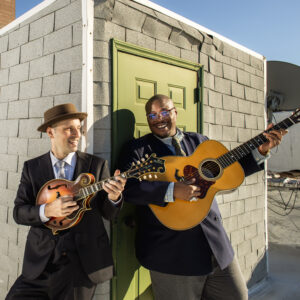
Jerron Paxton and Dennis Lichtman haven't always performed together. But the combination of their talents can result in beautiful music.
The duo will perform at 8 p.m. Saturday as part of the Roots Rising concert series at the Struthers Library TheaterPaxton and Lichtman play with a focus on predominantly earlier American acoustic roots music in a variety of genres.
Sharing a common love and high regard for the history, stories and significance behind their music, Paxton and Lichtman are world-renowned multi-instrumentalists and vocalists ready to engage with the audience for a one of a kind experience with a lively performance including acoustic blues, ragtime, Tin Pan Alley pop songs, 1920s jazz, twin fiddle hoe-downs, and original songs and compositions.
Paxton is very well known in the acoustic blues circuit internationally, and his most recent album is a solo record on the Smithsonian folkways record label. Talented in the guitar, banjo, piano, fiddle, harmonica, Cajun accordion, and percussion, Paxton draws a personal inspiration from traditional blues, jazz, and ragtime, demonstrating his connection to heritage with his multiple talents.
Lichtman plays a variety of musical styles including early jazz, bluegrass and Western swing, to name a few. Talented on clarinet, mandolin, fiddle, and more, Lichtman is also one of the curators of one of the best jam sessions in New York City for traditional jazz.
For nearly two decades, Lichtman has played at a place called Mona’s in New York City, as the clarinetist and bandleader of the famed Tuesday night traditional-jazz jam session. Mona’s was profiled in the New York Times, and has been described by the Wall Street Journal as “ground zero for an emerging late-night scene of young swing and traditional jazz players."
"It is quite the home for traditional jazz," Paxton said.
Traditional jazz is the folk music of urban areas, places like New Orleans and Chicago and New York where the music is very native to that place, Paxton said.
"It’s a beautiful gig that was the antithesis of my time studying jazz formally in school. You know, so much of antithesis, it made me quit and pursue traditional jazz as a career. And you know, that has influenced my playing from then until now," he said.
Currently residing in New York City, the two musicians got together a number of years ago over a shared interest and love for the same kinds of American roots music, approaching it from very different backgrounds and angles. When Paxton moved there, he began performing at several acoustic roots music and jazz gigs around town, making his presence known.
"So I met him and invited him to come down to the jam session at Mona’s. And that’s really where we first started playing together," Lichtman said.
Over time, a musical and personal friendship developed and eventually, the two began doing a bit of recording and performing as a duo.
"Because we love so much of the same music, and just felt like we could have a lot of flexibility in the duo format, to explore all different kinds of music that we love in our own way," Lichtman said.
With a love for acoustic music and acoustic instruments, they do their best to make sure people enjoy a variety of instruments played without having too many instrumentals. As the first project where they choose less instrumentals, they both really enjoy Ragtime and simply want to play some of the great tunes that they know. Having done an entire set of Ragtime at Symphony Space in New York City, Paxton recalls that it was the only show that was genre specific. Mixing singing and storytelling keeps everything interesting. Holding a tenderness in old fashioned entertainment, Paxton shared that they secretly lay into their instruments which allows people to enjoy that part of their personality while playing folk music.
Adding to that, Lichtman shared that part of what they love so much about the early roots music is that the stories behind the songs are so incredible and hold a rich glimpse into history as well as human stories.
"The songs don’t exist in a vacuum," Lichtman said. "They all come from a specific place in time, and there’s so much context behind all of these songs and why they exist, and how they exist. So we like to share some of that with the audience, and we each play about four or five different instruments and do some singing in the show."
Finding music so interesting, Paxton said that the storytelling is important because sometimes it doesn’t do justice just to play the song.
"Especially when you’ve been given a nice, beautiful venue where you can have a rapport with your audience, they really appreciate these little tidbits of information, rather than just song after song after song, and we try to keep it to an entertaining level, you know, we try not to have it turned into a lecture."
Paxton said that many of the songs deserve a proper introduction, while others are "just for the shaking of the posterior."
Lichtman added that giving people context for the songs helps enrich the experience.
"We love chatting with the crowd and having that rapport and getting a little bit of feedback, you know, a chuckle from the audience over a funny story that goes along with one of the songs is just, it just adds to the experience for everybody and gives people a good time," Lichtman said.
Lichtman said that it’s the music, its sound and the desire to play it with other people that really drew him to fall in love with being a musician and exploring styles of music deeply.
"The more you learn about the music," said Lichtman, "the more you learn about the histories behind the songs and the people who created this music and the instruments, and how that connects with general history and US history and world history and the stories are endlessly fascinating."
Pointing out that each song has a story makes it meaningful for these musicians who say that it's impossible to play old music well, unless you have studied where it comes from, why it was played in the first place, and why it needs to still be played today. Lichtman ended the interview by saying, "You need to have all of that to be a complete musician."
Held in the Mead Family Library Room on the fully accessible second floor of Struthers Library Theater, the doors open at 7 p.m. with the show starting at 8. Tickets are $20 general admission.
For more information on each musician visit www.dennislichtman.com and www.jerronpaxton.com.