Reconfiguration: Board hears results of internal survey on reconfiguration of grades 9 through 12
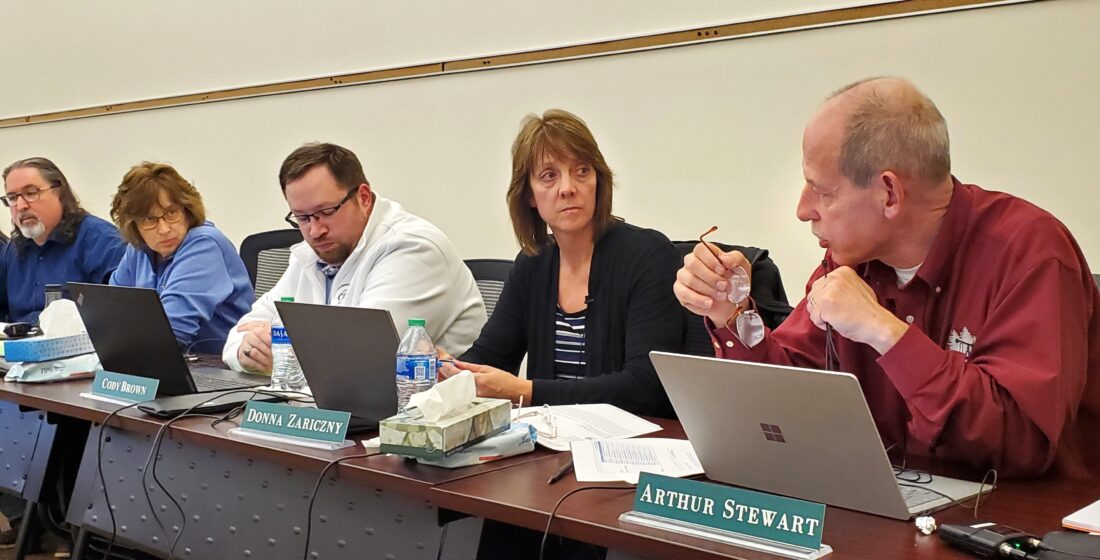
Times Observer photo by Brian Ferry School Board member Arthur Stewart (right) talks Monday about the reconfiguration of high schools during a discussion at the physical plant and facilities committee meeting.
-
- Times Observer photo by Brian Ferry School Board member Arthur Stewart (right) talks Monday about the reconfiguration of high schools during a discussion at the physical plant and facilities committee meeting.
-

- Times Observer photo by Brian Ferry Visitors concerned about proposed reconfiguration of Warren County School District schools listen as Jacque Catrabone of Strategy Solutions speaks Monday about reconfiguration before the physical plant and facilities committee of the school board.
On Monday, the physical plant and facilities committee heard from a company hired to direct the look into the possibilities. It also heard a message from more than 100 people who attended the meeting concerned about their community schools — typical meeting attendance is much closer to zero.
Jacqui Catrabone of Strategy Solutions presented the results of board and staff interviews regarding reconfiguration.
“We started internal,” Catrabone said.
Generally, that internal look showed the staff and board consider reconfiguration to be “necessary.” The first question posed by Strategy Solutions was about the current configuration of buildings. The board members rated the existing situation as on the good side of fair. The administration — mostly central office leaders and building principals — fell on the poor side of fair. Not all of those surveyed see the configuration as a problem – 5% of staff gave circumstances a “very good” rating.
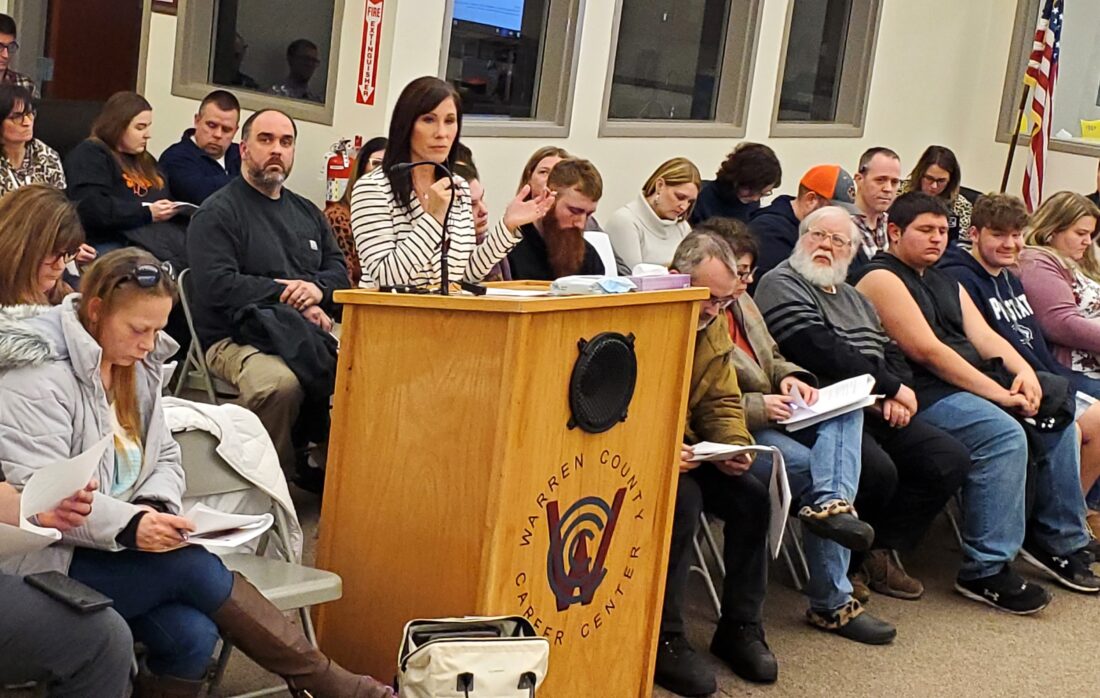
Times Observer photo by Brian Ferry Visitors concerned about proposed reconfiguration of Warren County School District schools listen as Jacque Catrabone of Strategy Solutions speaks Monday about reconfiguration before the physical plant and facilities committee of the school board.
Catrabone said those administrators said, “This is working right now. It makes sense for the geography.”
“Geography is a barrier and a challenge” to reconfiguration, she said.
There were more negative comments about the current configurations impacts than there were positives.
The positives included the benefits of smaller class sizes, shorter transportation times, community schools, students remain with the same core peer group throughout their time at school, and there are centralized resources available to all students.
On the other side, “there’s a declining student population,” Catrabone said.
“That’s impacting what’s available – smaller class sizes impact what can be offered. Some students don’t feel as prepared for college. It’s impacting socialization as well as athletic opportunities,” Catrabone said.
With respect to teachers, “there is a lack of consistency,” she said. “There are high populations of expedited teachers. Teachers are over-burdened. Honors courses don’t look the same across all four buildings.”
Board Member Arthur Stewart spoke about the honors programming offered to students in different schools. He said the board members are close to the subject and know things that the average citizen does not.
“If I was a member of the public, I would want to know exactly how many AP classes are available at Warren compared to Sheffield.”
“I know the answer – zero at Sheffield and lots at Warren,” he said.
Those surveyed were aware of the discrepancy.
“It’s kind of understood that there’s less academic opportunity … folks know that,” Catrabone said.
Students looking for that opportunity can “do an academic transfer,” she said.
Asked for ideas about how to address the negatives related to the high schools, those surveyed suggested offering ninth through 12th grades at only Eisenhower and Warren Area high schools, or only at Youngsville and Warren, creating kindergarten through 12th grade school at Youngsville, moving Sheffield Area High School to Warren, going to one high school for the whole district, and creating a magnet school system. The magnet school idea would create a particular focus — arts and music, math and science, etc. – at some or all of the existing high schools, allowing students to choose which best suits their needs.
Asked for their concerns about the proposed changes, board members listed “community perception,” “perception of loss/impact to community,” “impact on athletics and parent mindset,” “transportation,” and “mascots.”
The administrators added “impact on ability to participate in activities due to distance,” “ensuring students are accepted,” and “loss of school culture and community involvement.”
“Most staff and board members are on board with 9-12 reconfiguration and view it as necessary,” Catrabone said. “There is a lack of academic consistency across buildings at all grade levels. 9-12 reconfiguration will expand academic and extracurricular options for students.”
The survey results indicate that the district’s kindergarten through eight configuration is generally working well. There are plans to solicit teacher input, information from community leaders, and to hold multiple public meetings on the subject.
PUBLIC INVOLVEMENT
A public engagement session is set for 6 p.m. Wednesday, March 8, at the central office in Russell. The focus of that meeting was to “explore options for reconfiguration.”
“The hope is to allow the public an opportunity to talk about what they view as key considerations,” Catrabone said.
Including the public in the decision-making is not required, Stewart said. But the board has determined to take public input into account and we are “keenly interested in what the community has to tell us,” he said. “Having made the decision that we were going to involve the public, I want it to be as meaningful involvement as possible. I’m willing to have my opinion influenced by the people we said we are going to engage,” he said.
He is concerned that the public doesn’t have the information it needs – like the disparity in honors programming offerings – to make informed comment.
Stewart asked if the meeting could start with some information.
“The very last thing that I would do is options,” he said. “Once you start talking about options, it’s too late to start talking about needs. You don’t fix a problem until you know what the problem is.”
He suggested presenting information “on academic needs” rather than kicking off the meeting with a discussion of reconfiguration.
“Once the community hears that we have a science teacher at one of our high schools having to prepare five or six classes a day” while another teacher teaches the same information to five or six classes in a day, “they make the attachment – ‘my child or grandchild will get a better education,'” he said.
“We can’t ignore the obvious in the room that there is a value to having that school in the community,” Stewart said. “Talk to me about how you value a teacher being burdened with five preps versus the value of keeping that school in that community.”
With regard to transportation, “there may be some students when you look at options that we’re throwing out there that have to travel so far that it becomes a show-stopper,” Stewart said. “The data should drive the options, not the other way around.”
He said past boards made difficult and unpopular decisions regarding the consolidation of elementary schools.
“There was incredible opposition to closing elementary schools,” Stewart said. “We built a consensus with the community in many instances. Today, the elementary configuration that we have is sound.”
“Having done this a number of times in a number of different ways… putting out more information before we get to options will allow a more meaningful dialogue,” he said.
Local News

Prescribed burn underway in Allegheny National Forest

PennDOT plans Tidioute bridge project

Park planting kicks off Arbor Day event
Lawmaker proposes dementia training for first responders

Audubon Trail Guide training is April 28, 29