
Speaker listens to WAHS students, speaks to community
Trending
On Thursday, students at Warren Area High School heard that it was OK to not be OK.
They heard that there was someone who doesn't even know them who cares about their well-being.
The school has lost two students and a teacher in the past three months.
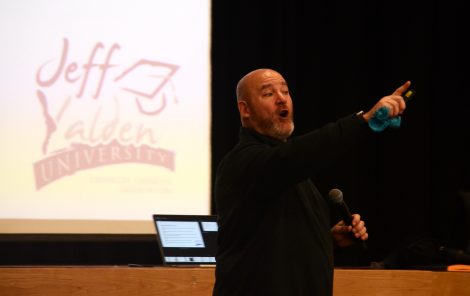
Motivational speaker Jeff Yalden spent all day at the school, then welcomed the community in the evening. More than 100 people, including parents, teacher, counselors, and people who fit multiple categories, were present.
"I'm truly thankful that you have an administration that says, 'We need to talk about this,'" Yalden said. "I'm sorry for your loss. I know how hard this has been for the community."
He urged parents to talk to their children about tough subjects.
"We need to get comfortable being uncomfortable talking about our feelings," he said. "The kids already want that. It's the adults. They don't talk to you because you're going to judge them or they're afraid they're going to be a burden."
"It's important for you to know, if you don't talk it out, you're going to act it out," Yalden said.
"Their perspective is maybe something that you don't see," Yalden said.
He passed along some of the things he had heard from students during the day. "You don't listen. You're trying to fix things."
"Men fix things," he said. "Gentlemen, don't do that any more. I always like to sit down and say to them, 'Are you venting and you want me to listen or are you venting and you want my opinion?'"
When it counts, he suggested asking, "How's your heart?" instead of "How are you doing?"
He said kids spend time thinking about who they are, but not directly. "I am not who I think I am," he said. "I am not who you think I am."
"I am who I think you think I am," he said. "They are constantly trying to think about what you think about them."
"I had a few kids tell me today they don't think their parents even love them," he said.
Yalden said parents should not be ignoring issues nor trying to diagnose their children themselves. "Trust the process," he said. "Give your child what your child needs."
Some of the kids told Yalden they were concerned because they didn't have a purpose.
He encouraged them to adopt a purpose that would give them time to find their purpose.
"You wake up, you get up, you dress up, you show up," he said. "If you show up every day, you're engaged, you're going to be OK."
"Rarely do I ever meet a child that wants to die," he said. "Today, I met a few."
For those in need, the district and Yalden reached out for help. "The decision we made today was to call the parents," he said. He told the students he would be happy to be there with them to talk with their parents.
Instead of sending students to a hospital for a week, "within two hours, we gave the child and the family and the school what they needed."
He stressed to the parents in the audience that their children's well-being had to be more important than their perception of their own reputation.
"We're afraid of what other people might think. Stop!" he said. "We don't need the school knowing our business. Stop! If you're concerned about your reputation more than your child's well-being, maybe you're part of the problem."
"Growing up today is harder than it's ever been," he said. "They need your help. They need your support. They need you to tell them, 'Honey, I love you.'"
"Start talking to them," he said. "Nothing changes if nothing changes."
He said the students are in good hands, that the school district has some excellent people in place to help them. "Encourage your kids to use some of the resources you have."
"Encourage your kids to do more of what makes them happy," he said.
He recommended three things that young people need - sleep, nutrition (more protein, fewer carbs), and "put the device down and get more involved.
He said volunteering for a cause that is "greater than themselves" gives people the same kind of dopamine response they get from the instant gratification they find on their phones and devices.
"The device shouldn't be our connection to the world," Yalden said.
"If we don't normalize the conversation and know that it's OK to not be OK, we're going to continue to have problems," Yalden said. "This is real stuff we're going through."
"If you think that something's not right, please do something," he said. "Do something. Don't be afraid to ask the questions. By you asking the question, they're going to feel more at ease."
Do something. I'd rather you do the wrong thing than not do anything," he said. "Change what hasn't been working."