EmergyCare raises concern about health region’s EMS system
-
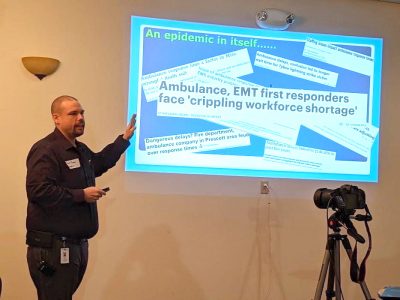
- Photo courtesy of EmergyCare David Basnak, EmergyCare’s assistant director, speaks during a legislator’s breakfast held last week in Saegertown. EMS in the region is “in critical condition,” he said. “We’re sick.”
-
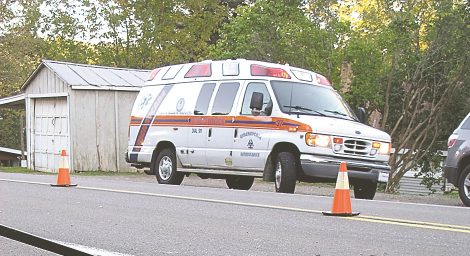
- Times Observer file photo EmergyCare is the only Advanced Life Support provider in Warren County,
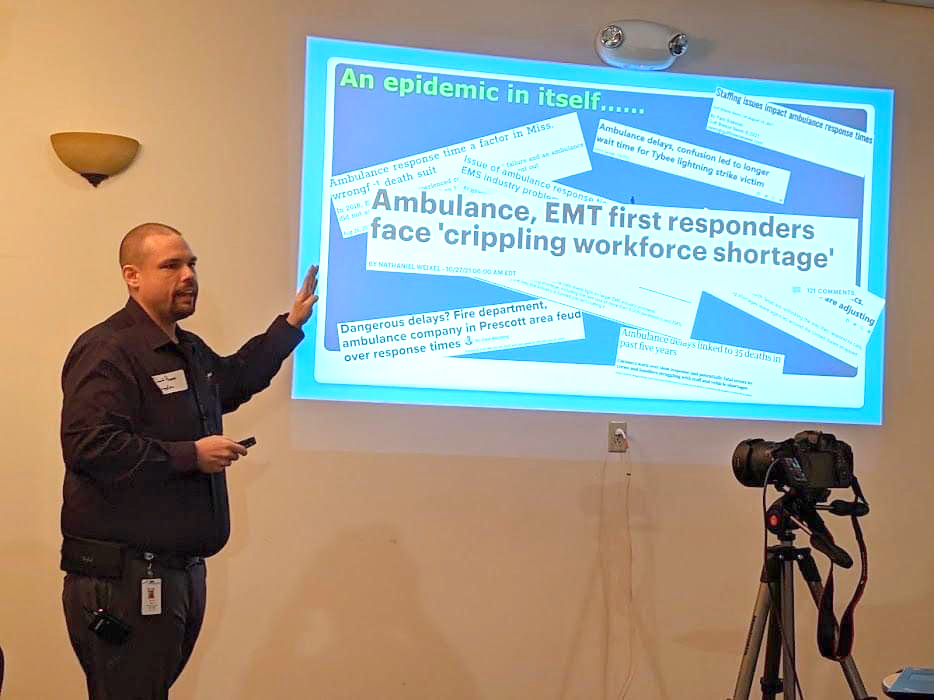
Photo courtesy of EmergyCare David Basnak, EmergyCare’s assistant director, speaks during a legislator’s breakfast held last week in Saegertown. EMS in the region is “in critical condition,” he said. “We’re sick.”
As the volunteer emergency medical services system in Warren County has started to crack in recent years, EmergyCare has stepped into a larger and larger role.
They’re now under strain, too.
David Basnak, assistant director for the non-profit ambulance service, outlined the entity’s obligations in the county as they stand today.
“EmergyCare is the primary ambulance service provider for Glade Township (and) part of Conewango — North Warren Area,” he said. “From our Corry station, we cover Columbus, Freehold, Bear Lake, and Spring Creek as the primary ambulance service provider.”
They also cover 12 hours, seven days a week in Youngsville and 12 hours, five days a week in Pleasant Township “to assist both fire departments with ambulance coverage,” he said.
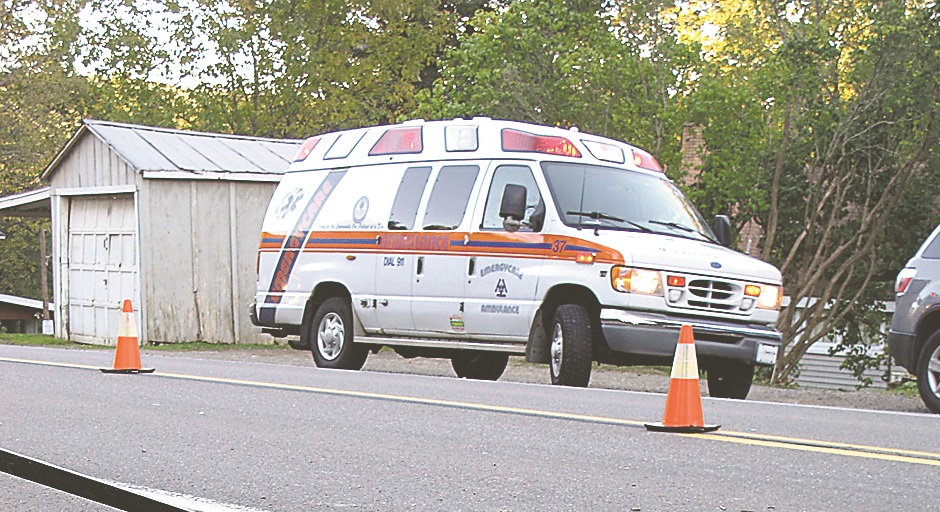
Times Observer file photo EmergyCare is the only Advanced Life Support provider in Warren County,
“EmergyCare is the only Advanced Life Support provider in Warren County, providing assistance to the Basic Life Support units when needed,” he said. “Also, EmergyCare leases an EMT to Sheffield Fire Department to assist with staffing during their peak call times.”
Information presented last week in a legislator breakfast detailed the cost to operate an ALS ambulance at between $750,000 and $1 million annually.
Those designated areas aren’t the only places in the county that EmergyCare is responding, though.
“Additionally, when other departments are unable to crew for an emergency, EmergyCare often will handle the call for them,” Basnak said. “Since Jan. 1, 2021, EmergyCare has taken over 800 additional emergency calls in Warren County where we are not the designated primary ambulance service provider. We expect that number to exceed 1,000 by the end of the year.”
The next question becomes pretty simple: How long can EmergyCare continue to operate at this level?
“Right now that depends on the people that we can keep in the system to keep it moving,” Basnak said. “The unprecedented time that we are dealing with is the significant increase in wages we are seeing in the job market.”
He said they can’t increase profit margins to accommodate because “insurance reimbursement has not increased to that point that allows us to continue to keep up with inflation. That’s compounded by a lack of funding from municipalities it serves.
“Often we are asked why we do not add another ambulance and the direct answer to that is there is not a sustainable call volume to financially support it,” Basnak said.
“The discrepancy in wage in the industry and the current funding model drives a wedge when trying to recruit and retain people to the ambulance service workforce,” he added. “Not to mention, the looming possibility of vaccine mandates that might be imposed by the Federal Government. This would come from the Center for Medicare and Medicaid Services (CMS) and has the potential to impact all ambulance services as CMS accounts for nearly 60-65% of our reimbursement income.”
It’s his view that “if we don’t see something happen in the next six months to a year, it’s very likely — not just Warren County but our region in general — that ambulance services are going to be impacted.”
To advocate regionally, EmergyCare held a legislator’s breakfast last week in Saegertown.
“We’re in critical condition. We’re sick,” Basnak said during that session.
“We are to a whole other level of seriousness right now,” Basnak, who will take over the top post in the agency in February, said. “(We’ve) tried to warm people up to the idea, tried to put it on people’s radar. If something doesn’t change in the near future… it’s not going to look good.
“We’re talking about life and death here.”
Bill Hagerty, the current president/executive director of EmergyCare, acknowledged up front what is becoming increasingly clear — the volunteer EMS system is “stressed.”
“They are having a very difficult time answering their calls,” he said. “We’re answering their calls for them which is causing a lot more stress on us.”
His picture wasn’t any more rosy — “Things are bad…. We are in a crisis. We are in bad shape and we need your help.”
The agency is reimbursed for many of the calls it makes but he explained that one of the challenges is that they’re not reimbursed for the readiness required — sitting and waiting for calls.
Staffing shortages are further compounding the problem.
“EmergyCare is down 30 staff members,” Hagerty said. “We have to grow our own. There’s just no help out there.”
“This is an epidemic in itself,” Basnak added. “Ambulance services today are at a critical, catastrophic position to where we can no longer afford to provide sustainable service without receiving additional funding.
“Our workforce shortage is crippling us.”
And he outlined why — the starting pay for an EMT is $13-$14 per hour.
There’s also a public perception problem.
“Everybody has just expected that it’s just there,” Basnak said of ambulance service. “(We all believe that) is the right thing but the problem is today we don’t have the people to provide that service. They’re not there. There’s nobody that’s coming in behind us.”
As is the case for the City of Warren, approximately 65 percent of EmergyCare’s calls are Medicare and Medicaid with reimbursement that is “extremely poor.”
“We have to be able to pay our staff a sustainable living wage to be able to recruit them and retain them in our industry,” he added.
Basnak outlined two pieces of legislation in the General Assembly that could assist – one would create public safety authorities and “would allow us to jointly work together” while the other is HB 1322, which would implement a one percent sales tax.
He said it’s his belief that is the “most sustainable option” as it would “help spread the cost of these services to everybody. Everybody would be paying into that.”
Estimates he presented show that the tax would raise approximately $6 million in Warren County alone.
“The funding has to be sustainable,” Basnak emphasized. “Those are the two (bills) that are out there right now that would benefit us the most.”
“Quite frankly, this is long overdue,” he said. “We need sustainable funding.”
Local News
Pittsburgh still pays public safety workers big leave cash-outs
Eight retired Pittsburgh public-safety workers received more than $60,000 last year in taxpayer-funded payouts for ...

Straight No Chaser to perform in Warren in July
Leek Party proceeds benefit Hospice
For some, school cellphone ban can’t be OK’d fast enough
Introduced in October, Senate Bill 1014 awaits House approval for its statewide “bell-to-bell” ban on cell ...
Service honors faith, freedom in U.S.