
Nuclear Fears
Remnants of Cold War-era security measures can still be found around town
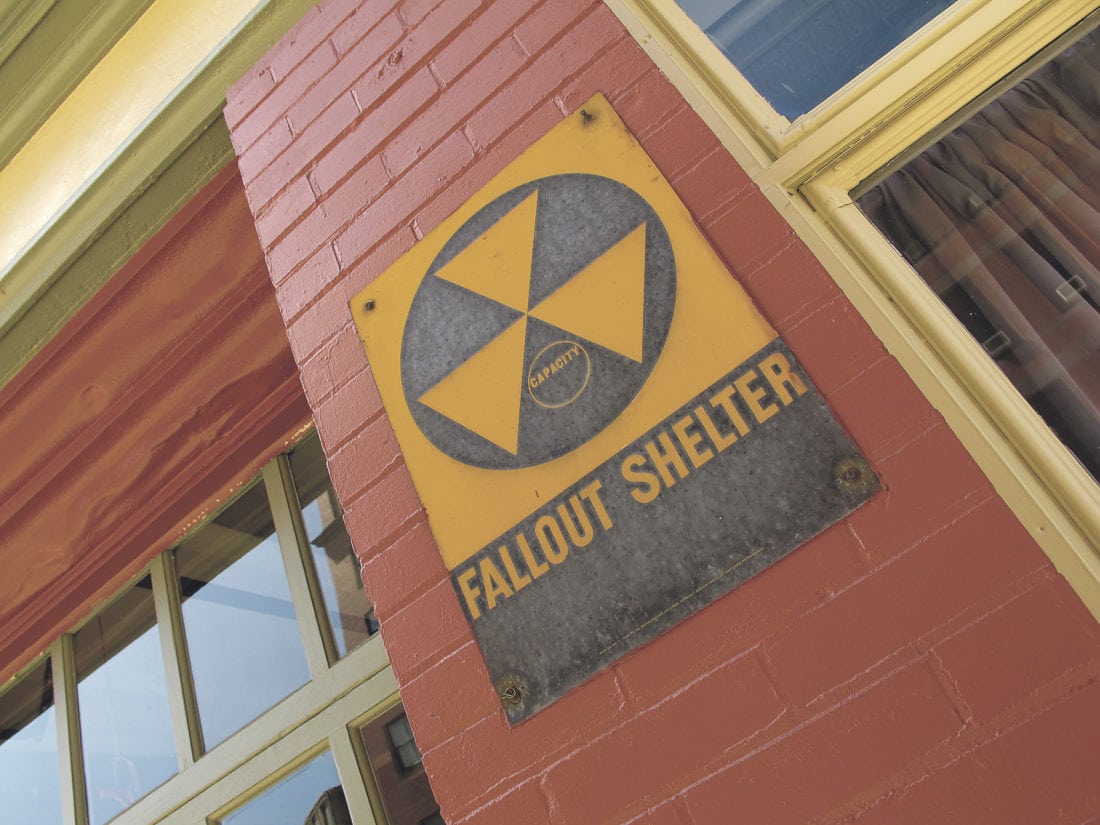
Times Observer photo by Brian Ferry A fallout shelter sign at 323 Pennsylvania Ave. W.
There are several official reminders of the Cold War Era posted around Warren.
Fallout shelter signs at various states of fading can be seen on a number of local buildings.
They are part of the Federal Civil Defense program — Part C, Chapter 8.
In their day, public fallout shelters were kept in a state of some degree of readiness.
Now, in case of an actual nuclear attack, those seeking shelter should not count on finding any available space, food, water, medicine, or anything else once indicated by the signs.
In the 1950s and 1960s, the Federal Civil Defense Administration, which became the Office of Civil Defense, was the agency tasked with making America more ready to survive a large-scale Soviet nuclear attack.
President John F. Kennedy issued Executive Order 11093 in 1963. That set up a system for emergency preparedness, including fallout shelters.
The goal was to help people stay safe while gamma rays were released from the nuclear fallout — alpha and beta radiation would also be dangers, but those don’t last as long and do not penetrate as well as gamma. Two weeks was generally considered the minimum.
Large, underground public spaces surrounded by plenty of concrete were identified, marked with signs and stocked with food, water, medical kids, and sanitation materials.
Signs, most of them heavily faded from the original black and yellow, can be seen at various locations in the county.
“Those were the actual old fallout shelters from the Cold War days,” Warren County Public Safety Director Todd Lake said.
Local shelters were run by Warren County Civil Defense, according to Lake. “At one point in time, all these fallout shelters had radiation detectors. A lot of them were stocked with food.”
The county also had a siren to warn folks to run for cover.
There were tens of thousands of fallout shelters in urban areas. They were not expected to be helpful. Major population centers would be likely targets for direct nuclear strikes. Fallout shelters would not protect people from the blast of a nearby nuclear explosion.
So, the government was trying to allay fears — and maybe save folks in areas that would not be targeted.
Depending on the advance warning and the location of the strike, those hearing the county’s siren would have some time to get to the shelters.
The explosion would turn nearby particles into radioactive particles called fallout.
Fallout would have been pushed around by the wind. Depending on wind conditions and how many nukes were sent this way, there might not have been much need for fallout shelter here. “I don’t know if we would have been in the fallout zone,” Lake said.
In shelters, survivors could weather the nuclear storm surrounded by concrete as fallout swirled outside emitting deadly gamma radiation. In the long run, even limited exposure to gamma rays can cause cancer and genetic damage. A heavier dose can cause immediate burns, including burning of tissues inside the body.
When Lake started in the public safety office, there were educational materials regarding nuclear preparedness.
“I had a kit here in a wooden box, a display you took to the school,” he said. “It showed how radiation went through stuff.”
It had paper, aluminum foil, and, of course, a bottle of uranium ore.
That probably was not a good addition to educational materials, but Lake is convinced there was no danger. “The level of radiation was less than what would be legal to eat on lettuce,” he said.
Lake’s educational materials also included a handy visual aid for ‘contamination’ vs. ‘exposure’ for the educator.
“He carries around this stuffed skunk,” he said. “That skunk puts off radiation.”
“You are exposed by it being on the other side of the room and you smelling it,” he said. “The thing sprays you, now you’re contaminated.”
Those materials are gone.
And there are no active, public fallout shelters in the county, Lake said. So, anyone looking to spend two weeks underground now will want to bring their own supplies.
By the 1970s, public fallout shelters had fallen out of fashion.
In the window at 323 Pennsylvania Ave. W. are an interior fallout shelter sign, a water barrel, and a sanitation barrel that were all basic parts of public fallout shelters.
If there were ever supplies in the other Warren County’s shelters, it is likely they have been gone for decades and the shelters themselves converted into some more productive use of space.
The signs pointing out the shelters are now nothing more than reminders and faded curiosities.
Local News
State House passes bill to protect kids from online predators
Boosting community: Brokenstraw Valley Fund among Warren Gives charities

Crimestoppers cases finding success in county
School district approves budget totaling $93M
Warren man involved in chase faces new charge
A Warren man who allegedly led police on a high-speed chase in January has had a new charge filed against him in ...
Russell UMC to host BBQ Saturday
Photo submitted to the Times Observer The Russell United Methodist Church will host a chicken barbecue from 4 to 7 ...