
Early German conquests bring more ‘undesirable elements’ under Nazi rule
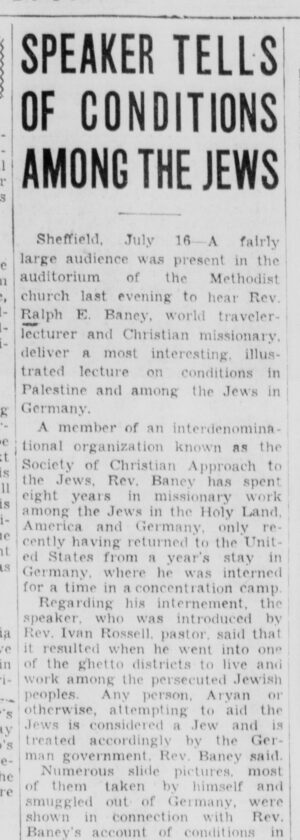
Photo from the July 17, 1940 Times Mirror The first truly local account that I could find that described in some detail the “conditions in Palestine and among the Jews in Germany.”
CLEANUP STARTS IN CZECHIA.
Secret police at Prague make systematic roundup of ‘undesirable elements’ including anti-Nazis and Jews; with official figures unavailable estimate of jailed person is placed at 600.
LARGE NUMBER OF SUICIDES REPORTED.
Two days earlier, Hitler’s Nazi legions invaded Czechoslovakia and residents in Warren County woke up to this series of headlines two days later on Friday, March 17.
The Associated Press story began this way: “Reports of arrests and suicides among anti-Nazi and Jews increased today as non-Jews began taking over administration of Jewish-owned stores in the former Czech republic.
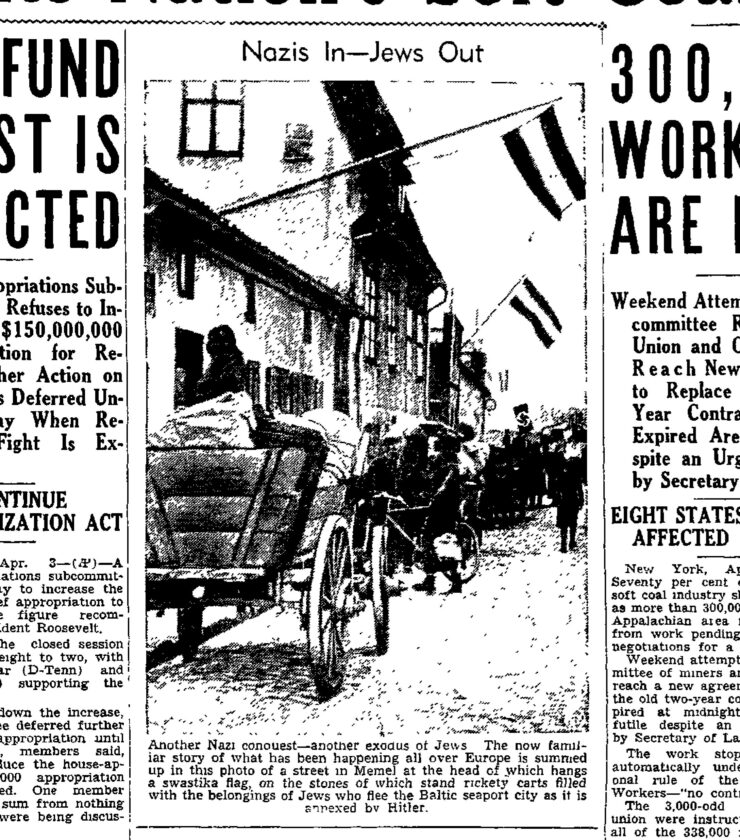
Photo from the April 3, 1939 Times Mirror. This photo appeared just below the main headline of the April 3, 1939 edition of the Warren Times Mirror.
“The secret police were making a systematic cleanup of ‘undesirable elements.'”
Among those arrestees were “47 welfare agency workers” which “brought to a collapse to efforts to assist refugees from the country.”
The prior fall, British Prime Minister Neville Chamberlain made a now-infamous proclamation: “My good friends, for the second time in our history, a British Prime Minister has returned from Germany bringing peace with honour. I believe it is peace for our time… Go home and get a nice quiet sleep.”
That statement was made in the wake of the Munich Agreement which was supposed to ensure the situation in Czechoslovakia was handled peacefully.
This March move shattered the idea that Hitler could be contained by peaceful means.
“Lists of those trying to flee Prague were seized among them the names of 200 Jews,” the Times Mirror reported. “Wealthy, they had agreed to provide for emigration of 200 less fortunate colleagues and themselves planned to go to San Domingo.”
Specific anti-Jewish codes were then outlined.
“Beginning today – under the Nazi anti-Semitic restrictions – Jewish-owned stores were being taken over by administrators until they can be sold to non-Jews,” the report explained. “Jewish doctors and lawyers can no longer practice here. There are about 400 Jewish lawyers in Prague; perhaps 250 more in all Moravia.”
This was included at the end of the story which makes me think that these kinds of restrictions on Jews must have been broadly known by this stage. I base that assessment on the fact that many of the 1930s Times Mirrors aren’t available here and, more importantly, the fact that the information is buried in the story.
Through the 1930s, Jewish emigration from Hiter’s Germany and occupied territories was not off the table. There were opportunities for people to get out, especially if they had family in other places that would take them in.
While – and for good reason – Nazi Germany and the Holocaust are synonymous, mass extermination was not German policy. There was a period where the Nazis would have accepted European Jewry just leaving the ever-expanding German territory.
That lead to a British proposal – White Paper of 1939 – that called for a homeland for the Jewish people in an independent Palestinian state within 10 years while also capping Jewis emigration into the UK.
The proposal led to this story in the May 22, 1939 Times Mirror: “Jews Throughout Nation Join in Protest Against New British Plan.”
“Bitterly and in sorrow American Jews met throughout the nation yesterday to join in their race’s world-wide condemnation of the British plan for Palestine,” the report claimed.
Times Mirror editors included an editorial on that issue the next day.
“‘No problem facing the world is so difficult as Palestine,” says Willis Thornton, NEA writer, in an editorial on the subject prepared for the Times-Mirror. ‘In no other case is it so difficult to define, let alone to achieve, complete justice to all.’
“Into this welter of conflicting interests the latest proposal of the British “White Paper” has been flung, with little augury of success. Truly a twentieth century Solomon might be sorely puzzled to deal even-handed Justice to all today in troubled Palestine.”
World War II launched in earnest on Sept. 1, 1939 when Germany invaded Poland.
That’s when the killing began in earnest with the einsatzgruppen, or mobile killing units, following behind the German advance. One source said those groups killed 65,000 by the end of 1939. That included Jews as well as other groups of people.
As the war grew, an editorial in the Wednesday, May 15, 1940 Times Mirror called for local participation in Red Cross efforts.
“In times like this, with a world tumbling about our ears, most of us are plagued by a feeling of helplessness…. This organization of mercy is going to be faced with terrible problems of helping the refugees, the starving and disposed victims of Europe’s horror,” the editors wrote. “For the means to do this, it is calling on the American people. We have been unable to stop the holocaust.”
Now, notice that the word “holocaust” is with a small h.
It appears that the use of the word holocaust to describe the Holocaust evolved gradually.
The dictionary definition of the word is “a great or complete devastation or destruction, especially by fire” or, in an alternate definition “a sacrifice completely consumed by fire; burnt offering.”
When I started looking for the use of the word in the Times Mirror, I found it and quite frequently; but always (before 1950) in the catastrophic/destructive nature of the word.
It was used in that way in an Aug. 30, 1940 article.
“The same 12 months have seen the United States turn resolutely to arming itself and to building a water-tight dike of defense around the New World. Sparks of war economy and psychology have leaped the ocean and burn brightly in the United States despite its unshaken resolution to keep clear of the European holocaust.”
The first truly local reference to the “conditions among the Jews” comes on July 17, 1940 in an article on an inside page.
“Sheffield, July 16. A fairly large audience was present in the auditorium of the Methodist church last evening to hear Rev. Ralph E. Baney, world traveler-lecturer and Christian missionary, deliver a most interesting, illustrated lecture on conditions in Palestine and among the Jews in Germany.”
The article notes that Baney was a “member of an interdenominational organization known as the Society of Christian Approach to the Jews” and had spent eight years in Europe “where he was interned for a time in a concentration camp.
“Regarding his internment, the speaker… said that it resulted when he went into one of the ghetto districts to live and work among the persecuted Jewish peoples. Any person, Aryan or otherwise, attempting to aid the Jews is considered a Jews and is treated accordingly by the German government, Rev. Baney said.
“Numerous slide pictures, most of them taken by himself and smuggled out of Germany were shown…. Many of the slides depicted actual scenes of Jews being maltreated by soldiers and some were of Jewish acquaintances of the speaker who had been injured and subsequently died.”
More on the ghettos next week.
-
- Photo from the July 17, 1940 Times Mirror The first truly local account that I could find that described in some detail the “conditions in Palestine and among the Jews in Germany.”
-
- Photo from the April 3, 1939 Times Mirror. This photo appeared just below the main headline of the April 3, 1939 edition of the Warren Times Mirror.