
Rapp signals support for independent pharmacies
Trending
Rep. Kathy Rapp will have a say in whether or not pharmacy benefit administrator reforms move forward in the state House of Representatives in the coming weeks.
House Bill 2270, sponsored by Rep. Rob Matzie, D-Ambridge, would create a single Pharmacy Benefit Administrator model for all of Pennsylvania's state-funded healthcare programs as well as change pharmacy payment rates, including directed payments using fee-for-service program pricing to all pharmacies.
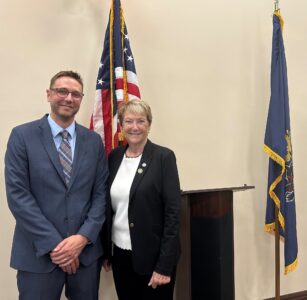
Rapp was among the House of Representatives Health Committee members who listened to testimony recently that included Scott Newton, owner of Gaughn's Drug Store in Warren. After the hearing, Rapp thanked Newton for his testimony before the committee.
"Mr. Newton, along with the rest of the testifiers, provided the committee with great insight into the challenges into how Pennsylvania administers its state-funded health care programs," Rapp said. "Independent pharmacies like Gaughn's are struggling to keep their doors open, and too many have closed already. It's clear that this system needs to change."
Matzie was involved in the passage of Act 77 of 2024, which brought greater oversight and transparency to the practices of PBMs - third-party administrators that decide which drugs consumers can receive, at what price, and how much dispensing pharmacies are reimbursed - but said more action is needed as Pennsylvania's small mom-and-pop pharmacies continue to fail as a result of PBM practices that favor large chains. Matzie introduced the legislation, which will next move to a committee vote, with state Rep. Katie Kunk, R-York.
Sally Kozak, who also testified before the House Health Committee this week, said those savings aren't likely to materialize if Pennsylvania moves to a single PBM model. Kozak, the state deputy secretary of the Office of Medical Assistance Programs, told lawmakers that Pennsylvania has already made the specific changes that produced savings in other states. She said moving to a single PBA would add cost, time, and risk in Pennsylvania without delivering the savings seen in other states, while a single Medicaid-only pharmacy benefits administrator would reach a small share of the prescriptions filled and wouldn't solve the pressures facing both large and small pharmacies in Pennsylvania.
Pharmacy benefit managers are the "middlemen" of the pharmaceutical supply chain. They typically negotiate the price of prescription drugs between health insurance companies and drug manufacturers, set compensation formulas for pharmacy payments, and may contribute to how formularies are structured within health benefit plans, which in turn affects drug coverage and shapes what patients pay at the counter.
A state analysis released earlier this year collected and analyzed data on prescription drug utilization, pharmacy reimbursement, dispensing fees, and costs borne by health plans and members in the fully insured market for calendar years 2022 through 2024. The fully insured market accounts for 24% of the overall healthcare market.
The analysis is based on data from five PBMs (Caremark, Express Scripts, Navitus, OptumRx, and Prime Therapeutics) which together represent all of the fully insured individual and small group insurance markets and 84% of the total fully insured large group commercial insurance market in Pennsylvania. The study found that simply requiring reimbursement based on National Average Drug Acquisition Cost pricing plus a $10.49 dispensing fee would likely redistribute payments rather than significantly increase total spending, and this change would benefit non-affiliated retail pharmacies and independent (non-chain) retail pharmacies the most, increasing their revenue. Adopting NADAC plus a $10.49 dispensing fee solely for independent retail pharmacies would result in an additional $14 million in annual revenue for independent retail pharmacies, which is .3% of the total prescription drug costs in the fully-insured market in the commonwealth.
It appears Newton has an ally on the Health Committee, at least when it comes to helping independent pharmacies.
"We can't expect our independent pharmacies, or any small business, to continue keeping their doors open if we're forcing them to operate at a loss," Rapp said. "We will continue working to find a solution that meets the needs of both our Medical Assistance recipients and our independent pharmacies."