
Hutchison, Rapp talk strengths, weaknesses of budget plan
Trending
State government doesn't have to have a budget on the books until the end of June.
But that's the focus of both the state House and Senate.
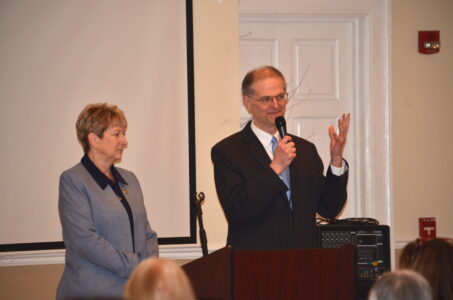
And it was the focus of the message that Rep. Kathy Rapp and Sen. Scott Hutchinson brought to the Warren Forest Hi-Ed legislative breakfast Friday morning.
"The governor came in and did his speech a couple weeks ago, proposing an increase in the budget," Rapp said. "What were doing now, both the Senate and in the House, (is) budget hearings."
There are structural challenges to the budget process and Rapp outlined one of them -- the "two biggest parts of the budget" -- education and human services, mostly medical assistance -- make up 77 percent of the state budget.
Hutchinson noted that this marks Gov. Josh Shaprio's first budget proposal.
"It gives us a little glimpse, what are his priorities or things that are not his properties," he said. "He didn't have time to put together a comprehensive snapshot of where he wants to go."
So the proposal, in Hutchinson's mind, is "setting the groundwork" for what Shapiro believes in and will fight for.
"He did propose some rather good increases for education -- basic education and higher education," Hutchinson explained. "A lot of these details… will be hashed out over the coming months. This is just first blush."
The spending proposal includes "flat-lined" line items for both Hi-Ed and the Northern Pennsylvania Regional College and Hutchinson outlined how that's actually a good thing.
"In most years," he said, "the governor will not fund those things whatever" and legislators will have to bargain for funding there. "Those are good starting points."
But the budget picture isn't all sunshine and roses.
"We have lots of money in the bank, historic amounts of dollars in the bank," Hutchinson said, from one-time pandemic-related federal funding. "I think we prudently spent some of that but put a lot in the back."
In spite of that, he said the state is "still in a position where normal taxes coming into Pennsylvania are not keeping pace with the things we are required to fund. Eventually that's going to catch up with us."
Balancing those amounts requires economic growth and "(the) governor and I agree on the fact that tax policy is part of that puzzle," Hutchinson said, "saying our business taxes have to be competitive with other states in order for us to grow our economy."
But he's "disappointed" that the revenue side of Shapiro's budget proposal includes $670 million generated through the Regional Greenhouse Gas Initiative (RGGI).
According to the Department of Environmental Protection, RGGI sets a "regional cap or limit on carbon dioxide emissions from electric power plants in the participating states."
Hutchinson described RGGI as a "tax on all carbon-produced electricity" that will be "added on to your current electric bull. (We've) been hearing for many months now how… electric rates have skyrocketed. The RGGI tax is not included in there. (It's) going to be on top of that."
Rapp added that RGGI is "just going to escalate and continue escalating" the utility cost for businesses and manufacturers.
"In our region, we have access to fossil fuels," she said. "(that) this governor and the former governor tried repeatedly to shut down the production of. With RGGI, it's not going to get better for people in Pennsylvania."
Hutchinson said Shapiro's budget proposal counts on "full legalization of marijuana in Pennsylvania.
"He is projecting that we will legalize it and will be a tax on it," he explained. "Some of that money… is in the budget. That's a big problem for me. At the very least, we should have a full robust conversation about it and not just assume it's going to happen."
Rapp said efforts to legalize were stopped because the legislature wouldn't run the bills.
"The health risk to marijuana I believe is more" than alcohol, she added. "There's a lot of studies about the negative consequences of legalizing marijuana. Is the tax revenue worth it? The citizens of Pennsylvania have to think about the risks?"
Hutchinson said Shaprio's budget proposal shows a 3.5 percent spending increase, year over year.
He said some members view the 3.5 percent increase as the floor for how much should be spent.
"I think that's the ceiling… of where we should be going," he said.
"(I'm) concerned about a lot of things in the budget," Rapp said.