
Creek groups mull Wild and Scenic River status
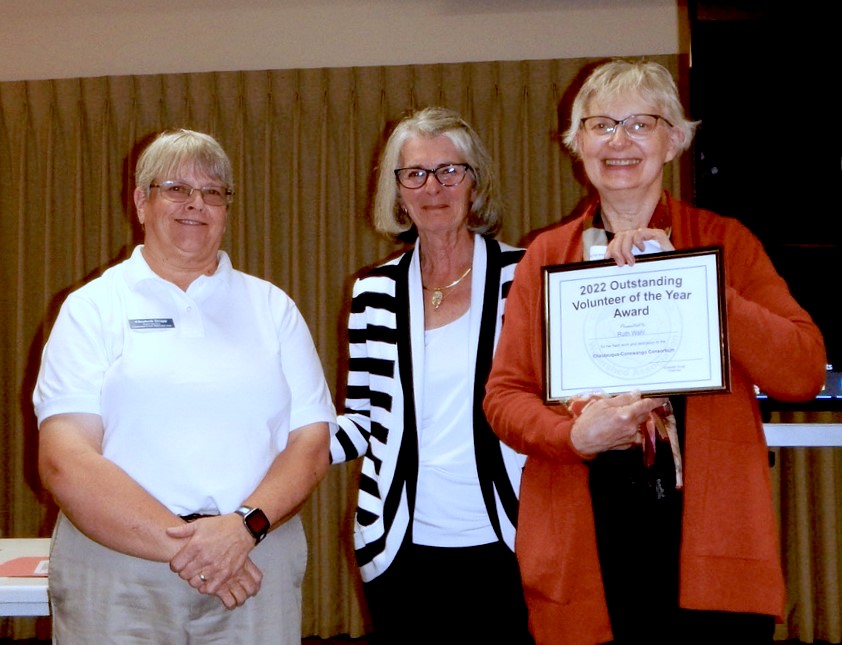
Ruth Wahl (right) receives the Conewango Creek Watershed Association and Chautauqua-Conewango Consortium Outstanding Volunteer of the Year award from (left) Elizabeth Dropp of CCWA and Jane Conroe of CCC at the organizations’ annual gala.

Photos submitted to Times Observer Above, part of the Conewango Creek (blue) is pre-qualified to apply for the Wild and Scenic River Program. The watershed is outlined in magenta.
Ruth Wahl (right) receives the Conewango Creek Watershed Association and Chautauqua-Conewango Consortium Outstanding Volunteer of the Year award from (left) Elizabeth Dropp of CCWA and Jane Conroe of CCC at the organizations’ annual gala.
Photos submitted to Times Observer Above, part of the Conewango Creek (blue) is pre-qualified to apply for the Wild and Scenic River Program. The watershed is outlined in magenta.
Trending
Conewango Creek, or at least a part of it, could soon be added to the list of Wild and Scenic Rivers.
Guest speakers Lisa Ronald and Fred Akers of the Wild and Scenic River Coalition, spoke via Zoom at the recent Conewango Creek Watershed Association and Chautauqua-Conewango Consortium annual gala.
According to the National Wild and Scenic Rivers System website -- www.rivers.gov -- "The National Wild and Scenic Rivers System was created by Congress in 1968 to preserve certain rivers with outstanding natural, cultural, and recreational values in a free-flowing condition for the enjoyment of present and future generations. The Act is notable for safeguarding the special character of these rivers, while also recognizing the potential for their appropriate use and development. It encourages river management that crosses political boundaries and promotes public participation in developing goals for river protection."
Ronald spoke about the coalition's work with Congress. WSRC counts as members more than 50 entities, including large, nationally-active advocacy groups, small local river friends' groups, land management focused groups, volunteer groups, river stewardship groups, environmental journalists, and university scientists.
Akers "explained the eligibility process to be designated a Wild and Scenic River," according to a release from CCWA Chairperson Liz Dropp. "There are currently 16 rivers in nine states that are not on federal lands."
The Conewango has a leg up on the application process.
"The National River Inventory for the Allegheny Watershed shows that 27 miles of the Conewango Creek are pre-qualified to apply to the WSR program," Dropp said.
Also during the gala, held at the Audubon Community Nature Center, retired educator Ruth Wahl was named the CCWA and CCC Outstanding Volunteer of the Year.
Wahl is a CCC member who retired after 30 years as a high school science teacher, Dropp said. "She has also taught at Jamestown Community College and the Chautauqua Institution."
"Ruth has been a very active participant with the Consortium by maintaining the membership lists, writing newsletters and news releases, and attending workshops," Dropp said. "Her extensive science education background has assisted the organization with their summer series of public service ads that were published in the local newspaper."
During the 2022 season, 98 volunteers gave 659 hours toward cleanup efforts, removing 3,706 pounds of trash, six tires, and three shopping carts during four cleanups, according to CCWA Board Member Sue Nielsen.
Jane Conroe of CCC, who presented the volunteer award to Wahl, announced that the consortium -- a Waterkeeper Affiliate and subcommittee of CCWA -- celebrated the 50th Anniversary of the Clean Water Act, held meetings with the New York State Department of Environmental Conservation, monitored harmful algal bloom reports, interpreted satellite imagery for water quality, wrote letters, conducted public relations, and provided scientific publications to local media, during 2022.
More information about the organizations, including how to get involved, may be found by visiting www.conewangocreek.org, www.cccwaters.org, or one of the entities' Facebook pages, or by calling (814) 726-1441.