
House Dem seeks review of development projects
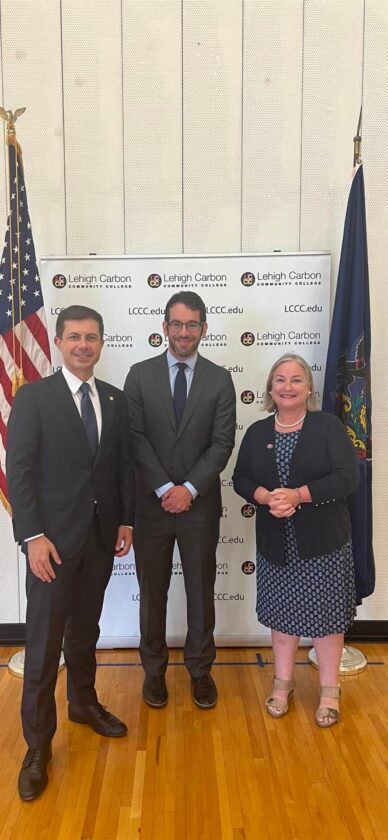
From left are Pete Buttegig, federal transportation secretary, state Rep. Michael Schlossberg, D-Allentown, and U.S. Rep. Susan Wild, D-Allentown, during a recent news conference at Lehigh Carbon Community College in Schnecksville.
A Lehigh County lawmaker wants the state to require municipalities to take a closer look at large development projects.
Rep. Michael Schlossberg, D-Allentown, has introduced legislation (House Bill 2768) to amending the Municipalities Planning Code. Schlossberg specifically wants to require mega-development developers to provide a detailed analysis of the impacts of development, including the real cost on traffic, future infrastructure costs, emergency management services, sewer, storm water, damage to agricultural lands, parks and open space, impact on neighborhoods, natural resources and wildlife and harm to neighboring properties.
Schlossberg’s bill has been referred to the House Local Government Committee. It thus far has no Republican support, so is unlikely to move forward anytime soon.
“It is frustrating to be stuck in traffic on a stretch of road which used to be relatively easy to travel, especially when you are late for work, to a doctor’s appointment, or to pick up your kids from school,” Schlossberg wrote in his legislative justification. “Throughout Pennsylvania, mega-real estate developers are turning agriculture and open spaces into road-clogging warehouses and other uses that hurt taxpayers through costly infrastructure nightmares. Even worse, residents now must question their own quality of life as they experience more traffic, higher levels of pollution, and land deterioration.”
There are nine specific types of development Schlossberg singles out for further review.
Locally, the most likely types of development that would trigger the type of review Schlossberg is proposing would likely be a petroleum storage facility, a waste handling facility or the expansion of an existing waste handling facility that occurs during any three-year period and creates a significant degradation in the level of service with respect to traffic impact, as determined by regulations established by the state, a truck stop facility that creates a significant degradation in the level of service with respect to traffic impact, as determined by regulations established by the department or a land development in a watershed that is unstudied under the 1978 Storm Water Management Act that involves at least 100 acres of contributory watershed upstream from the land development and at least 25 acres in total land area of earth disturbance activity associated with the land development.
He also wants to allow the host municipality to use its analysis to consider conditions which address the impacts and costs of the development as well as give give neighboring municipalities the opportunity to have their concerns addressed. The legislation spells out a lengthy process of public input requirements and required studies and analysis.
“This is happening because local leaders in host municipalities do not have the tools and resources they need to determine what impact these projects will have on their community,” Schlossberg wrote. “It is time to give local leaders the chance to protect the quality of life, health, and infrastructure of the people they were elected to represent. … Reasonable and responsible development is expected in life as it creates jobs, expands economic opportunities, and supplies needed housing in growing regions. But that development needs to take into account the impact it has on the rest of us.”
Local News
PennDOT plans Tidioute bridge project
Park planting kicks off Arbor Day event
Lawmaker proposes dementia training for first responders

Audubon Trail Guide training is April 28, 29
Finding ‘Support’: Child Abuse Prevention Month, Founders Day receive proclamations from City Council
ANF prescribed fire begins today
The Allegheny National Forest’s planned prescribed fire is scheduled to begin today, pending all required ...