
‘Talk about it’: Crisis team meets with parents
-

- Times Observer photo by Brian Ferry Center for Community Resources speakers (right) Katie Doerr and Kris Fenton speak Friday at Warren Area High School during a crisis meeting. Times Observer photo by Brian Ferry Contact information for the Warren County crisis line is close at hand after a Friday presentation by the Center for Community Resources and Warren County Human Services. Times Observer photo by Brian Ferry A crisis team Center for Community Resources and Forest Warren Human Services distributed information materials during a crisis meeting Friday at Warren Area High School.
-
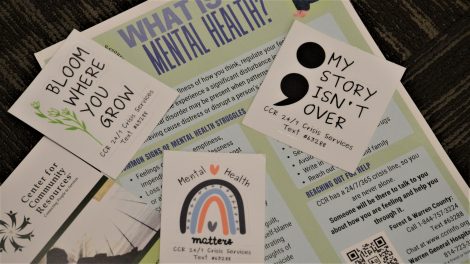
- Times Observer photo by Brian Ferry A crisis team Center for Community Resources and Forest Warren Human Services distributed information materials during a crisis meeting Friday at Warren Area High School.
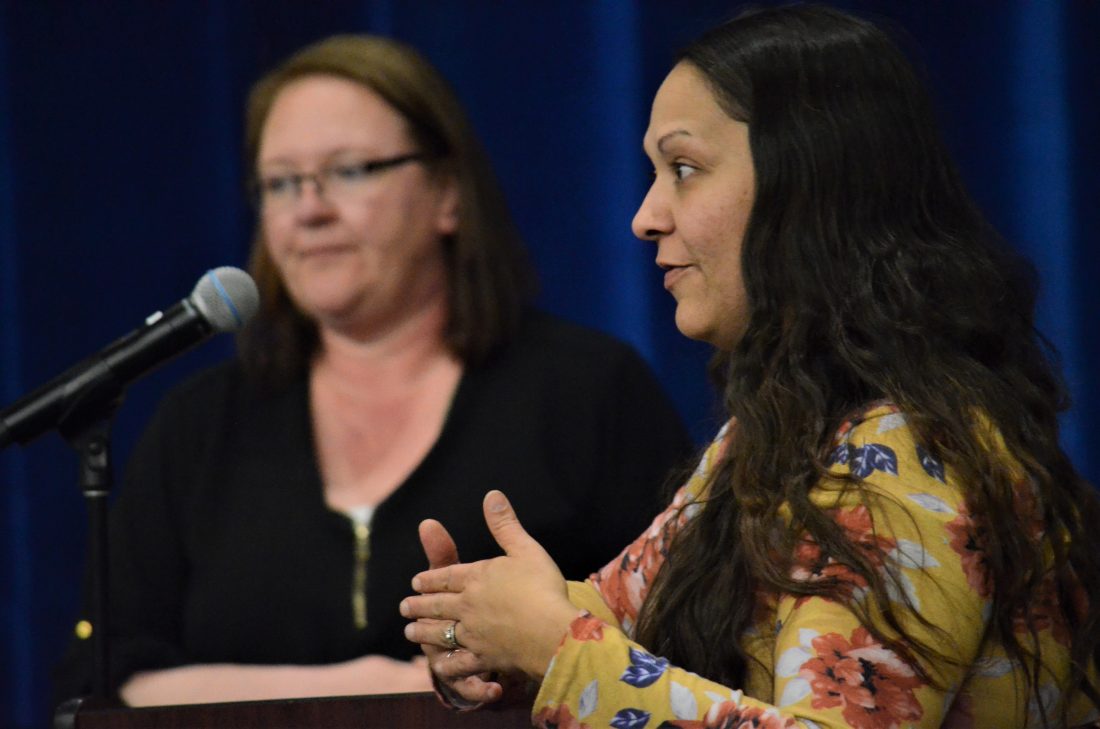
Times Observer photo by Brian Ferry Center for Community Resources speakers (right) Katie Doerr and Kris Fenton speak Friday at Warren Area High School during a crisis meeting. Times Observer photo by Brian Ferry Contact information for the Warren County crisis line is close at hand after a Friday presentation by the Center for Community Resources and Warren County Human Services. Times Observer photo by Brian Ferry A crisis team Center for Community Resources and Forest Warren Human Services distributed information materials during a crisis meeting Friday at Warren Area High School.
Sometimes, it’s hard for parents to know what young people are thinking.
Talk to them.
There are some topics that are very uncomfortable.
Broach them.
Following a week in which two Warren County high school students lost their lives, a team from the Center for Community Resources addressed concerned parents at three events this week.
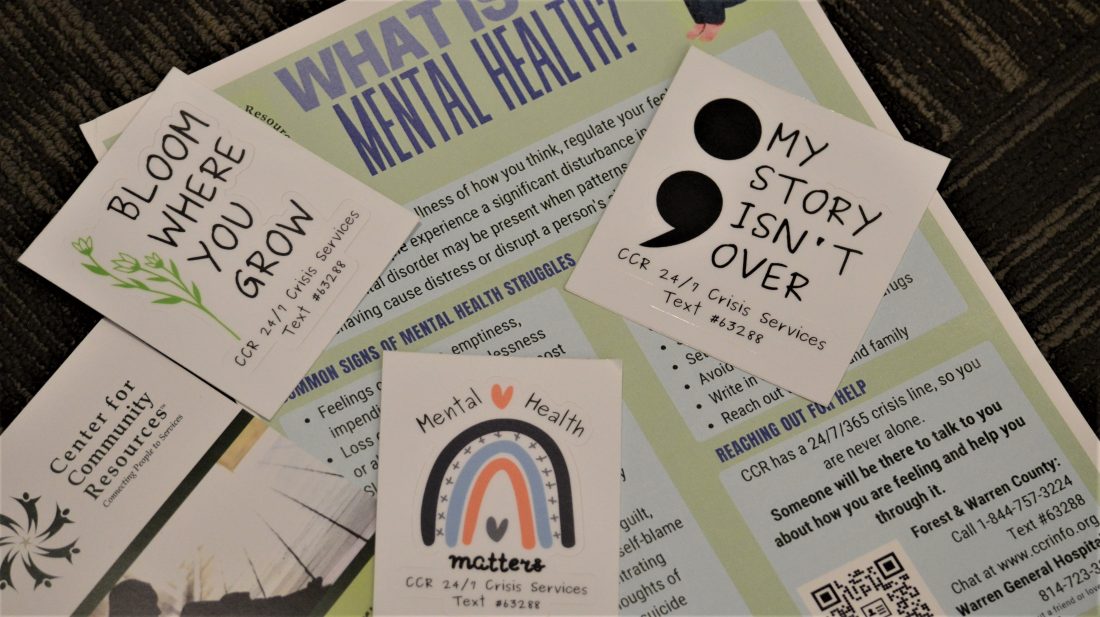
Times Observer photo by Brian Ferry A crisis team Center for Community Resources and Forest Warren Human Services distributed information materials during a crisis meeting Friday at Warren Area High School.
They recommended having age-appropriate, but open and honest discussions with young people.
On Friday, Ronna Tipton of Forest Warren Human Services, and Kris Fenton and Katie Doerr of the Center for Community Resources – recently named the county’s crisis hotline provider – met with a small group at Warren Area High School.
They had an honest conversation, the kind they suggest parents have with their children.
They addressed mental health, suicide, what to talk about, and what to look for.
If a teenager goes off to her room for hours every night, should that automatically a mental health red flag?
No. But, coupled with other behaviors, particularly changes in behavior, it could be.
“Every child’s going to be different,” Doerr said. “Every age is going to be different.”
“Teenagers can be hard,” she said. “Isolation could be perceived as behavior that raises concerns. He could be struggling with something. Having those open conversations should clear some of those things up.”
They talked about their own children at times, saying that, when one is locked in their room, it might be to get away from a sibling, or it might be that is where they play video games.
Doerr said she is “always knocking on the door,” just to check in.
“You really want to look at changes in behavior,” Fenton said. “They don’t enjoy hanging out with their friends anymore. They don’t want to go to church. They don’t want to play basketball.”
It’s important to find out why. It could be a mental health red flag. Or, it could be as simple as playing basketball causes them physical pain.
The CCR’s information lists some common signs of mental health struggles:
–feelings of sadness, emptiness, impending doom, or hopelessness;
–loss of interest or pleasure in most or all normal activities;
–sleep disturbances;
–tiredness and lack of energy;
–reduced appetite and weight loss or cravings for food and weight gain;
–slowed thinking, speaking, or body movements;
–feelings of worthlessness or guilt, fixating on past failures or self-blame;
–trouble thinking and concentrating;
–frequent or recurrent thoughts of death, suicidal thoughts, and suicide attempts;
–feeling nervous, restless or tense;
–having an increased heart rate; and
–having the urge to avoid things that trigger anxiety.
They also provided some coping mechanisms:
–keep doing things you like;
–avoid alcohol, caffeine, nicotine, and recreational drugs;
–don’t become isolated;
–structure your time;
–set small goals;
–write in a journal; and
–reach out to friends and family.
“Talk about it,” Doerr said. “Those conversations are totally necessary. Kids do hear us.”
“We’re talking about suicide,” she said. “We’re talking about mental health. It’s hard sometimes. We want people to be able to not shy away from that.”
If young people ask about death and suicide, that can be an opening for parents to broach those subjects.
“Start the conversation,” Fenton said. “How was your day?”
If something is off, follow up.
“Are you struggling today?” Doerr said. “I’m worried about you. Are you having any suicidal thoughts?”
Depending on the age of the child, they may not even understand the words they are using. “That’s another piece that can be somewhat of a challenge,” Doerr said. “Do you know what this means?”
Honesty is a key in the conversation.
“If you’re not honest with her, at some point, she’s going to figure it out,” Doerr said. “Openness and honesty is always the best policy.”
“There are things that happen in this world that are tragic,” she said. “As you continue to talk about it, it’s easier to talk about.”
“As parents and care-givers, we want to give our children the tools to be able to have success in life,” Fenton said.
They need tools to deal with information. They have instantaneous access to a world full of information. “With social media, things are instant,” Doerr said. “Kids know things instantly. It can be good. It can be bad.”
Knowing that words on social media can have real-world consequences for them and for others is important.
The Warren community is still in crisis mode, Tipton said. “We’re not through the intervention yet as a community.”
Immediately, Human Services and Center for Community Resources are focusing on making sure young people and adults know where to find help.
The crisis line is answered 24/7. The number is (844) 757-3224.
The text number is #63288.
Online chat is available at www.ccrinfo.org.
“If you need somebody to talk to, call,” Doerr said.
“The resource is available and free,” Fenton said.
Concerned parents can call. Friends can call.
Fenton and Doerr said they made sure stickers with crisis line information were made available to the school district immediately.
Some of the visitors suggested that affixing those stickers to cell phones was a sure way to be certain that they would always be at hand.
When the community is able to move through crisis mode, Human Services and the Center for Community Resources will be ready to move with it into recovery and education.
Local News

Scouts host conclave

Culture Class begins Tuesday at First Lutheran

A Patriotic Pace
Art in the Wilds is June 27-28
Art in the Wilds returns to Evergreen Park in Kane on Saturday, June 27, from 10 a.m. to 5 p.m. and Sunday, June ...

Himes scholarship winners announced
White Cane Foundation plans vision screening
Following a successful spring vision screening event that helped dozens of local residents receive affordable ...