Fond Memories
105-year-old has lived through two pandemics
-
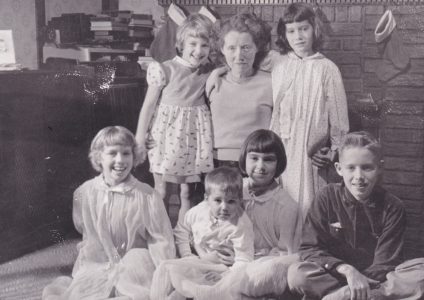
- Photo submitted to Times Observer Mary Laurich is surrounded by six of her children at Christmas 1955.
-
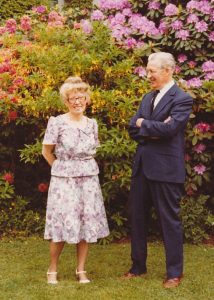
- Photo submitted to Times Observer Mary and Stephen (Pop) Laurich in 1979.
-
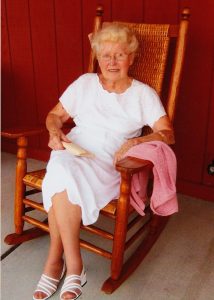
- Photo submitted to Times Observer Mary Laurich on her 97th birthday in 2012.
-
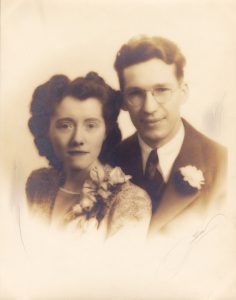
- Photo submitted to Times Observer Mary and Stephen Laurich in 1941.
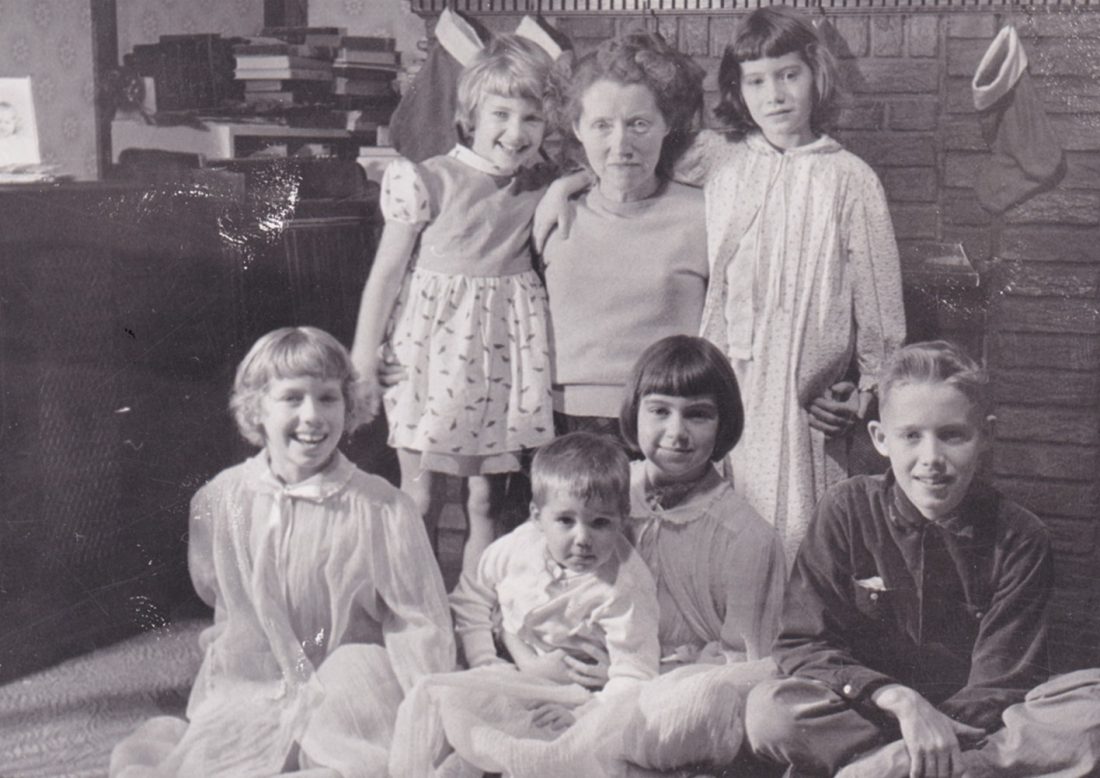
Photo submitted to Times Observer Mary Laurich is surrounded by six of her children at Christmas 1955.
Mary Coyle was 3 years old when the Spanish Flu pandemic swept the globe in 1918.
Mary, now Laurich, was 105 when she contracted, and survived, COVID-19. She never even had any symptoms.
In between, she lived a life full of hardships, happy memories, and loving lessons.
Mary was born in Detroit in 1915. Her family moved to Cleveland shortly after.
Poverty, and her parents’ unhappy marriage, kept them on the move.
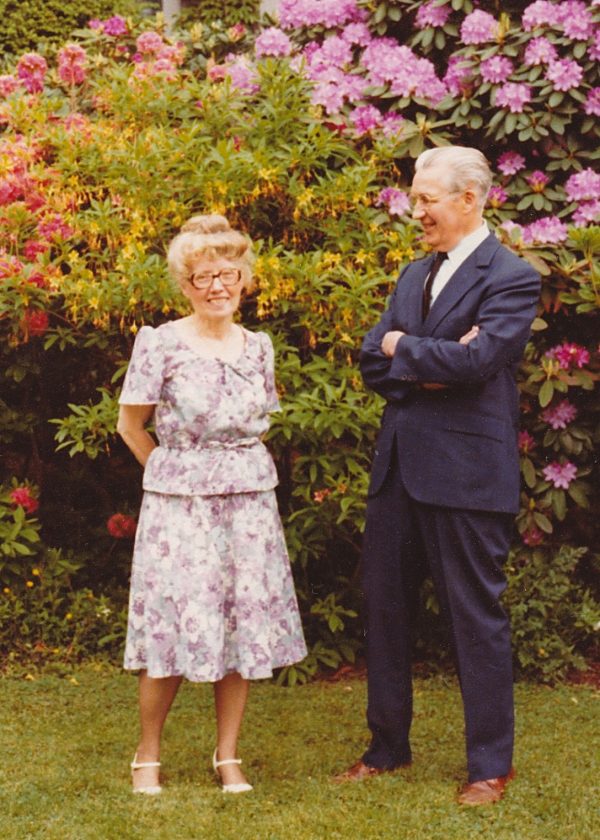
Photo submitted to Times Observer Mary and Stephen (Pop) Laurich in 1979.
According to Mary’s children, she attended about 10 different public schools in the Cleveland area. She remembers with pride attending high school with Jesse Owens — who went on to win four gold medals in the 1936 Olympics in Berlin.
During the Depression, her family was not able to support three children — Mildred, Mary, and June. “In the early 1930s, teen-aged Mary was sent off to live with friends in Texas,” Laura, the youngest of Mary’s seven children, said. “She often talked about eating beans every day during that time.”
Having one less mouth to feed wasn’t enough. “The family was so poor they had to sell off their living room furniture to get money to live on,” Laura said. “Some time later they went to the parsonage to visit the pastor of their church and found him sitting on their sofa surrounded by their tables and lamps. They were astonished, but managed to maintain their dignity and not say a word.”
Back in Cleveland after the Depression, Mary, through her older sister Mildred, met her future husband — Stephen.
“Stephen (the kids call him Pop) had a friend who owned a phonograph, a rare possession in their circle of friends,” Laura said. “Steve, his two sisters and their friends formed a group that met regularly to listen to classical music recordings since they couldn’t afford to attend concerts.”
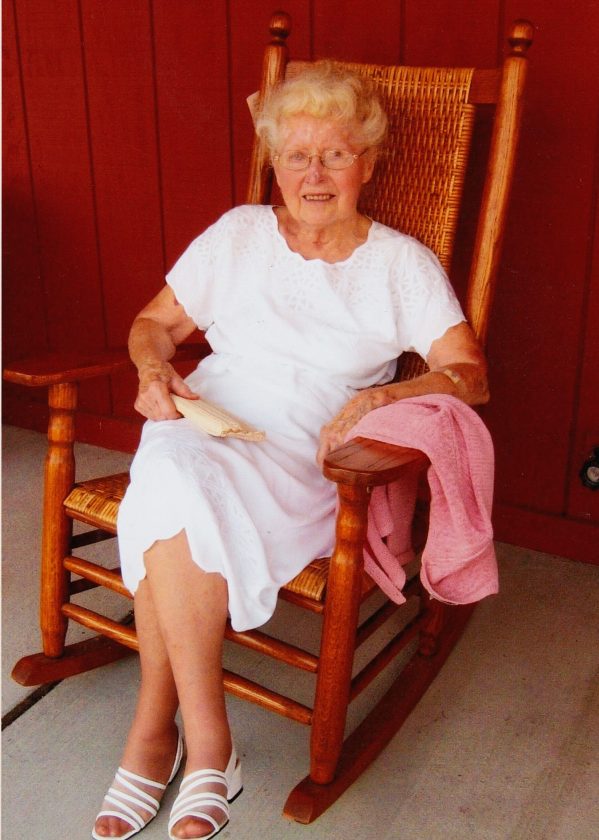
Photo submitted to Times Observer Mary Laurich on her 97th birthday in 2012.
“Steve’s two sisters happened to be friends with Mildred Coyle and asked her to join the group,” she said.
When Mildred took her younger sister to the group, Mary met Stephen. They fell in love and were married in 1941.
Music continues to tie the family together. All of their children still listen to classical music and many continue to play the instruments they picked up early in life.
During a visit this week, Mary, who isn’t always aware of who is visiting, asked Kitty, “Did Wendy bring her cello?”
The Laurich family came to Warren in 1946 when Stephen, a chemical engineer, took a job at Struthers Wells. Stephen, Mary, and their oldest two children landed at Buchanan Street.
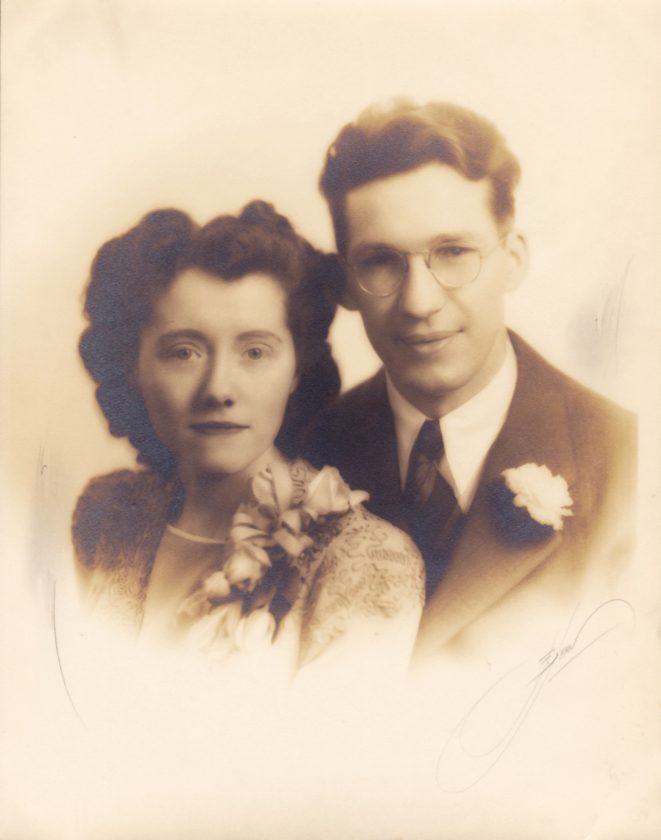
Photo submitted to Times Observer Mary and Stephen Laurich in 1941.
The family — Stephen and Mary, and Steve, Sue, Wendy, Kitty, Christy, Jon, and Laura – soon outgrew the house. They moved to Conewango Avenue in 1951 and Mary Laurich lived there for 65 years – a lifetime for many – until 2016 when she moved to the Rouse Estate. Pop passed away in 2000.
“Mary and Steve happily dove into small town life, a welcome respite from the urban lifestyle of Cleveland,” Laura said. “The main source of their social life was the First United Methodist Church where they both taught Sunday school, attended retreats to Wesley Woods and Jumonville, and helped select the giant Christmas trees for the sanctuary. Family outings were enjoyed as we watched the Kinzua Dam being built and spent countless hours at Jake’s Rocks and Hearts Content.”
Mary was a traditional housewife and mother of the era.
She had much to do at home – especially when Pop was on a business trip. “She was absolutely indefatigable and never seemed to rest,” Laura said.
“Mom had an unbelievable way of handling situations without raising her voice,” Christy said. “We had commotion but not chaos. She kept things under control.”
She encouraged good choices, kindness, and doing one’s best.
“When I was in high school I wanted to join the sorority,” Christy said. “They were kind of underground but I asked Mom if I could join.”
“Her answer was, ‘If you don’t embarrass yourself or your family, go ahead,'” she said. “She made her point and let me make the decision – I didn’t join.”
Not long ago, “Mom said she thinks she is getting old,” Christy said. “Laura said, ‘You are old.'”
It wasn’t hurtful, but Mary was still in charge and ready to take the opportunity to teach.
“After a pause, Mom said, ‘Be a nice girl,'” Christy said. “I love that – so simple – just be a nice person.”
“I always think of Mom as a tiny lady, yet mighty,” Wendy said. “In her quiet way she taught me to always strive to do my best.”
“Even though she was a perfectionist, she was also gently encouraging,” she said. “For example, she would look at the doll clothes I would make and say, ‘I think you can do better.'”
“Off I would go to my little hand cranked sewing machine and strive for a better result,” she said. “Most often I proved her right and those lessons are still with me — with most everything I do.”
“It drives me crazy, but I am grateful for it,” Wendy said. “I think she had that effect on many people.”
That message resonates with Kitty and Steve.
“When I was in college in the mid 60’s and came home for a break, I remember putting on an oxford collar blouse with the intention of pulling a crew neck sweater over it,” Kitty said. “Because only the collar and cuffs would show, that’s all I ironed.”
“Mom caught sight of me in just the blouse and was horrified, and said I should take it off and iron the whole thing,” she said. “She admonished me, saying, ‘If something is worth doing, it’s worth doing right.’ I think about that all the time when tempted to take short cuts.”
As a manager of managers, with decades of experience, Steve still knew to take advice from Mom.
“Sometime in the 1980s Mom sent me a copy of the poem ‘Good Enough’ by Edgar Guest along with a letter in which she stated the poem really gave good advice and I might want to give copies to my managers,” Steve said. The poem starts with “My son, beware of ‘Good Enough,'” and closes with “Only the best is ‘good enough.'”
He took her advice and passed it along.
There were times when one or more of Mary’s seven children challenged her – but she was up to it.
When the family dog died in 1959, Sue and Kitty decided they needed a kitten.
“With seven kids in the house, Mom didn’t think we needed anything else to take care of,” Kitty said. “Sue and I secretly began perusing the want ads in the paper and finally found a woman who was looking for a home for some kittens. Since she was the oldest and bravest, I made Susie make the phone call to inquire about the kittens.”
The kittens were available, but they were on Warren’s South Side.
“So, there we were on Conewango Avenue, and the kittens were across Hickory Street bridge – much too far for us to walk,” Kitty said.
They needed help.
“We went over to our neighbor, Magda Fanaritis, and asked if she would take us to get the kitten,” she said. “She said yes! But she couldn’t go for 45 minutes. After that eternity, we finally piled into the car and Mrs. Fanaritis began backing down the common driveway.”
“Suddenly, Mom charged out of the back door waving her arms and pulled the car door open,” Kitty said. “As we continued down the driveway, she said, ‘If we’re going to get a kitten, I’m going to see it first.'”
“Years and years and years later I realized that Mrs. Fanaritis had used those 45 minutes to talk to Mom and let her know what was afoot,” she said.
“Wendy and I were so close in age, 15 months apart, that Mom once took us to buy new shoes at the same time,” Sue said. “I’ve always been very easy on shoes and Wendy’s wore out before mine did.”
One time Sue was ready before her shoes were.
“The day came when Mom was planning to take Wendy to buy new shoes; I wasn’t invited since mine were still in decent condition,” Sue said. “So, I took an ice pick to the bottom of my shoes and showed Mom that my shoes were indeed worn out. I don’t know how long I had to wear those ‘worn out’ shoes – I think quite a long time! She knows how to teach a lesson!”
“When I was 12 years old I agonized over memorizing a piano piece for an upcoming recital,” Laura said. “It seemed impossible and I was ready to throw in the towel. I went to Mom, semi-hysterical, and told her I wanted to quit piano lessons. She calmly told me, ‘You can quit, but I’m not going to call your piano teacher – you will have to do that.'”
“Well, my piano teacher was quite intimidating and I was quite shy,” she said. “I didn’t have the nerve to call her so I doubled down on my efforts and learned the piece in time for the recital.”
“Mom and Pop taught us so much – table manners at the dining room table and to appreciate the special occasion when we were eating at the dining room table, respect for what we had and for people around us, the importance of proper grammar for instance when you use the word I or me — I listen to people and think – they didn’t have my Mom for a mother – but we do and we are so blessed!
Mary’s attitudes were developed in the early 20th century and the Great Depression fortified them.
She made clothes and purses, and even repaired shoes.
“With five daughters in the family, Mary spent a great deal of time at her 1930’s era Singer sewing machine,” Laura said. “She made nearly all her own clothes and those of her five daughters, including many prom dresses and several elegant wedding gowns for her daughters and friends.”
“She sewed constantly and even took apart old adult-sized coats and made them into new ones for the youngest children,” she said.
She found materials where she could get them. “One year she went to the giant annual sale at New Process and came home with a giant bag full of huge pleated skirts,” Kitty said.
Those skirts weren’t going to fit any of the Laurich girls. They weren’t meant to.
“They were camel colored wool, and she picked out every stitch, steamed out the pleats, and sewed new skirts and vests for all of the girls,” she said.
Mary also decorated the home – not always as frugally.
“Although tiny in stature, she could be found teetering near the top of a ladder while painting and wallpapering her home on Conewango Avenue,” Laura said. “She also sewed all the draperies and enjoyed refinishing furniture.”
Everyone remembers Mary wallpapering an entire room, then changing her mind, removing it, and starting over.
“Pop would come home from a business trip to it all completely redone, never understanding what was wrong in the first place – and perhaps not even always realizing there had been another change,” Kitty said.
Granddaughters Amy and Amy both carry that memory.
“One particular week, I believe Grandpa was out of town, and she took down the wallpaper that she like and quick fixed it the right way before he got back,” Amy R. said.
“She was a genius at re-engineering things to work,” Amy H. said.
Grandma was also a baller. “I have vivid memories of playing basketball with her in the driveway in the mid-1980s,” Amy H. said. “Tiny bun-topped Grandma in dress underhand tossing the ball to the net. I was completely charmed by the fact that she played basketball with us.”
Grandson Christopher has memories of Grandma in the kitchen — “feeding the family and of course making popcorn balls.” While he was in college, Mary would send cookies. “I know it was a chore to make and mail cookies, but the cookies always made me happy.”
Grandma Mary christened Christopher “Christo-Thopper” as a youngster and that name has stuck with him “50 years later.”
Mary’s skills didn’t always match up with the interests of her two sons, but she was always interested.
“Mom loved projects and always had one or two going at any time,” Jon said. “I also like projects, but mine were completely different from hers.”
“I did, and still do, a lot of wood working,” he said. “Even though that wasn’t one of her skills, I could always discuss any problems I encountered with her. She would listen carefully and ask good questions to make sure she understood. She often had good advice.”
“Mom was also completely tuned in to the details when I built our backyard waterfall and did a major landscaping job with paving stones,” Jon said. “She always had a vision for how things should turn out.”
“We didn’t always agree, but it was fun hashing out the details with a good listener and I really appreciated that,” he said.
And she wasn’t afraid to get her hands dirty.
“Both my brother Steve and I enjoyed deer hunting,” Jon said. “Steve had a friend who knew how to clean and process deer. Mom asked him to teach her how to do it.”
“It’s pretty amazing, thinking back to my tiny little mom standing in the yard with me, dealing with such a messy job,” he said. “And it’s not like she didn’t have anything else to do!”
While Mary lived through times of change including changing roles of women, “She was always traditional and it never would have occurred to her that being a housewife and mother was anything but a noble calling,” Laura said.
That doesn’t mean she never worked outside her home.
She was a telephone operator during World War II, Steve said. She had to have a special chair to reach the highest rows of outlets. Eventually, she was moved to a location that simply didn’t have those top rows.
“She was so grateful for that job that she was a lifelong customer of AT&T,” he said.
Life was “too easy” for Mary when there were only two children left in the house. When Cady’s Hallmark opened up, she decided to work there. To this day, people still remember “the tiny lady who worked at Cady’s,” Kitty said.
“I can speak for all the spouses of the Laurich ‘kids’ in that we all love and admire Mom,” Peter, Laura’s husband, said. “My wife Laura often tells people, ‘It was my husband who insisted we name our daughter Mary, after her grandmother.'”
Mary wanted her house to be busy and seven children wasn’t always enough. She made a point of inviting people in to share their lives for at least a little while – over the years those included Juanita, Enrique, Patricia (who is still in touch) and Christian, others whose names have been forgotten, and Diane.
Kitty introduced her mother to her friend Diane almost 25 years ago. “You are just what I need,” Mary said to Diane. “Another daughter.”
“She was serious,” Kitty said. “Diane remains our ‘adopted sister’ today.”
Diane tells the story of a clandestine “late night beer run” in Utah with 86-year-old Mary.
“When Mary was around 86, Kitty and I took her on a trip to southern Utah to see all of the beautiful national parks there,” Diane said. “Also along for the ride were my slightly younger folks who were perhaps, a bit more conservative yet fun to travel with as well.”
After a particularly busy — and sunny — day, Diane’s parents headed to bed early.
“Mary, Kitty and I decided that the day needed extended to enjoy light refreshments like beer and chips which, of course, could be obtained easily at the local gas station just down the road.”
They sneaked out, but the van was parked outside of Diane’s folks’ room.
“We put the car in neutral and the three of us pushed it slowly back until it was in position to start,” she said. “We revved up and spun out of the lot turning on the lights only when we got to the road.”
They returned with their loot – “a six-pack of Coors and a big bag of Sun Chips” – coasted into the parking spot with the headlights off and crept back to the room.
“It was absolutely hilarious and we laughed ourselves silly having pulled off this stunt like a trio of college girls,” Diane said. “We told the owner of our clandestine adventure the next morning and she exclaimed, “You and the little grandma!?!”
“We sent her a picture of us all together on the bed cracking up with our glasses of beer and it hangs on the wall of the establishment to this day,” she said. “The truly stunning thing about Mary Laurich was the inner joy that emanated from her every single day,” Diane said. “That kind of joy isn’t found or bought. It’s just a gift that made her life into the rare treasure that made us all better and grateful for having known her.”
Mary is no longer a spring chicken, but she’s still enjoying life.
“One of the things my Mom is known for at Rouse is that she’s always singing,” Laura said. “And I think it’s fair to say that she still finds joy in each day. She’s gone through her whole life with a positive attitude.”
Local News
Chief Cornplanter Council holds volunteer recognition dinner
Documents reveal depths of Tidioute water crisis
More than two months after a boil water advisory was first issued for customers of the Southwest Warren County ...
‘Empowering’ example
State invests $21M to support victims of crime, prevent youth violence and delinquency
This week, members of the Pennsylvania Commission on Crime and Delinquency (PCCD) approved more than $21 million in ...
Domestic incident led to felony gun charges
A domestic incident in February led Warren police officers to get the federal Bureau of Alcohol, Tobacco and ...