Volunteers obtain emergency shelter training in Youngsville
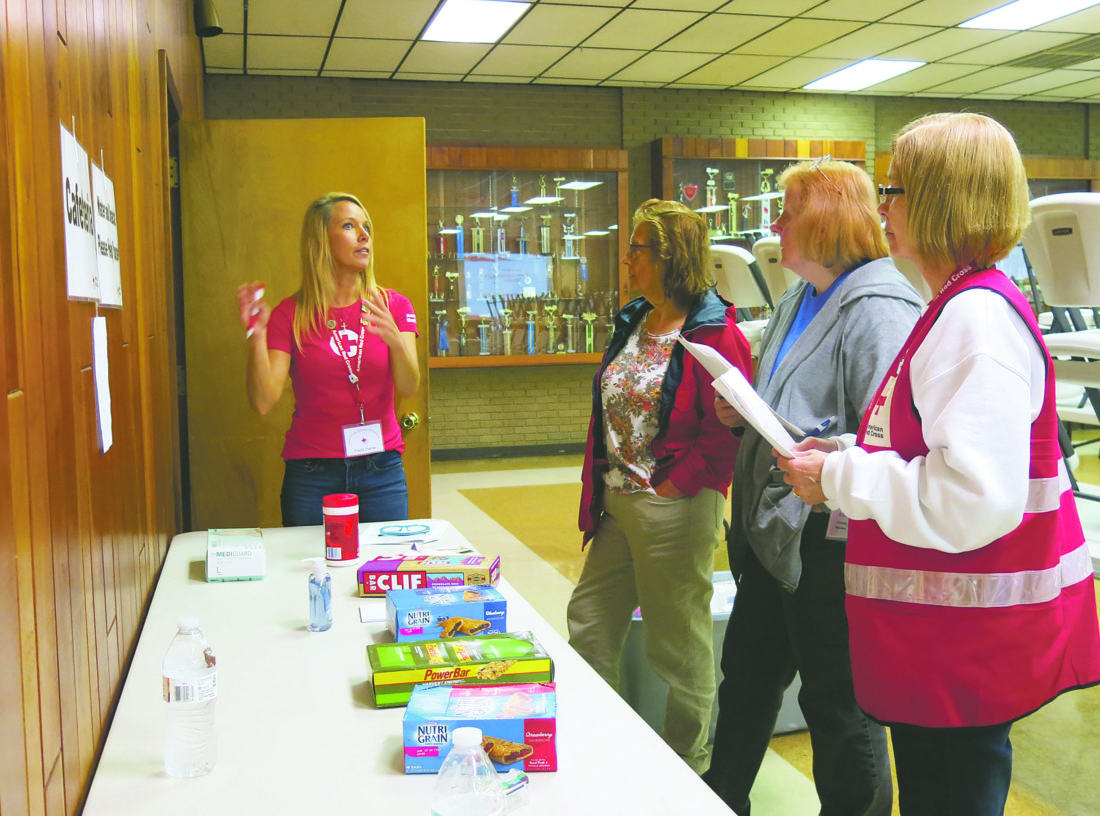
Paula Pierce (top), Althea Pasett, Margie Lewis, and Linda Ferenbach discuss their food service strategy during the mock scenario.
You have been assigned to be a shelter worker at a shelter facility in Youngsville, Pa., about 40 miles from your home… There is a large population of retirees. There are some minority groups who may speak Spanish. Your shelter facility is located the farthest from the damage. It is a fire hall. The building capacity is 300 people. The hall has a full service kitchen, however the kitchen and cafeteria staff are not available to enter the shelter. There are no separate generators for the building, which is not a problem since the building has not lost power.
When you get to the shelter, “it’s going to be confusing,” Jason Bange, District Program Manager for the American Red Cross in Bradford, tells the 16 volunteers who’ve come to the Youngsville Fire Department on Tuesday night to practice shelter setup, maintenance, and tear down skills.
In the event of an actual emergency, said Bange, a shelter location would be decided and someone would be acting as a shelter manager, identifying needs and delegating tasks to whatever volunteers were there to support the effort.
Tuesday’s shelter training, said Bange, included a body of both new and veteran volunteers, some with shelter experience, but many without. The goal was to prove that volunteers in the region could successfully set up and maintain a shelter for 200 people for three days according to American Red Cross protocol.
The microcasm, an opportunity to practice real emergency skills in a scripted, controlled environment, said Bange, is only an approximation of what the shelter work experience is really like. Overall, Bange said, the purpose of the training was to give volunteers a chance to practice roles, gain experience, and identify areas for improvement based on the content presented in an online training — “Shelter Fundamentals” and “Shelter Manager” courses.
The goals of Tuesday’s simulation were to promote teamwork through interactive group activities that correspond to resourcing, opening, operating and closing a shelter, reinforce the key activities and tasks that are involved in that goal, and provide participants with hands-on opportunities to practice the minute tasks of getting a shelter up and keeping it running smoothly.
Volunteers were broken into one of three groups for Tuesday’s simulation, and rotated between three stations at which there were opportunities to practice one major shelter operation skill — Reception, Dormitory Registration and Information, and Dormitory Feeding and Supplies.
Teams had to work as a group to complete various tasks at each skills station.
At the Reception station, volunteers were instructed to demonstrate the ability to set up a sample shelter reception area, including dormitory registration processes, by addressing key areas of consideration and resources that would be available at the shelter based on Red Cross guidelines and the equipment, personnel, and supplies available.
Quality customer service is an important part of the registration skill, said Bange. Explaining the purpose of various registration forms, completing an interview using appropriate forms are all parts of registration, Bange said. Having an understanding of internal and external signage needs based on what services and resources are available at any given shelter is also important. Letting those displaced by a disaster know where registration, feeding, sleeping, health, and mental health areas are within a shelter is an important way to make the shelter experience efficient for everyone, according to the training handout.
Identifying client language, feeding, health, or accessibility needs during the intake process are crucial parts of making a shelter successful, the training material said. Effective communication between volunteers and from volunteers to clients is an important skill to master. Conducting thorough interviews will also keep volunteers abreast of what services are being offered at any given time during a shelter experience as well as give them information about needed services or resources that aren’t being met. Also, tear down is an important skill in reception, as dormitory registration areas are to be returned to “pre-shelter” conditions when the shelter experience is over.
At the Dormitory station, volunteers had to work together to set up a standard, short-term sample shelter sleeping area for eight clients according to established Red Cross shelter guidelines, with necessary equipment and supplies. The Red Cross dictates that living and sleeping spaces in their shelters must include protecting the flooring of the building, setting up individual cots and client furnishing. Ensuring enough space for each client — both those with and without accessibility needs — is integral to this skill. Volunteers also needed to set up a client location chart and explain reporting requirements for workers in a shelter. Dormitory volunteers are responsible, during a real emergency, for identifying the type and location of needed signage, what considerations and resources are needed based on unique constellations of client demographics, and return the dormitory area of a shelter to it’s “pre-shelter” conditions.
For Feeding and Supplies volunteers, tasks include setting up and maintaining a 24-hour snack area, taking an inventory of available supplies at the time a shelter opens and developing a plan for how supplies and equipment will be reported to the shelter manager, setting up space considerations for clients with accessibility and functional needs, and determining how supplies will be distributed and stored during the shelter experience. Feeding specialists are also in charge of determining how supplies will be returned and/or disposed of when a shelter closes.
Special care was given to introduce or remind volunteers how to work with clients who have special accessibility for functional needs while in a shelter experience. The goal of the Red Cross, said Bange, is always to deliver exceptional customer service.
Throughout the three skill stations, volunteers who have had shelter experience both regionally and nationally often took the lead, recalling how shelters worked during their various deployments and ideas for how to run each station efficiently based on their past experience.
The training, said Bange, is “to get hands-on practice and refreshers” for how to smoothly open, operate, and close a shelter during an often fractured and confusing period of time. Often, said Bange, shelters are opened and no one shows up to them. “Especially here in northwestern Pennsylvania,” said Bange, “people tend to take care of themselves.”
If people displaced by a fire or disaster can find somewhere else to say, said Bange, they generally will. Shelter life isn’t exactly the height of comfort or convenience, but it can be an invaluable resource when there is nowhere else to go. Having an idea of how they might respond in unique situations, said Bange, gives volunteers the confidence and competence to provide the customer service that the Red Cross prides itself on.
“It’s nice to get the practice,” said Bange. The Red Cross tries to facilitate trainings — both online and hands-on experiences — multiple times throughout the year. The Red Cross in our area, said Bange is actively seeking groups who might be interested in becoming qualified to volunteer in the event that help is needed with a shelter operation in the area. Groups like service organizations, church groups, and other collections of interested individuals would be great candidates. Bange said that Red Cross personnel is always happy to provide trainings like the one given Tuesday night to groups interested in learning the skills.
For more information on the American Red Cross in Warren, contact the local office at 305 Market Street in Warren or calling (814) 723-6000.
Local News
Murder case focus turns to MCM Enterprises employees
Family’s song is music to downtown ears
Storm quiets 92 Gold in Warren
Saturday’s winds temporarily turned down the music. WRRN, 92 Gold (92.3 FM) was off the air from Saturday ...

Making the Grade

Man in police chase on probation in Pa.