
Warren statue dedicated in 1910 by DAR
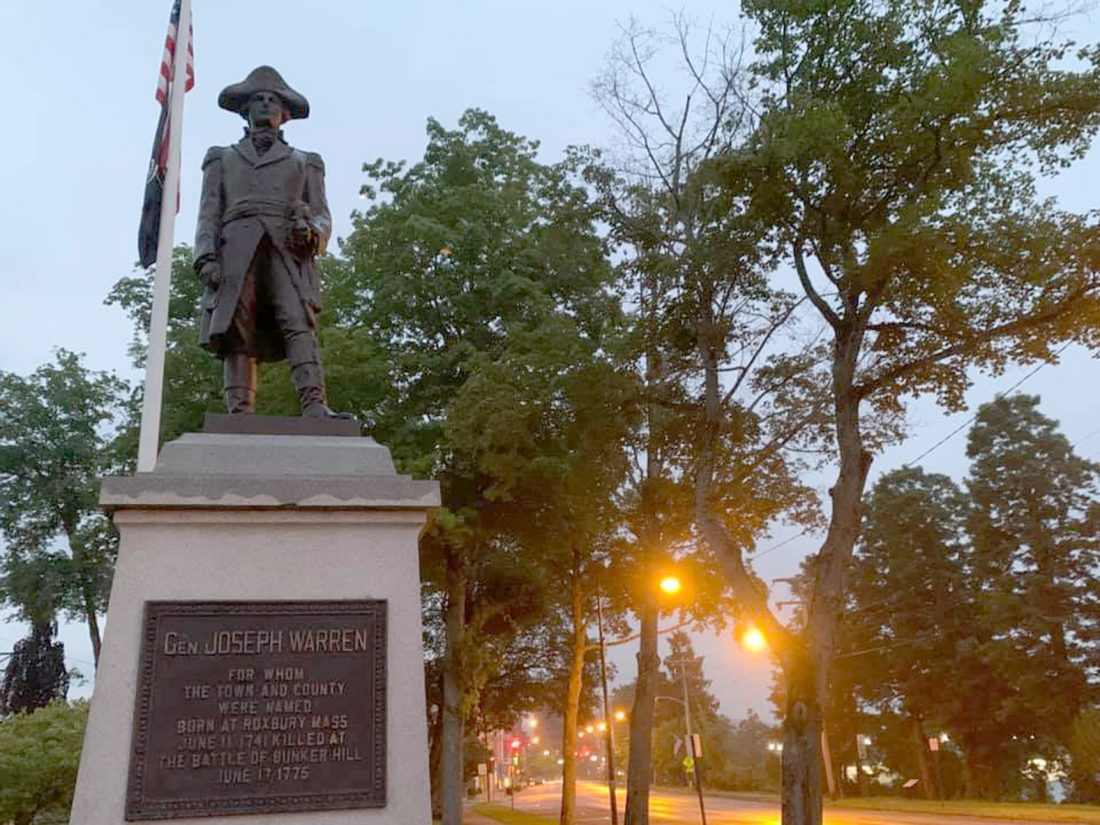
Times Observer photo by Josh Cotton This statue of the Dr. Warren statue in Gen. Joseph Warren Park was dedicated in July 1910.
By JOSH COTTON
jcotton@timesobserver.com
With all that’s been said and written in the last few weeks about the county’s namesake, Dr. Joseph Warren, there are two questions left relatively answered that have local implications.
The first is what will follow here – how the statue came to be that’s currently located at Gen. Joseph Warren Park in downtown Warren.
The second, which I think will take a little more time but will remain on my radar, is how the county’s name came to be. We know who its named for but how was that decision made? Who was involved? Were there other names considered?
But the statue…
The dedication day was July 4, 1910.
“Invitation is extended by the Tidioute Chapter, Daughters of the American Revolution to all citizens of Warren county and surroundings to be present at the unveiling ceremonies of the monument rejected to the memory of the Revolutionary heroes who are buried in Warren county, and to General Joseph Warren, for whom the town and county are named,” according to the Tionesta Forest-Republican.
“At 11 o’clock, July 4th, at Library Theater, a patriotic and fitting program will be given. Ex-Lieut. Gov. Charles Warren Stone has consented to make an address on the life of General Warren, and Mrs. Donald McLean, ex-President of the National Society, Daughters of the American Revolution, will speak, and possibly Mrs. Matthew T. Scott of Chicago, President General, and other notables.”
The Warren Evening Mirror ran a story on the event on July 5, 1910: “GEN. WARREN DULY HONORED.”
The paper called it a “SPLENDID MEMORIAL.”
“Previous to the unveiling of the monument and statue of Major General Joseph Warren, appropriate exercises were held at Library Theatre,” the paper reported.
“The city in which we reside takes its name from General Warren. It is a true honor that we are named after a patriot who stood in the redouts at Bunker Hill until the third charge of the British soldiers and died as one who had been offered a high command, but who served as a volunteer. General Joseph Warren was born in Roxbury, Mass. and the date was June 11th, 1741. He was graduated from Harvard in the year 1759. His valor, his honesty, his love of country and his true devotion to a cause of true patriotism cannot be disputed.”
“The Daughters of the American Revolution requested that Charles W. Stone deliver the principal address of the occasion. He was born in the same county as was Joseph Warren, the patient of the revolution and spent the boyhood years of his life there. Coming from a family of revolutionary ancestry, no person could have been better chosen to make the principal address of the occasion.”
I’ll summarize Stone’s address in next week’s edition. It’s lengthy so it’ll be an abridged version, though the paper ran the speech in its entirety.
The Evening Mirror said they were running the full text so “all, especially the young, can find therein an inspiration for true devotion and loyalty to our country and the flag that stands paramount.”
The events of the day started at 11 a.m.
“The exercises began at eleven o’clock and the president of the day was Hon. Henry H. Cumings. There was music by the band followed by invocation by Rev. H.M. Conaway. The patriotic song, “America” was sung by the audience, accompanied by the band.”
Given that the DAR sponsored the festivities (the current Gen. Joseph Warren Chapter was an offshoot of the Tidioute Chapter as I understand it), Mrs. May Gwin Eaton presented a paper
“In the article there was set forth much information regarding the organization of the D.A.R. Its inception was in the year 1893 in the city of Washington. The present membership is 75,000. It was outlined that the organization stands for American freedom….”
The Tidioute Chapter had formed 10 years earlier and already had 111 members, which was the fourth largest chapter in the state.
Unfortunately, other elements of the ceremony reported by the Evening Mirror, were illegible.
While the Stone speech will be here next week, I would be open to any thoughts or potential sources you might have on the original naming of the county. There weren’t newspapers here in 1895 so I anticipate that being a little harder to dig up.
The General Warren Chapter of the DAR added a plaque to the statue back in 2018 to recognize the sculptor who, among other things, was an associated of world-famous architect Frank Lloyd Wright.
From a 1910 article: “When the chapter had decided upon plans sufficiently to call for bids, a number were submitted but that of Messrs. Peterson and Frick, of Jamestown, N.Y., was much the lowest and gave best promise of most satisfactory execution, therefore the contract was awarded them.
“Messrs. Peterson and Frick gave the American Art Foundry, Messrs.. Jules Berchen & Co. of Lake Street, Chicago, the order for the portrait statue of General Joseph Warren and they, in turn commissioned Mr. Richard Bock to model the statue.
“Mr. Bock is a sculptor of note, having exhibited work at all of the later World’s Fairs, and received a number of medals as recognition of excellence.”
According to a biography from Greenville University, location of the Richard W. Bock Sculpture Collection, Bock set up his first permanent sculpture studio in downtown Chicago in 1891 after years of education in Berlin and Paris.
His first major commissions were for the 1893 Chicago Columbian Exposition, a sculpture at the Indianapolis Public Library and a interior sculpture in Chicago, where Bock first met Wright.
Several years later, Bock was “contracted by Frank Lloyd Wright and asked to execute several sculptures for the architect’s home in Oak Park, and other works for several of Wright’s architectural commissions.”
The Times Observer reported then that the statue had been restored in 2011 by the DAR, in part to restore the sword which had disappeared.
But a host of other problems were discovered – the statue had been painted which didn’t allow it to breathe so it was deteriorating from the inside out and just one of the bolts originally holding the monument on the Vermont granite base remained.
Community
Mother and 6 children killed in explosion at central Pennsylvania home
Deadline to register for primary election nearing
Secretary of the Commonwealth Al Schmidt reminded eligible Pennsylvanians today that the May 4 deadline to register ...
Youngsville Life: American Legion Auxiliary offering scholarships
Please email community news to Colette Nelson at Colettenel.ypl@gmail.com by Wednesday of each week to be included ...
Briefs
Farrah Grotto meets Tuesday The mystic order of the veiled prophets of the enchanted realm of Farrah Grotto will ...

ANF seeks artists for summer, fall programs
Drake Well Museum “Seeing Double” with new exhibit
TITUSVILLE – Grab a pair of 3D glasses and head to Drake Well Museum and Park for a unique exhibit experience ...