Sacrifices
Stories of the men of Warren County who served and sacrificed for the nation during World War I
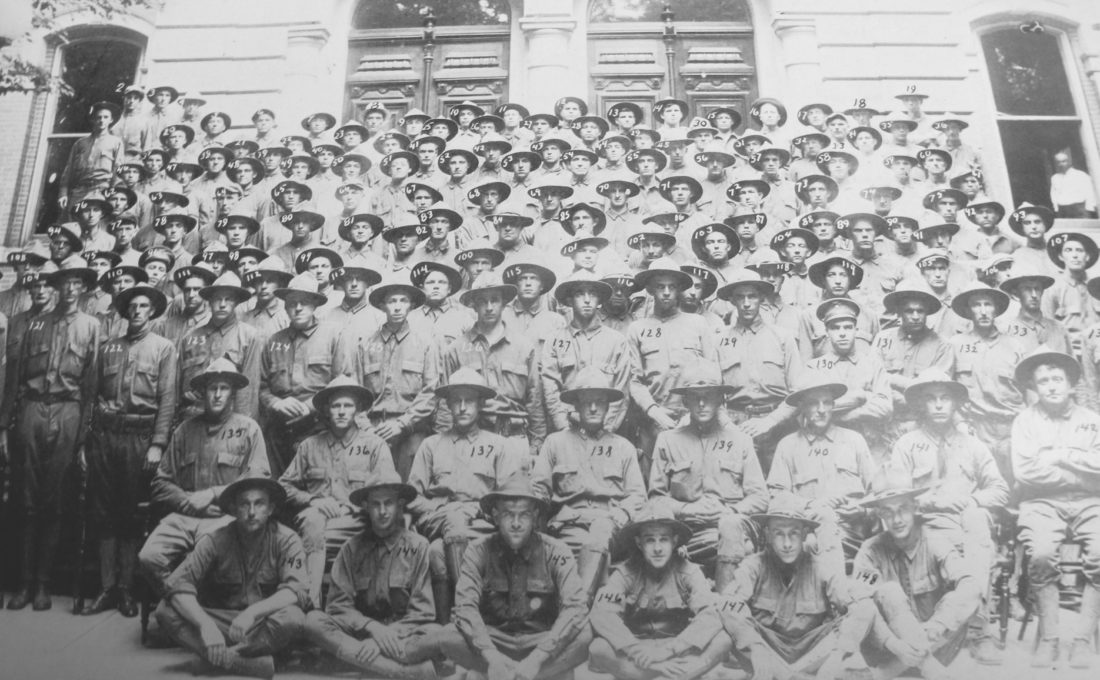
Photo from Warren County Boys Over There This photo of Company I was likely taken just before the Company left Warren for Camp Hancock, Georgia in 1917. Below, the first Selective Service Contingent to leave Warren in September 1917.
The men of Warren County who served in World War I served in a host of different ways.
Some joined the infantry.
Some the aviation.
Others the field artillery.
Some in the Ambulance Corps.
Others served in the U.S. Navy.
There were even some Marines.
But there’s little question that one unit stands out – Company I, 112th Regiment, 28th Division of the Army National Guard.
The unit dates back to the American Civil War and was incorporated into the National Guard in 1878. It included companies from Erie, McKean, Venango, Elk, Warren and Crawford counties.
It was mobilized for service during the Spanish-American War in 1898 and served in Puerto Rico.
The regiment was also mobilized for service on the Mexican border iin 1916 prior to American involvement in World War I, spending seven months along the Rio Grande.
The 28th Division – given the name the “Iron Division” – was initally called up to service by President Woodrow Wilson on July 3, 1917 and Company I was formally mustered into service at the Warren Armory on July 15.
In September, Company I went to Camp Hancock in Georgia for training but did not receive overseas orders until the followoing March.
Additional training followed in France and Company I was sent to the front lines in July 1918.
The 1918 book Warren County Boys Over There sheds light on Company I’s sacrifices on the Western Front.
“The 112th Regiment went through the battles of Chateau Thierry, Fismes and Fismette, Argonne Forest and the Woevre. At Chateau Terry the Pennsylvanians shared equally with the marines in credit for saving Paris.”
The cost of those efforts was remarkably high.
“Forty-five out of every 100 men int he regiment were either killed, wounded, gassed or reported missing on the Woevre,” the boo explains. “The 112th was in the thickest of the fighting at all four places mentioned, and in the Arginne they held the center of the line with every availble man in the front. They went through machine gun infested woods and underbrush from four to eight feet high without being halted, notwithstanding the heavy casualties. As the old 16th always gave a good account of itself in the Spanish-American war and on the Mexican border, so did the boys of northwestern Pennsylvania, as the 112th, in their service for our country overseas.
“Company I made glorious history for itself on the western front in 1918.”
The men of Company I were awarded the fourragere, a French military distinction, “in effect, a blanket decoration for bravery conferred on every man in the regiment,” according to the book, which described the award as “a braided cord to be worn looped over the left shoulder.”
When the book was published by the Warren Historical Company in 1918, it was known that Company I would be home late.
“The men of Company I will be the last from Warren to return home, as the 28th Division has been delegated as part of the army of occupation in Germany.”
While Company I may be the most notable single unit from Warren County, many more were selected in one of 15 Selective Service Contingents (i.e. the draft).
Warren County’s Draft Board was organized in the summer of 1917 and included the sheriff and a county commissioner, among others.
By November 15, 1918, the Draft Board had inducted nearly 900 men into the service of the 7,822 that registered.
The men were not sent to war empty handed.
The Farewell Committee along with the Red Cross “supplied the departting men with knitted outfits and comfort kits. Mrs. Blanche Partirdge headed the committee which regularly, with the assistance at times of the Chamber of Commerce, the Elks and private citizens, furnished the boys with cigars and cigarettes.”
The first Selective Service Contingent left on September 7, 1917, the day before Company I left for Georgia.
“The crowd at the station, although there was but a handful of men (13 to be exact), rivaled what which was to see Company I depart on the following day. The frist tears were shed, the first cheers of farewell rang out and the boys who were to the first of this county on Europe’s bloody fields left for the front,” according to the book.
At that time, the remaining Civil War veterans accompanied the men to the station, a tradition that continued with subsequent contingents.
The next group left 12 days later and was much larger, totaling 84 men.
“The glory in men off to defend their country’s rights had not yet penetrated the rank and file,” the book states. “They only saw the sadness of parting. Probably more tears were shed at thee station than at any time sense. There were a few married men in the contingent also and this contributed to the feeling of sorrow which seemed to permeate nearly all.”
——
Ernest Watt: Warren County’s only POW
By JOSH COTTON
jcotton@timesobserver.com
Only one man from Warren County was taken prisoner during World War I.
But there’s a lot more to the story than that.
Ernest Watt was one of the men who served in Company I, 112th Regiment – a unit made up of many men from Warren.
He was reported killed in action in July 1918.
The Times-Mirror published two letters in August from soldiers at the front that make mention of Watt’s death.
The paper reported on August 7 that Dick Walker wrote to his mother “on the day that Ernest Watt, a member of Company I was killed in action.” The letter is dated July 7, 1918.
The following day, Sidney Lucy wrote to his mother and reiterated that Watt was killed.
“Dear Mother: I will now drop you a few lines to let you know I am feeling fine. I received your letter you sent to me at Camp Upton. I suppose you have got my letters I sent to you from over here by this time. I got a letter from Mary since we have been here. I am going to answer it today Have you heard from her lately? France is some country, believe me. We have been under airplane raids a few times. I know you know Ernest Watt. He was killed yesterday. I cannot tell you where.”
In Warren County Boys Over There, Frank Auchiutto, who returned stateside in November 1918, “said he climed out over Watt’s body July 6 after their platoon had stormed enemy machine gun nests.”
The tricky thing? He wasn’t dead.
He was later carried on the official casulty list as a German prisoner and turned up as a prisoner at Camp Rastatt, Germany.
Germany held roughly 2.4 million troops from enemy nations – including the United States – during World War I so it shouldn’t be a surprise that a Doughboy could be lost in the shuffle.
Community
Wilder Museum to open season with Fashion Flaunt
Briefs
Caregivers Support Group To Meet The regular meeting of Caregivers Support Group-Warren will be Monday, May 18, ...
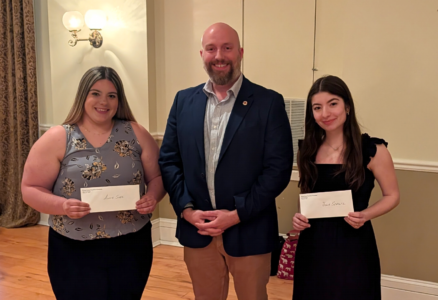
GOP scholarship winners
Youngsville Life
Please email community news to Colette Nelson at Colettenel.ypl@gmail.com by Wednesday of each week to be included ...
NPRC names county students on dean’s list
Northern Pennsylvania Regional College (NPRC) has announced students who achieved Dean’s List recognition for the ...