For sale:
A piece of history in a tomahawk pipe that belonged to Chief Cornplanter
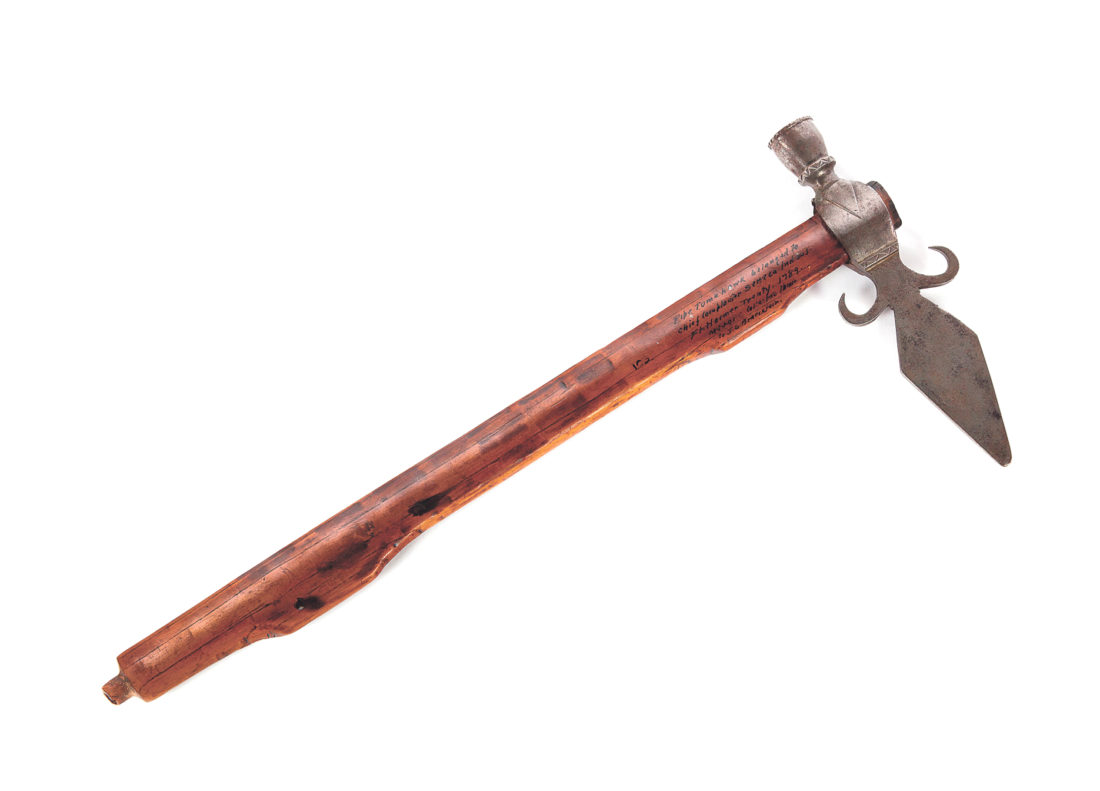
Photo courtesy of Selkirk Auctioneers and Appraisers This tomahawk pipe, which was reportedly carried by Chief Cornplanter of the Seneca Nation at the signing of the Fort Harmar Treaty of 1789, is up for auction at 10 a.m. and carries an estimated value of $25,000 to $35,000.

Photo courtesy of Selkirk Auctioneers and Appraisers
This tomahawk pipe, which was reportedly carried by Chief Cornplanter of the Seneca Nation at the signing of the Fort Harmar Treaty of 1789, is up for auction at 10 a.m. and carries an estimated value of $25,000 to $35,000.
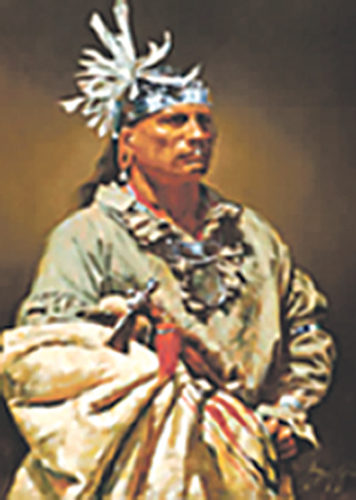
Image courtesy of Paramount Press and Robert Griffing
In this painting (inset) by Robert Griffing, Chief Cornplanter holds a tomahawk pipe similar to the one to be sold at auction Saturday through Selkirk Auctioneers and Appraisers of St. Louis.
Lot 95 in a Selkirk Auctions of St. Louis special auction Saturday of Native American and Ethnographic Artifacts will be a tomahawk pipe that belonged to Cornplanter and is connected to the Fort Harmar Peace Treaty. The estimated value of the pipe has been set at $25,000 to $35,000.
The piece has a hardwood haft that bears an ink inscription written long after the treaty was signed. The axe head is made of iron.
The consignor and officials at Selkirk are confident of the provenance — the origins and history — of the pipe. “There is pretty extensive cataloguing of that piece,” Specialist and Consignor Representative Bryan Laughlin said.
The Fort Harmar Treaty of 1789 was expected, by the Iroquois Six Nations — Mohawk, Onondaga, Oneida, Cayuga, Seneca, and Tuscarora — and other tribes, to solve some “outstanding issues” with the Treaty of Fort Stanwix of 1784, according to Laughlin.
The governor of the Northwest Territories, Arthur St. Clair, led the negotiations for the United States. According to records, St. Clair did not use the authority given to him to offer an exchange of land for some of the lands in dispute. Instead, he got the parties to sign, reportedly using threats and bribery, a treaty that did nothing to resolve the outstanding issues with previous treaties at Fort McIntosh in 1784 and Fort Stanwix in 1785.
Cornplanter, a Seneca diplomat and war chief during the American Revolution and the French and Indian Wars, was one of the signers of the Treaty of Fort Harmar and the Treaty of Fort Stanwix. He was the son of a Seneca woman — Gah-hon-no-neh (She who goes to the river) — and a Dutch fur trader and gunsmith — Johannes Abeel II.
Streets in and near Warren’s South Side are named for the members of the Iroquois Confederacy — Seneca, Mohawk, Onondaga, Oneida, Tuscarora, and Cayuga. There is also a Harmar Street.
Simon Wills, Account and Business Development Manager and Modern Art Specialist at Selkirk Auctioneers and Appraisers of St. Louis and Garth’s Auctioneers and Appraisers of Delaware, Ohio, dealt directly with the consignor of the piece.
He said the pipe was likely a ceremonial item, rather than actually being passed around and smoked at the treaty signing.
“I’m not certain exactly what role the pipe would have played,” Wills said. “I don’t imagine that they would have physically smoked it.”
There is a gap in the history of the piece. Those looking for records have not been able to account for the pipe’s location for about 100 years from the signing of the treaty until it came into the possession of a Kansas City architect who was a collector.
Wills said he could not disclose the name of the seller. “The piece is consigned by an Ohio collector,” he said.
“It was in two private collections that we have documented back to around 1885,” Laughlin said. “The last was from the collection of a fairly prolific collector in Indiana, Jim Dressler. We have the provenance from Dressler.”
Prior to that, “it was owned by a gentleman in Kansas City,” Laughlin said.
That collector, architect John George Braecklein, who reportedly developed the first skyscraper in Kansas City, was born in 1865 and died in 1958.
“The Dressler collection had it directly from that gentleman,” Laughlin said.
“There is a gap in the period between the signing of the treaty and Mr. Braecklein,” Wills said. “It would have been in possession of someone else.”
Wills described Dressler’s and Braecklein’s as “distinguished collections.”
“At some point the haft was inscribed,” Wills said. “It may have done as part of Braecklein’s inventory.”
The inscription tells some of the history of the piece and may have told more at one time.
The lines of the inscription read:
¯ Pipe Tomahawk belonged to
¯ Chief Cornplanter Seneca Indians
¯ Ft. Harmer Treaty, 1789
On the fourth line there are “indistinct” letters, according to Wills, followed by “Collection thence”
¯ To J.G. Braecklein
The indistinct portion of the inscription may have given the prior owner.
“That’s where we might be able to find the missing piece of the provenance,” Wills said. “We tried at length to find that missing piece. The writing on it is pretty illegible.”
Still, the history of the item makes it valuable.
“It carries an estimate of $25,000 to $35,000,” Wills said.
The auction starts at 10 a.m. Those who are registered may track the action on the item at selkirkauctions.com.
“The way that it works in a live auction, as opposed to an online auction, the bidding will start at the auctioneer’s discretion in the sale room,” Wills said. “The seller will have a reserve. That reserve can’t be any higher than low estimate. The bidding will start somewhere below the low estimate. As the bidding goes on, people will compete for it.”
Bids may be placed in person, absentee — written, online, or by telephone.
The Warren County Historical Society would like to see the item in the county.
“We hope that someone local will purchase the artifact and preserve it for many generations to come,” Managing Director Michelle Gray said.
“We’ve had some good interest,” Wills said. “We’re hoping for a great outcome.”
Community
Film Festival Awards return to Jamestown
JAMESTOWN — On Friday, the International New York Film Festival Diamond Globe Awards returns to the Cappa Theater ...

Mother and 6 children killed in explosion at central Pennsylvania home
Deadline to register for primary election nearing
Secretary of the Commonwealth Al Schmidt reminded eligible Pennsylvanians today that the May 4 deadline to register ...
Youngsville Life: American Legion Auxiliary offering scholarships
Please email community news to Colette Nelson at Colettenel.ypl@gmail.com by Wednesday of each week to be included ...
Briefs
Farrah Grotto meets Tuesday The mystic order of the veiled prophets of the enchanted realm of Farrah Grotto will ...