
Arrest made in murder case sparks rumors, crowd
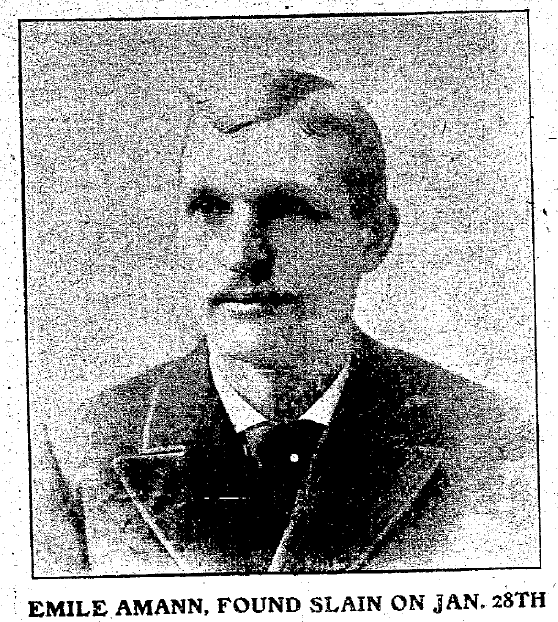
Photos from the Warren Evening Mirror A photo of Emile Amann, the man killed on Tanner Hill that resulted in charges being brought against John Andrews.
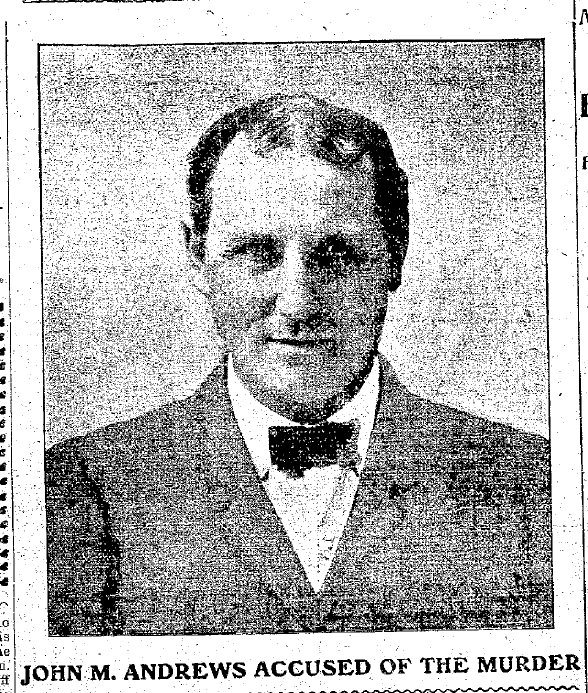
This man, John Andrews, was charged with murder in the Jan. 1911 killing of Emile Amann. This, however, does not represent the conclusion of an open and shut case.
Photos from the Warren Evening Mirror A photo of Emile Amann, the man killed on Tanner Hill that resulted in charges being brought against John Andrews.
This man, John Andrews, was charged with murder in the Jan. 1911 killing of Emile Amann. This, however, does not represent the conclusion of an open and shut case.
Trending
As the rumors regarding Emile Amann's murder on Tanner Hill continued – called one of the "foulest murders" in the county – so did the investigation.
It was an effort led by two Pinkerton detectives in conjunction with the county's 30-year-old district attorney – Frank J. Lyons.
Nearly three months after the incident occurred an arrest was made.
The accused? John McMillan Andrews.
The Evening Mirror reported on April 8 that he was arrested shortly after noon while walking to work but "took matter cooly."
"My God, don't do this, don't do this," Andrews was reported to have said. A constable "clapped one handcuff to the alleged murderer's wrist and the other to his own" and, along with a Pinkerton, went to the office of the justice of the peace."
The Mirror said the arrest had been expected for "several weeks" and reported that the "officers and prisoners were soon surrounded by a large gathering of citizens and townspeople."
It's unsurprising that the papers dug into Andrews' background. They found that he was born in a Pittsburgh suburb and lived in Ohio for a time before coming to Warren.
"Since his residence in Warren he occupied a prominent social position and belongs to a number of clubs and social organizations," one of the papers claimed. "In his duties he has been faithful to his employers and his administration of the office of the water company, until a short time ago, was never marked by criticism."
He was a superintendent of the Warren Water Company, a job he left a year before this incident. He and his family lived at 406 Liberty St.
Andrews appears to have been met at the office of the justice of the peace by who would become his defense attorney – Delford U. Arird.
According to the Warren County Historical Society, Arird was born in Sugar Grove in 1851 and was a school teacher, prothonotary, school board member and city council member before he was admitted to the bar. He would go on to serve as judge in Warren County for 20 years in the 1920s and 1930s.
Some of the intense interest in the case – and Andrews' first court appearance – seems likely to have been rooted in lack of a clear motive.
From the Evening Mirror: 'It will be learned in a large measure how many of the thousands of rumors that have gained general circulation since the commission of the crime are founded upon fact and how many of them have been the evolutions of different imaginations.
"The ascribing of a motive for the commission of the alleged murder… has been one of the problem(s) which the people of this city have pondered over and few, if any, have really arrived at the right conclusion. Andrews and Amann were both known to have been great friends and in their work for the Warren Water Company kept close counsel."
They first alleged that financial irregularities got Andrews fired.
"Much evidence of instances wherein Mr. Andrews misappropriate funds of the Warren Water Company" existed, the paper claimed.
Was Amann a whistleblower who had to be kept silent? One source alleges that as a motive.
The Evening Mirror attended his initial arraignment. "Mr. Andrews calmly took off his overcoat and placing it on a chair, was handed the complaint, which he read. He handed it back to Justice Perry, never once changing color or displaying the slightest tremor of uneasiness.
He "was as carefully groomed as ever and carried himself with a buoyant air that was in strong contrast to the saddened air worn by some of his best friends who are much perturbed over his plight," the paper added.
Detailed stories of the testimony offered took up a couple hundred column inches in the papers.
The Mail reported that the revolver was "similar to one which had been presented to Andrews by William H. Allen, attorney to the State Railroad Commission, and a son-in-law of former Lieutenant Governor Charles W. Stone, of Warren." (His mansion still sits at the corner of Fifth Ave. and Liberty St.)
The Mirror then reported an interesting exchange between Arird and the justice.
"What will you do?" inquired Justice of the Peace Perry.
"Of course we will enter a plea of not guilty," said D.U. Arird, attorney for the alleged murderer.
"I don't suppose there is any use of taking bail," said Attorney Arird with an inquiring look at the justice.
"Not with me," replied Justice Perry.
"It is generally understood," the Mirror claimed, "that not a single clue could be found that pointed in any direction other than toward the man who is now in jail, charged with the dastardly crime."
One account cited Andrews' testimony to the corner's inquest that said Amann asked him to go to the reservoir that night but that he declined. He provided what amounts to an alibi defense, accounting for his whereabouts throughout the evening.
The hearing ran in excess of two hours.
"Fraught with the greatest anxiety as to the outcome of the hearing," the Evening Mirror added, "hundreds of Warrenites thronged the street" outside the court, which was located on "Second Street."
The reporter specifically commented on the women in the crowd – "the brilliant color effects on the gowns and hats of the women marked a strong contrast with the sombre event of the day."
The Mail informed readers that no bail could be given for a murder charge and he was jailed after the hearing "but business associates of the accused were granted permission to see him for the purpose of arranging business details connected with the Floridin Company, a Florida company handling fullers earth, of which Andrews is vice president and loca manager…. After that, he assumed the cool and seemingly not worried attitude which has been his since the ghastly finding of the murdered man and during the time that he knew that the finger of suspicion was pointing his way."
Andrews spoke during the hearing and, unsurprisingly, those words were taken down by the reporters in the room.
"Taking into consideration the length of time that the detectives have been working on this matter, if all they can do to connect me with this crime is to bring the evidence of this broken down old man, I do not feel I need to fear the consequences," he said.
"My sorry is not for myself, but for my dear wife and our two darling children. God only knows how they must suffer."