
Today marks 95 years since Lindbergh crossed the Atlantic
-
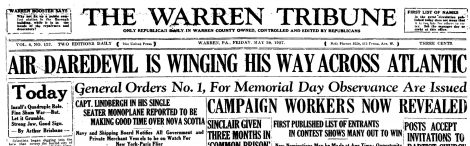
- Photo from the Warren Tribune One of several front pages of the Warren Tribune dominated by coverage about Charles Lindbergh’s historic transatlantic flight.
-
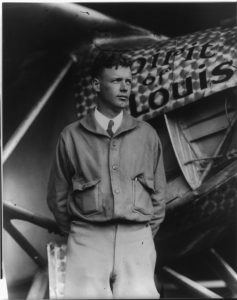
- Photo from the Library of Congress Lindbergh with his plane, the Spirit of St. Louis.

Photo from the Warren Tribune One of several front pages of the Warren Tribune dominated by coverage about Charles Lindbergh’s historic transatlantic flight.
If I wanted to get to Paris, I could fly from Erie and be there – with two connections – in 18 hours.
If I drove to Pittsburgh, I could shave six hours off of the total time.
A commercial flight from New York City to Paris, with one stop, takes less than 11 hours.
It’s easy to forget that this kind of efficient world travel is a relatively new phenomenon.
Sure, 100 years ago might feel like a long time ago but in 1922 no one had yet made that flight. It would be another five years before that would happen.
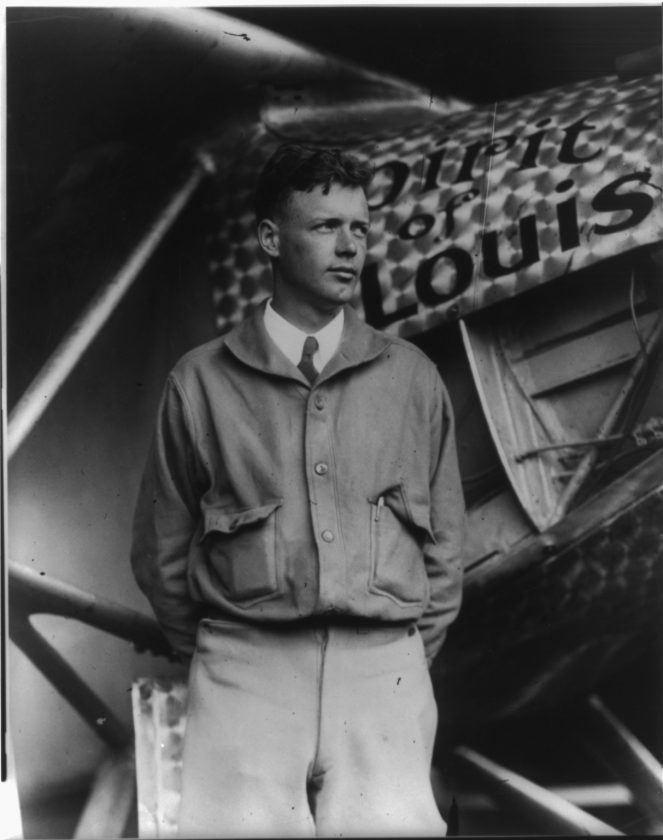
Photo from the Library of Congress Lindbergh with his plane, the Spirit of St. Louis.
And the event spawned a national hero.
And the Warren Tribune was spellbound.
That first nonstop, transatlantic flight occurred for the first time 95 years ago today when Charles Lindbergh and his Spirit of St. Louis landed in Paris over 30 hours after taking off from Long Island.
Lindbergh became a celebrity and aviation exploded, paving the way for the future of aviation.
In an age without the internet or television, radio and print were how news spread.
And Lindbergh was NEWS. Stories on the historic flight were the lead in both the May 20 and May 21 editions.
By press time on the 20th, the Tribune had learned that Lindbergh was to be over Nova Scotia. The main article is really a series of dispatches from Washington, Massashucsetts, Montreal, Halifax, all providing either evidence of a Lindbergh sighting or information about the conditions he would face (like in London, where “favorable wind conditions” were reported but also “danger of drizzles, low clouds and possibly fogs.”)
The dispatch from Washington said that the Navy and Shipping Board “notified all government and private merchant vessels in the north Atlantic to be on the watch for Capt. Charles Lindbergh” and to “wireless immediately” if he was seen.
There was also an article about the reception to the flight in Paris, editors calling Lindberrgh a “YANKEE AVIATOR” on his “lonely challenge to death” that “grips sympathetic imagination of Frenchmen.”
By press time on the 21st, information about the flight was still fragmented.
“Many rumors on progress of lone airman on way to Paris but not any can be confirmed,” the Tribune concluded. “Odds against Captain Lindbergh decrease as hours speed by,” another article claimed.
There appeared, however, to be some substance to the sightings in Europe. One was reported over Ireland at 12:55 p.m. and then over Normandy at 3 p.m.
There were rumors that the British would provide an escort over England but the British Navy issued a denial.
Those more substantive sightings, though, gave organizers of his reception in Paris reason to be optimistic.
From a United Press report: “Odds against Captain Charles Lindbergh in his effort to fly from New York to Paris were decreasing this afternoon and the crowd continued to grow at Le Bourget field, where the lone airman was scheduled to arrive.”
The crowd was estimated at 2,000.
“The odds first quoted at 10 to 1 against Lindbergh went to eight to one and finally seven to one this afternoon,” the report stated. “Two sets of plans for his reception, depending on his condition when he arrives, were made. If the young pilot, who will have gone 64 hours with only two hours sleep if he reaches Paris, is not exhausted, he will be the guest of honor at a banquet….”
The reporter tried to capture the sentiment at the landing site: Having recovered from the first shock of amazement that any man would attempt what Lindbergh was expected to achieve today, American residents in Paris from General John J. Pershing down to the flapper tourists were rooting for him to win.
‘Four sandwiches in his plane and only a coupla hours sleep before he started,” exclaimed a youth of unmistakably American environment. ‘My Gawd!’ That more or less suggests the attitude of Paris in general toward the unassuming daring of Lindbergh.”
The Tribune didn’t publish on Sunday, May 22 so the news of success was the lead story on May 23 under the headline “LINDBERGH IS HERO OF EUROPE.”
The paper called him the “American Conqueror of Atlantic” in one of three stories on the trip including one that already questioned the final disposition of the plane.
For his part, Lindberg said the lack of sleep wasn’t a problem but that the sleet was, forcing him to fly higher out of the weather.
“It wasn’t agreeable,” he said. “One of the greatest dangers I faced was in landing at Le Bourget field, when the crowd almost overwhelmed me.”
With Lindbergh safe on the ground, the Tribune editors were free to unleash an editorial which quickly turned into a diatribe against, well, fake news.
From twelve o’clock noon on Saturday, The Tribune editorial room was kept busy denying reports that emanated from a dozen other sources that Captain Lindbergh had landed, and after he really did bring his plane down on French soil, it was this office that was called for verification of the fact.
Some one once said that the natural inclination of people was to lie and that the degree in which they refrained from lying marked the degree of their will power. Did you ever consider how many totally false reports are bruited (spread) daily? Do you recall how during the anthracite coal strike of 1925-26 stories were circulated upon five occasions that the strike had been settled when there was not the slightest ground upon which to base any of them? In the same manner we hear exaggeration of almost every tragedy that happens….
Always the reports make the occurrence whatever it may be, worse than it really is…. It takes little to fire imaginative minds; it takes less to cause the tongues of those who are not inclined to check their natural inclination to lie, from wagging. A hint of an alleged fact gets half a dozen mouths. After that it is only a matter of elaboration and decoration.