
The freeze: June snow in 1859 brought ‘calamity’ to Warren County
-
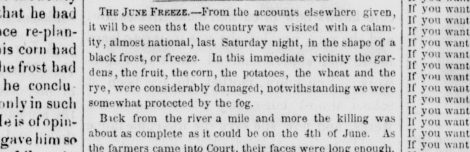
- Photo from the Warren Mail “The Freeze” brought a heavy frost and a couple inches of snow to Warren County and much of the region on June 4, 1859.
-
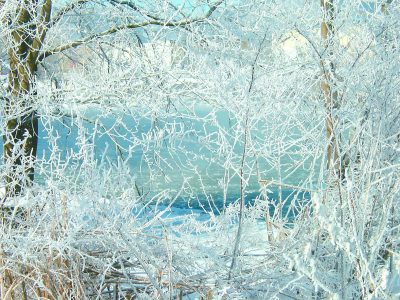
- Times Observer photo by Victoria Barone Frosty morning Sub-zero temperatures Thursday night and Friday morning left plenty of hoar frost around the area, as seen on these trees at Point Park.
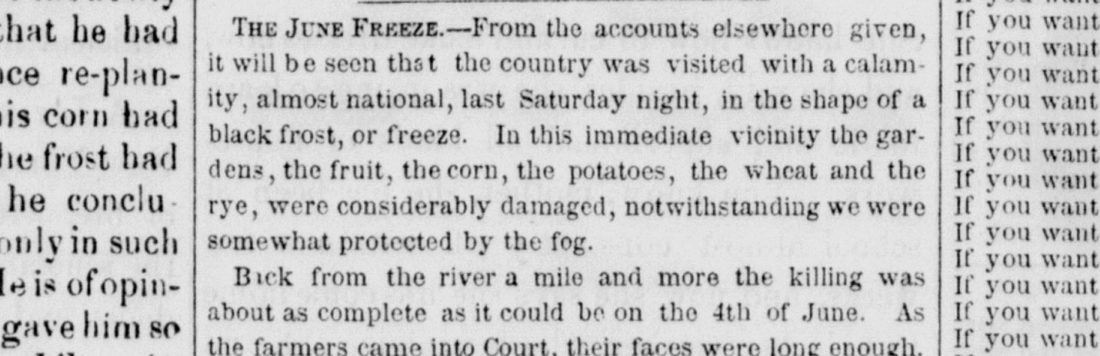
Photo from the Warren Mail “The Freeze” brought a heavy frost and a couple inches of snow to Warren County and much of the region on June 4, 1859.
I woke up on the day I wrote this piece to a temperature that came in at a balmy zero degrees.
We all – or almost all – desperately wait for the better weather around the corner. But for everything there is a season.
Because there’s literally a season for this kind of weather, you can imagine the surprise that befell county residents on Saturday, June 4, 1859 when weather they would have expected to see months before – snow and frost – blanketed the landscape.
Such an occurrence would shock us today. But most of us wouldn’t truly be harmed by it.
But in the 1850s when the county was much, much more agrarian? It was a much more dangerous situation.
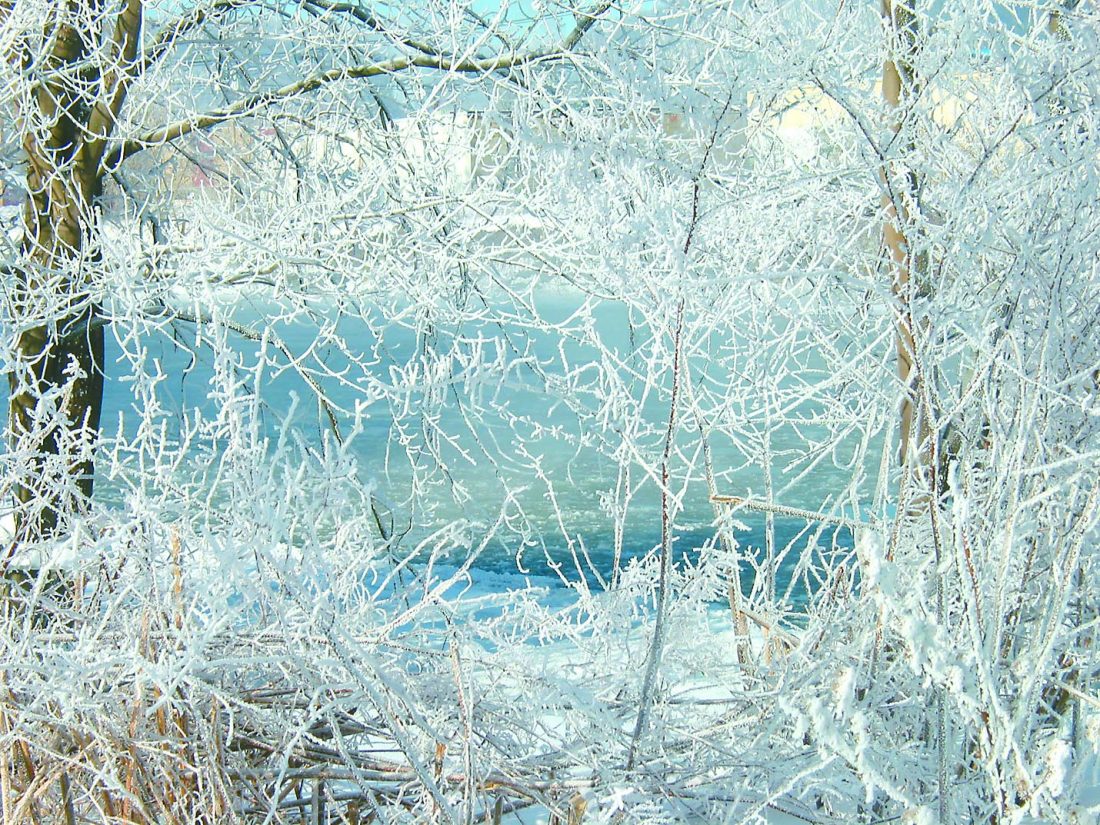
Times Observer photo by Victoria Barone Frosty morning Sub-zero temperatures Thursday night and Friday morning left plenty of hoar frost around the area, as seen on these trees at Point Park.
“By four o’clock in the afternoon there was a good two inches of snow on the ground and us boys in our bare feet,” James Clark told Arch Bristow for his Old Times Tales of Warren County work. “At first everybody took the snow storm as a good joke, threw snowballs and said they reckoned likely we’d have good sledding on the Fourth of July.”
The atmosphere had changed by the following morning.
“In the morning I was up at daylight and saw a sight such as I’d never seen before and I’ve never seen since. All the crops were gone,” Clark said. “Everything was frozen stiff, corn, grass, things in the garden. I was a tough, rugged lad, I’d laid away my shoes early in May and wasn’t going to bother looking them up again. So I went off down across the pastures to fetch the cows and the grass and weeds were crisp and crackly with the thick frost under my feet.”
The county’s most prominent newspaper, the Warren Mail, went to press on Friday to publish on Saturday. So their first opportunity to comment on the scene was the following Saturday, June 11.
“The weather here has been warm most of this week. On Tuesday night we had a fine rain, which will do something towards reviving the frost bitten crops. But neither rain nor sunshine can erase the yellow foot-steps of one night’s frost,” they reported. “As we go to press, Friday morning, we have a cold rain. Possibly another frost may be the result.”
The Mail spent considerable column inches trying to put a June frost into context, striving to identify just how serious the consequences may be.
“From the accounts elsewhere given, it will be seen that the country was visited with a calamity, almost national, last Saturday night, in the shape of a black frost or freeze,” they reported. “In this immediate vicinity the gardens, the fruit, the corn, the potatoes, the wheat and the rye, were considerably damaged, notwithstanding we were somewhat protected by the fog.”
They reported that outside of Warren the “killing was about as complete as it could be on the 4th of June.
“In Elk, Corydon, Farmington, Freehold, Columbus, Spring Creek, South West, Deerfield and Sheffield, it appears to have been equally severe, the hill farms generally fairing the worst. Some farmers have already put in other crops and others are preparing to do so. It is not yet too late to plant corn and potatoes, and still too early for buck-wheat, which is some consolation.”
As the week unfolded after the freeze (that’s how the Mail described it), editors started to think it might not be as bad “as it was feared to be at first.
“Around here the grass shows hardly any signs of injury, the wheat but little, the rye is not so very bad, while fruit bids fair to be much better than it was last year. Another week, however, will fully develop the extent of the injury.
“As an evidence of the cold here we may say that about noon on Saturday there was a little bit of hail, just enough to be perceptible. On Sunday morning we hear that ice a quarter of an inch thick was found in pails, and many but not all of the Locust tree leaves were killed. Pieces of cloth and papers were frozen stiff and some pretended to have seen the top of the ground frozen to a crust.”
The Mail editors included dispatches from Cleveland, Dansville, NY, Cincinnati, Pittsburgh, Buffalo and Toronto that told of similar destruction.
With another week of hindsight at their disposal, the June 18 report in the Mail on the situation seems more defined.
“The first accounts from the country at large, made under the influence of a panic, are shown by later accounts to have been somewhat exaggerated,” they detail. “The loss will of course be severe, but not complete even in the worst places. The damage to wheat and rye depended materially on the forwardness of the crop, some fields being badly damaged while adjoining fields were hardly touched. Some farmers calculate that the rust, the fly and the grasshoppers have been more or less destroyed by the frost.”
They concluded that corn, potatoes and most garden vegetables “are nowhere completely lost.
“Most fields will come again with little hindrance, while there is time to replant that which was totally killed.”
But Clark’s story paints a different picture of life on the ground for the county’s farmers.
“The next winter was the worst the people in this section ever went through. There was almost no feed for the stock. The farmers butchered their cows or sold them if they could,” Clark said.
“All we tried to winter was one team of horses, three cows and a brood sow. The farmers all over the country turned their cattle out to browse all winter, it was the only thing that kept the stock alive. We went into the woods and cut down young maple, birch, beech or basswood. The cows would eat the buds and the twigs, eat twigs as thick as a lead pencil sometimes…. Some stock died and all the horses and cattle were thin and starved looking by spring.
“The cattle weren’t the only ones that suffered; it was slim fare on most of the farms. We helped each other out. If one man had a little corn and the other potatoes they traded part of what they had. There were two weeks when we had nothing but potatoes in the house. Not even a little milk; the cow had gone dry.”
So while it may be beyond frigid when I write this, I think the moral of the story is the idiom: “For everything there is a season.”