
Court decision forces change to second-degree murder sentencing
Trending
A state lawmaker is proposing legislation that would rewrite the state's second-degree murder sentencing laws after the state Supreme Court ruled earlier this year that the state's existing law is unconstitutional.
In Commonwealth v. Lee, the state Supreme Court struck down mandatory life sentences for people convicted of second-degree murder as unconstitutional under the state constitution. The court stayed its ruling for 120 days to allow the state Legislature to rewrite state law.
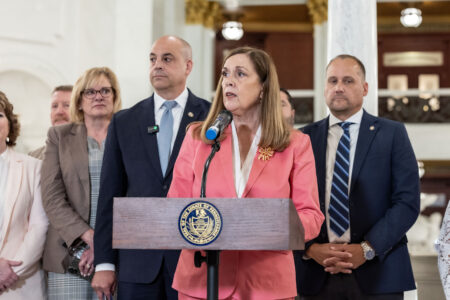
One proposal to do that was introduced Monday in the state Senate by Sen. Lisa Baker, R-Dallas, co-sponsored by 13 fellow Republican senators. Senate Bill 1400 would establish a new system of sentencing for second-degree murder convictions, providing discretion for courts when sentencing someone convicted of second-degree murder based on the degree of the defendant’s culpability and the circumstances of the case. The state Senate passed the legislation on Thursday.
"Our legislation will seek to ensure an opportunity to be released for those who deserve it, while simultaneously preserving the interests of both community safety and the family members of murder victims," Baker wrote in her co-sponsorship memorandum.
Generally, Senate Bill 1400 will authorize a sentencing range of 35 years to up to life with the possibility of parole. Judges in cases Baker said are outliers – such as when someone is a getaway driver or wasn't actively involved in the death of another person – will have the ability to set a sentence less than the 35-year minimum but no less than 10 years when specific criteria are met. The bill also establishes a sentence of life in prison without parole if a jury determines a person charged with second-degree murder caused the death of the victim and one of four additional factors: if the victim was a law enforcement officer or a child under the age of 13, if rape or deviate sexual intercourse by force was involved in the crime, if the defendant was previously convicted of a violent crime or if the defendant caused serious bodily injury or death to another victim.
In an effort to ensure a uniform and consistent process, Baker also proposes allowing those currently serving sentences for second-degree murder to become eligible for parole after serving at least 35 years incarceration or attaining the age of 70 and having served at least 20 years.
Baker said Melody Kocis Bartusek, one of her constituents, raised concerns about the court's decision following the 2007 murder of her brother, Bryan, after two men broke into his home, slit his throat, stabbed him 28 times in the torso, and then set a fire to cover up the murder. Prior to trial, and in exchange for his testimony against his co-conspirator, Bartusek and her family gave the prosecutor their blessing to allow one of the defendants, Joseph Kerekes, to plead guilty to second-degree murder and be sentenced to life without the possibility of parole.
"For the Kocis', the Supreme Court's decision has obviously introduced great uncertainty and concern," Baker wrote. "The trauma they endured from losing Bryan was lessened when his killers were convicted. Knowing they would remain incarcerated until their natural death helped Melody and her family move on and begin to heal. But nearly two decades after finally achieving justice, that same pain has unexpectedly resurfaced for reasons wholly unrelated to Bryan's case. The notion that one of the two men who violently murdered their loved one could be released – despite all parties agreeing decades ago that he be incarcerated for the rest of his life – is understandably unsettling."
Baker's bill comes as the state Legislature is still trying to hammer out a budget agreement that now will include how to tax skill games after a recent state Supreme Court decision. The Supreme Court's 120-day stay to change the state's second-degree murder sentencing statute is scheduled to expire July 24.