
Right conditions
Northern lights seen Monday over Warren County
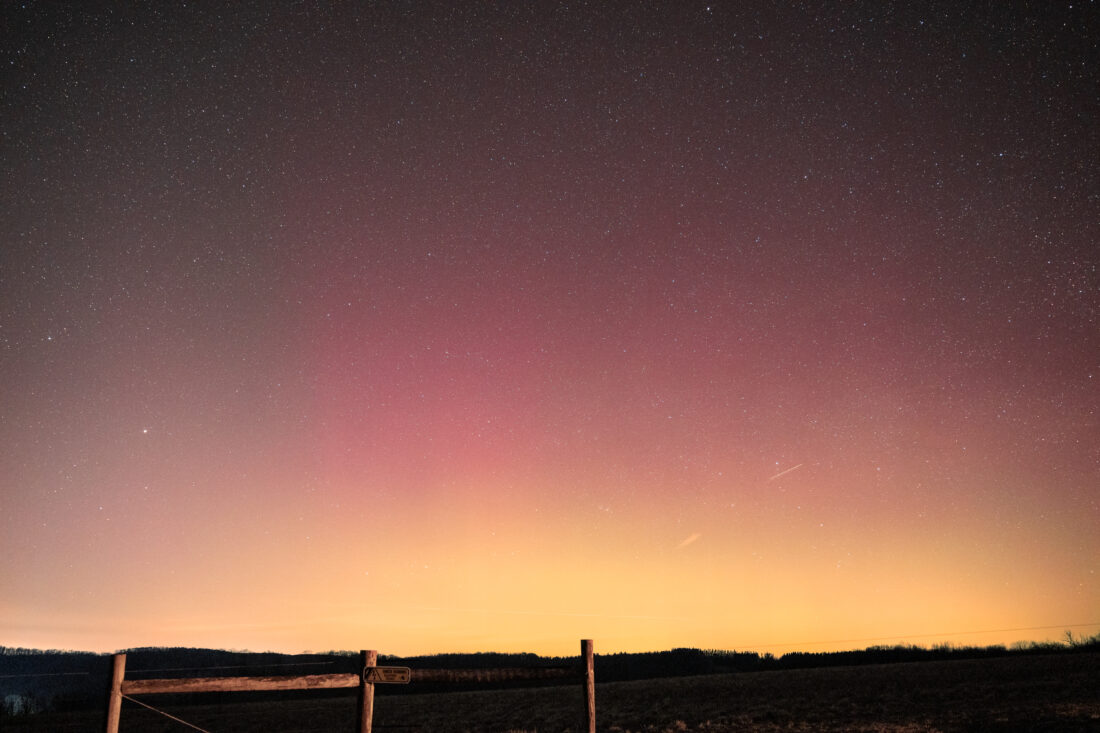
Photo courtesy of Dave Wilkins The aurora borealis — northern lights — were visible Monday morning in Warren County. This image shows reds and yellows visible from Fox Hill Road.
Negatively-charged solar wind ripped through Earth’s magnetic field Monday morning.
Nothing dangerous — in fact, the conditions were right for some northern lights in Warren County.
The phenomenon was captured by local photographer and astro-photographer David Wilkins, who staked out a spot on Fox Hill Road for a photo.
Monday’s solar wind carried a strong negative charge and flew through at about 800 kilometers per second or nearly 2 million miles per hour, according to SWPC Physicist Terry Onsager. That’s about twice as fast as normal.
The solar wind is magnetized from its interaction with the sun’s magnetic field.
Like magnets, the earth’s magnetic field can either attract or repel the solar wind. That depends on the alignment of the wind’s field.
“When the interaction is right, it connects the sun’s magnetic field to the earth’s and that enables the current to flow,” Onsager said. “The aurora can turn on and off depending on the direction of the sun’s. When the solar wind magnetic field is oriented in the right direction, then these magnetic fields interact… they interconnect… and the magnetic fields act like wires.”
The charge, and the speed, impact the appearance of aurora borealis.
“In this particular event, we had some really strong southward magnetic field… and some very fast solar wind speeds,” Onsager said.
The earth’s atmosphere acted as a resistor in that electrical model. Atoms absorbed the energy of the solar wind.
The solar wind “excites the atoms,” Onsager said. “They release light. How bright the aurora is depends on how strong that current is.”
The color of the light depends on the types of atoms.
The aurora may be the one impact of solar wind that humans can pick up with their own senses. But, the phenomenon can have impacts on things like satellites, GPS accuracy, and the power grid, according to Onsager.
The SWPC’s website — spaceweather.gov — has information available to anyone interested in the aurorae.
Observations of the sun’s surface can give a couple days of notice about an event.
A satellite “upstream” from earth relays information about the solar wind – its direction and strength, Onsager said. It “predicts how strong and where the aurora will be.” That satellite gives more detailed information, but only with about 30 to 45 minutes of lead time.
Monday morning, the geomagnetic storm conditions were a G3 on the SWPC’s scale. That’s a “strong” storm.
Strong storms are pretty uncommon. There will probably be less than 200 days of G3 conditions during the 11-year solar cycle.
G3 is the level at which there is a decent chance of seeing aurora in northern Pennsylvania.
For those who would like to try to see aurora borealis with taking a trip to the far north, Onsager recommends tracking the geomagnetic storm conditions.
There are alerts available through spaceweather.gov for those who want to receive as much advance warning as possible.
When conditions are right, the only other thing that is required is a clear night.
“It needs to be dark out,” he said. “There can’t be clouds in the sky.”
The darker the better — there’s no need for sunlight. In fact, “sunlight gets in the way,” he said.
Local News
Man jailed after exposing himself outside church
A Warren man faces charges after standing naked outside a Pennsylvania Avenue church on Monday. Justin L. ...
U.S. Brig Niagara sets sail for Erie from Maine
ERIE — The Pennsylvania Historical and Museum Commission (PHMC) has announced that the U.S. Brig Niagara is ...

Superintendent: levels of child abuse, neglect are a concern

Thrifting for a cause
Post announces annual essay winners
Lt. Gov. Davis says administration will ‘halt’ ICE facility plans
During a speech at an annual gathering of progressives last week in Philadelphia, Lt. Gov. Austin Davis assured ...