County eighth graders get up close civics lesson
-
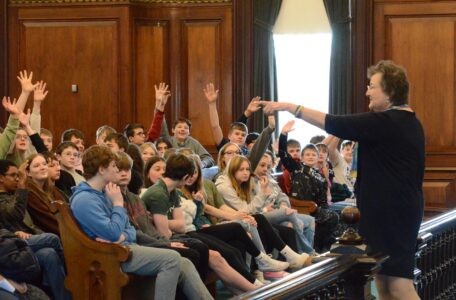
- Times Observer photos by Josh Cotton Beaty-Warren Middle School eighth graders try to get selected for roles as justices and attorneys during an on-site civics lesson Wednesday at the Warren County Courthouse. Eighth graders from throughout the district participated in the event.
-
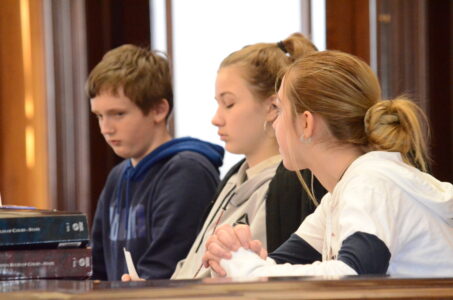
- A three judge panel makes a ruling during a mock trial as part of Wednesday’s civics lesson with Judge Skerda.
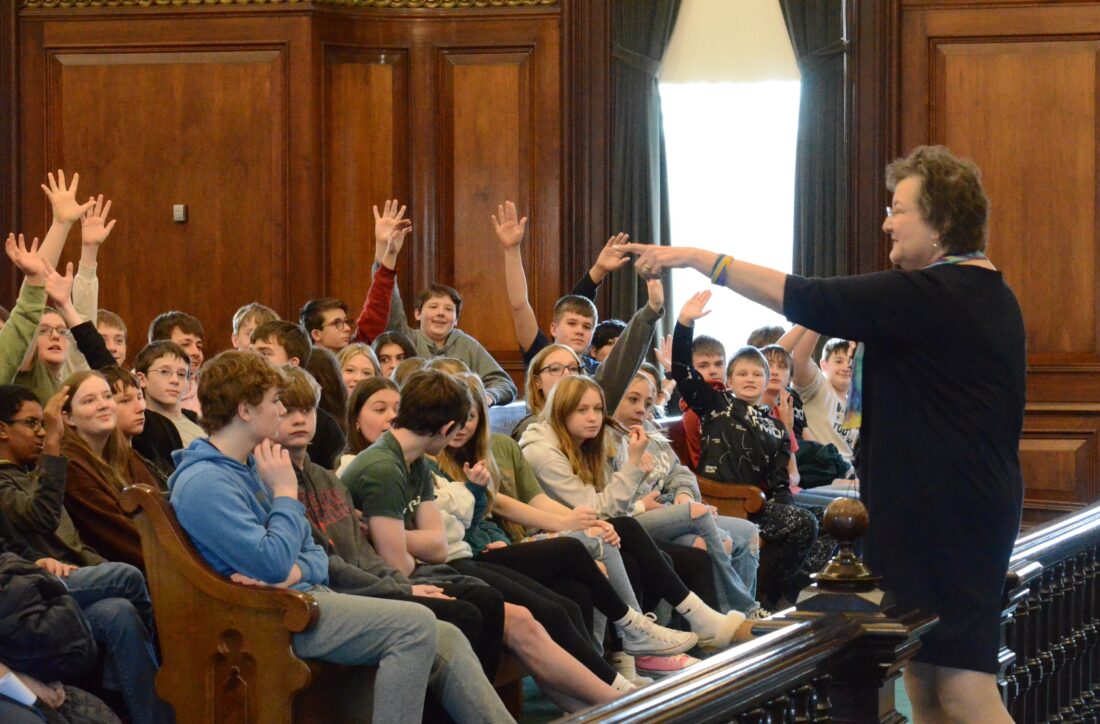
Times Observer photos by Josh Cotton Beaty-Warren Middle School eighth graders try to get selected for roles as justices and attorneys during an on-site civics lesson Wednesday at the Warren County Courthouse. Eighth graders from throughout the district participated in the event.
An eighth grade civics textbook might not really be anyone’s definition of a good time.
The same material might ring a little different coming from an actual judge in an actual courtroom.
Eighth grade students had that possibility on Wednesday.
President Judge Maureen Skerda led a discussion on how the legal system works through the lens of a Supreme Court case — West Virginia Board of Education vs. Barnette.
That case overturned precedent that was used to rule that the Barnette children, Jehovah’s Witnesses, were required to stand and recite the Pledge of Allegiance at school.
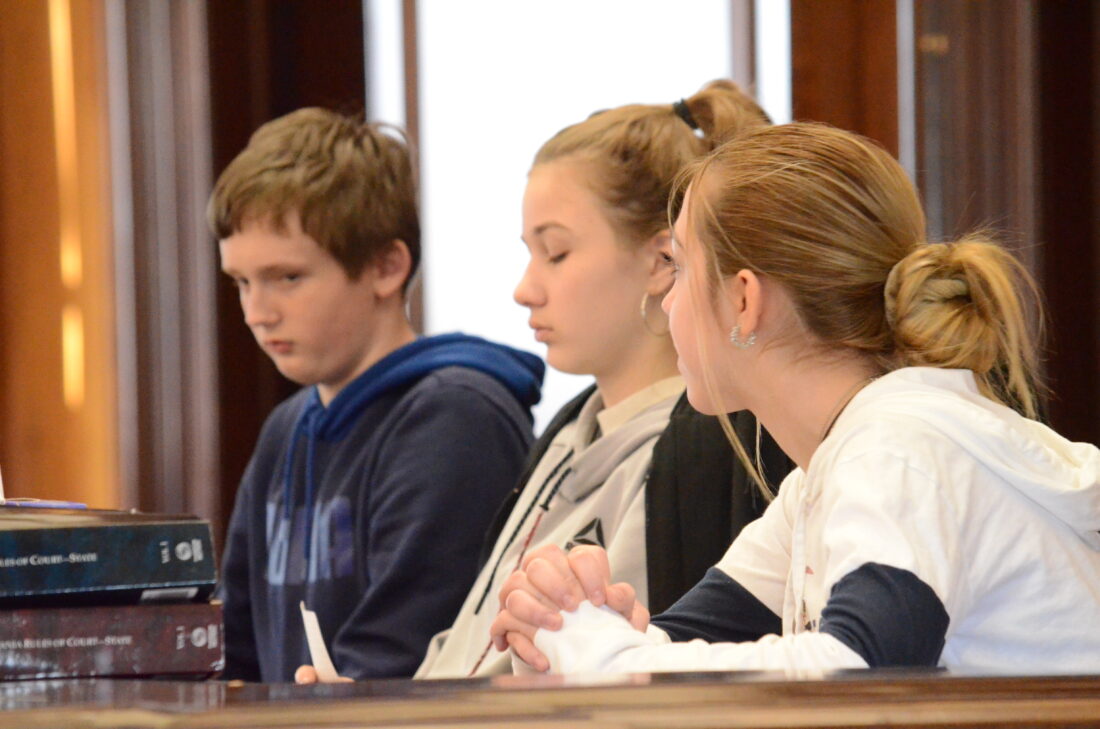
A three judge panel makes a ruling during a mock trial as part of Wednesday’s civics lesson with Judge Skerda.
Skerda made a very notable connection with this case — Justice Robert H. Jackson, born in Spring Creek and raised in Jamestown, wrote the majority opinion in that landmark decision.
Sheriff Brian Zeybel started the session by walking the students through each of the amendments in the Bill of Rights.
“You do have freedom of speech with responsibility,” he said. “Freedom is freedom with responsibility.”
Several of those rights were at the heart of the Barnette case.
Skerda walked the students through how a case like that in Pennsylvania would have started at the local level, winding its way through the state court system to the state Commonwealth and Supreme courts before appeal to the Supreme Court of the United States.
That included a broader look at the appeal process but also explanations of who people are in a courtroom and what roles people have.
Opening the session up for questions, Skerda was inevitably asked to point out the bullet holes in the main courtroom from the Judge Wade killing.
Other questions ranged from the practical — how legal paperwork is kept organized — to why and how Skerda became a judge and the hardest parts of the role.
Skerda said she pursued law in part in response to immigration-related experiences she had in her hometown.
“I like advocating for people,” she said.
To become a judge, she had to be elected. “The election process is sort of political,” she acknowledged. “Once you become a judge you become blind to that.”
What’s hardest?
“Family law is by far the hardest,” she said.
Other questions were clearly impacted by the popular perception of judges.
Does she know Judge Judy? What about the robe? The gavel?
She doesn’t know Judge Judy and she acknowledged the job is the one place where a person can wear a robe all day and no one will ask questions. As for the gavel? Yes, she has one, but the “gavel is more of a formality.”
Local News
Forest Service monitoring Rainbow Family gathering
Observers hope election will turn up heat on budget process
Pennsylvania counties last year lost millions of dollars and domestic violence programs in the state laid off ...
‘Gas station heroin’ ban passes House
Council approves liquor license transfer for restaurant
The City Council has unanimously approved a resolution supporting the transfer of a liquor license for a new ...
Learning opportunity