First Webb images wow local optical engineer
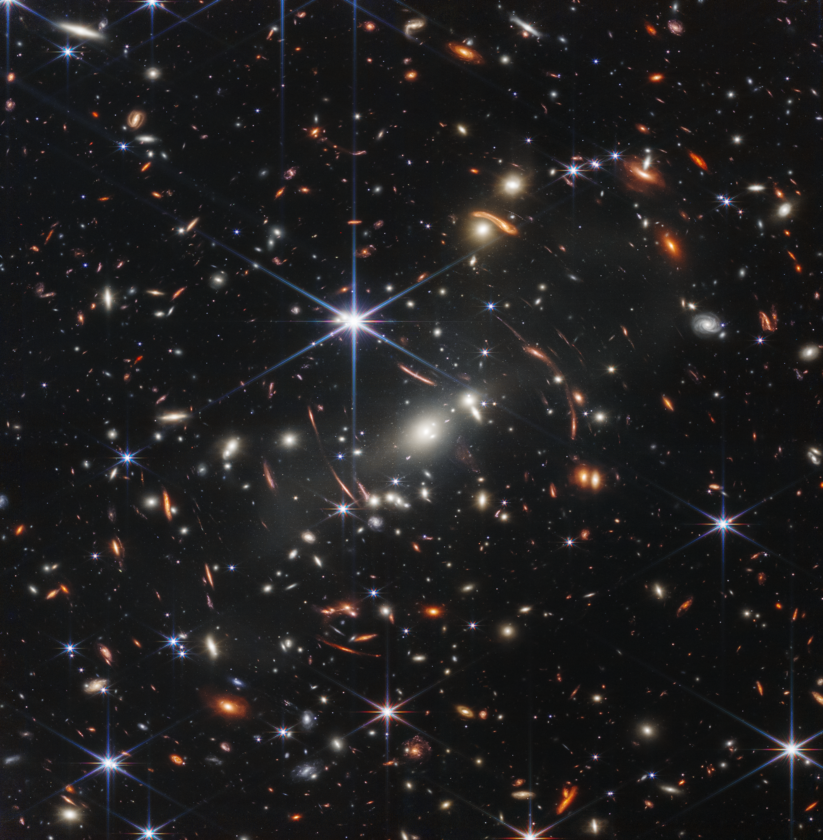
NASA, ESA, CSA, and STScI photo This is the first deep field image from the James Webb Space Telescope. It’s an image of a portion of the sky the size of a grain of sand held at arm’s length.
Since the James Webb Space Telescope launched on Christmas, the first batch of pictures from the $10 billion telescope sitting one million miles from earth has been highly anticipated.
NASA released the images in a stream last week.
The images gave humanity clear looks at elements of the university that have never before been seen.
And, aesthetically, the images are just beautiful and captivating.
They mark a milestone in a decades-long program.
Warren’s John Mangus, now a retired senior spaceflight optical engineer with six decades experience at NASA and then as a consultant, has been involved in what we now know as Webb since Webb was an idea.
His reaction to the first images?
“I was amazed,” he said. “Some of the MIRI (Mid-Infared Instrument) images, in particular… a black hole popped out. It’s a whole series of images at different wavelengths.”
And the light that makes up those images — outside of the visible range — comes from hundreds of light years away.
The images are a key first step, evidence that the instruments are working as they were designed, that the telescope can thrive a million miles from home.
But this, scientifically, is just the tip of the iceberg.
And that’s what has Mangus’ attention moving forward.
“One of the goals of Webb is to try to detect the first stars that formed and how they formed,” he explained, calling it the “Genesis image.”
For Mangus, his interest goes back to studies of the cosmic background radiation, key evidence in Big Bang theory, in his time at Goddard Space Flight Center. That background radiation is basically left over from the Big Bang.
“Webb is built to look back into that period of time,” he explained.
And that’s what he’s hoping Webb will reveal.
“I would like to really see the series of pictures where we can see the first star light,” he said. “I really am waiting for that.”
But he acknowledged one really obvious challenge — wading through a universe full of objects.
The first image was unveiled by President Joe Biden. It covers, according to NASA, a patch of sky approximately the size of a grain of sand held at arm’s length by someone standing on the ground.
That’s a tiny sliver of the sky. And it’s filled with thousands of galaxies and other objects.
“In you look at all the objects you have to sort through, how in the world are you going to find these oldest, oldest, oldest stars out of the various objects you see,” Mangus asked, “in that teeny, teeny portion of the sky?”
He explained that cosmological theories would allow astronomers to narrow the search somewhat by identifying elements likely to appear in those earliest images, hydrogen, lithium, rather than carbon and nitrogen.
“That’s what I am sitting around and waiting to see what happens,” he said. “The images are absolutely phenomenal.”
There’s nothing like the universe to remind us just how small we are.
“Outer space is big,” Mangus said. “(The) universe is just so huge.”
Local News
Chief Cornplanter Council holds volunteer recognition dinner
Documents reveal depths of Tidioute water crisis
More than two months after a boil water advisory was first issued for customers of the Southwest Warren County ...

‘Empowering’ example
State invests $21M to support victims of crime, prevent youth violence and delinquency
This week, members of the Pennsylvania Commission on Crime and Delinquency (PCCD) approved more than $21 million in ...
Domestic incident led to felony gun charges
A domestic incident in February led Warren police officers to get the federal Bureau of Alcohol, Tobacco and ...