
City pharmacy owner testifies to House committee
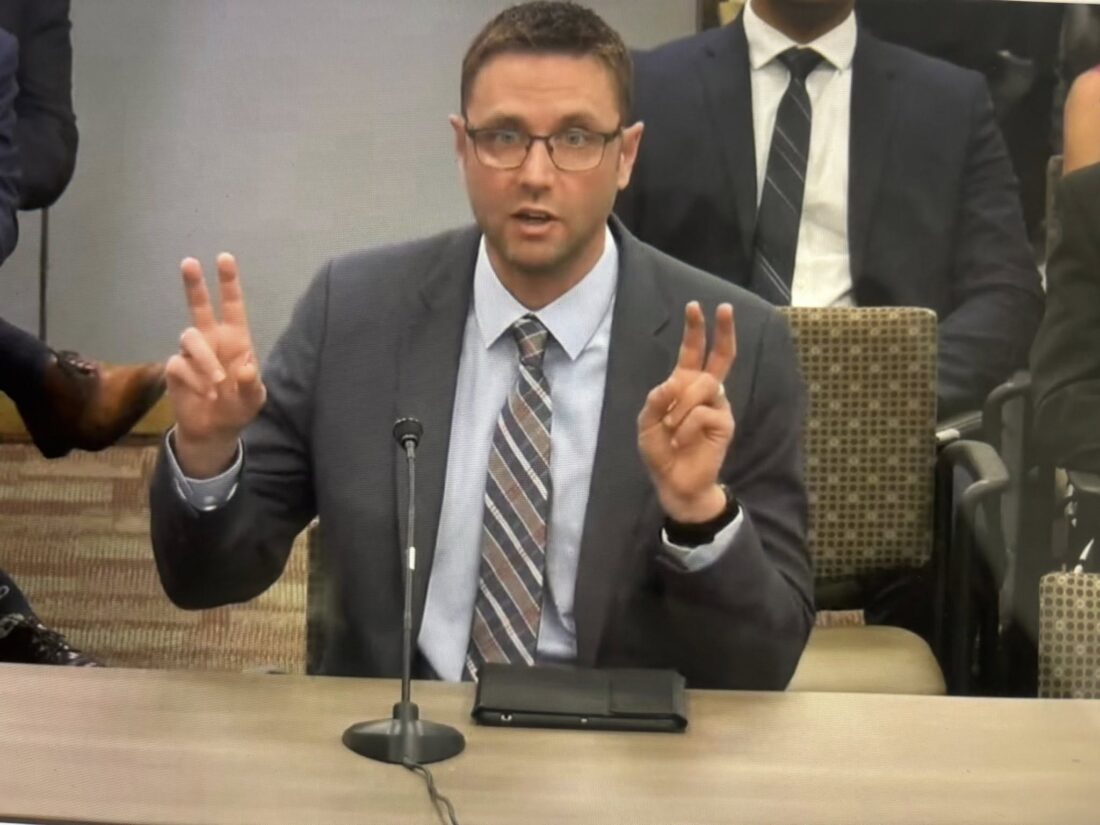
Scott Newton, owner of Gaughn’s Drug Store in Warren, is pictured during testimony earlier this week before the State House of Representatives Health Committee regarding proposed pharmacy benefit manager reform.
Scott Newton, owner of Gaughn’s Drug Store in Warren, is pictured during testimony earlier this week before the State House of Representatives Health Committee regarding proposed pharmacy benefit manager reform.
Trending
Scott Newton, owner and pharmacist of Gaughn's Drug Store, thought he was protecting pharmacy access for his customers when he sold his Port Allegany location to Rite Aid.
That pharmacy, Darling said, had served the local community since 1937. The location was busy – but was not making money.
"We closed because volume no longer translated into sustainability," Newton said during testimony to the state House of Representatives Health Committee this week. "We felt that by selling the pharmacy to Rite Aid, a large corporate chain, that we would at least ensure the continuation of care for our patients. However, Rite Aid eventually closed their location as well, along with other nearby pharmacies. Today, many patients in that region no longer have a pharmacy within reasonable proximity. For elderly patients, patients without transportation, or those managing chronic conditions, that is not merely inconvenient -- it is life-threatening. In a similar scenario, in Warren County, with the recent pharmacy closures, roughly 50% of the population lives in a pharmacy desert according to data compiled by the University of Pittsburgh. That reality should concern every member of this committee."
Committee members heard testimony as it considers House Bill 2270, sponsored by Rep. Rob Matzie, D-Ambridge, that would create a single Pharmacy Benefit Administrator model for all of Pennsylvania’s state-funded healthcare programs. Matzie was involved in the passage of Act 77 of 2024, which brought greater oversight and transparency to the practices of PBMs - third-party administrators that decide which drugs consumers can receive, at what price, and how much dispensing pharmacies are reimbursed - but said more action is needed as Pennsylvania's small mom-and-pop pharmacies continue to fail as a result of PBM practices that favor large chains. Matzie introduced the legislation, which will next move to a committee vote, with state Rep. Katie Kunk, R-York.
"Beyond the dollars and cents, we all know that some PBMs - for a variety of reasons - pick winners and losers. And the losers, so to speak, have been not only our community pharmacies but some chain pharmacies, as is apparent from the closure of Rite Aid," said Matzie, who is chairman of the House Majority Caucus and co-chair of the Pennsylvania Community Pharmacy Caucus. "Act 77 brought greater accountability and transparency to the practices of these middlemen, but regulating the patchwork network of these administrators remains difficult.
"By directing the Department of Human Services to select one single administrator to manage prescription drug benefits statewide, our bill would bring these practices under one umbrella, allowing for more effective regulation and bringing consistency, fairness, and transparency to pharmacy reimbursements."
Matzie said that after adopting a similar model, West Virginia and Ohio saved $54 million in one year and $140 million over two years, respectively, while California, Kentucky, New York, North Dakota, and Utah have seen combined savings totaling more than $1 billion.
Sally Kozak, who also testified before the House Health Committee this week, said those savings aren't likely to materialize if Pennsylvania moves to a single PBM model. Kozak, the state deputy secretary of the Office of Medical Assistance Programs, told lawmakers that Pennsylvania has already made the specific changes that produced savings in other states. She said moving to a single PBA would add cost, time, and risk in Pennsylvania without delivering the savings seen in other states, while a single Medicaid-only pharmacy benefits administrator would reach a small share of the prescriptions filled and wouldn't solve the pressures facing both large and small pharmacies in Pennsylvania.
One aspect of Matzie’s bill is a change to pharmacy payment rates, including directed payments using fee-for-service program pricing to all pharmacies. Kozak said that part of the legislation would eat up any administrative savings from switching to a single pharmacy benefits manager.
“This directed payment, if even approved by the Centers for Medicare & Medicaid Services (CMS), is projected to result in a possible increase in MA costs of $200 million in total funds,” Kozak said. “In addition, the required cost of a dispensing survey every three years would increase MA program costs on an on-going basis. This projected increase is driven by the bill's requirement to pay all pharmacies fee-for-service rates and dispensing fees, not by the single PBA structure itself. Mercer's analysis found the cost savings reported in other states do not translate to Pennsylvania, as program efficiencies recognized by a single PBA have already been implemented in our program over the past several years.”
Newton, meanwhile, said there are four reasons for him to support Matzie's bill. The legislation would create greater transparency and accountability within the PBM system, reducing hidden fees, retroactive clawbacks, and opaque reimbursement practices that make it nearly impossible for pharmacies to plan and operate responsibly. The use of NADAC pricing benchmarks would more accurately reflect the true acquisition cost of medications than outdated benchmarks that Newton said have been manipulated by PBMs for their own financial gains at the expense of all others. Newton said ensuring a fair and realistic dispensing fee would properly recognize the operational, cognitive, clinical, and patient-care services pharmacists provide every single day and cover all of the necessary costs to operate a community pharmacy sustainably. A more transparent and sustainable reimbursement structure would help preserve access to local pharmacy care, particularly in rural communities like Warren County, Newton said.
"This legislation is not about making independent pharmacy owners wealthy. It is about allowing community pharmacies the opportunity to survive while continuing to provide accessible, high-quality healthcare to the patients who depend on us," Newton said. "I stand before you today not only as a pharmacy owner, but as an advocate for my patients, my staff, my profession, and my community. While I do not claim to be an expert in every technical aspect of PBM operations or legislative policy, I am an expert in what it takes to care for patients and operate a community pharmacy. I have seen firsthand the consequences of the current reimbursement system on small businesses, healthcare access, and patient care in rural Pennsylvania."
Pharmacy benefit managers are the "middlemen" of the pharmaceutical supply chain. They typically negotiate the price of prescription drugs between health insurance companies and drug manufacturers, set compensation formulas for pharmacy payments, and may contribute to how formularies are structured within health benefit plans, which in turn affects drug coverage and shapes what patients pay at the counter. A state analysis released earlier this year collected and analyzed data on prescription drug utilization, pharmacy reimbursement, dispensing fees, and costs borne by health plans and members in the fully insured market for calendar years 2022 through 2024. The fully insured market accounts for 24% of the overall healthcare market.
The analysis is based on data from five PBMs (Caremark, Express Scripts, Navitus, OptumRx, and Prime Therapeutics) which together represent all of the fully insured individual and small group insurance markets and 84% of the total fully insured large group commercial insurance market in Pennsylvania. The study found that simply requiring reimbursement based on National Average Drug Acquisition Cost pricing plus a $10.49 dispensing fee would likely redistribute payments rather than significantly increase total spending, and this change would benefit non-affiliated retail pharmacies and independent (non-chain) retail pharmacies the most, increasing their revenue. Adopting NADAC plus a $10.49 dispensing fee solely for independent retail pharmacies would result in an additional $14 million in annual revenue for independent retail pharmacies, which is .3% of the total prescription drug costs in the fully-insured market in the commonwealth.
"Health and human services programs account for approximately 40% of our budget," said Rep. Kathy Rapp, R-Warren and minority party chair of the House Health Committee. "The General Assembly needs to look at ways to try to balance the needs of medical assistance recipients while also providing the entities that administer the progs with the tools they need to effectively provide benefits to these recipients. The idea of a single pharmacy benefits administrator has been discussed for several years. I look forward to hearing from all the testifiers as we continue to debate this issue."