Raging Spring
Spike in county wildfires caused by burning debris
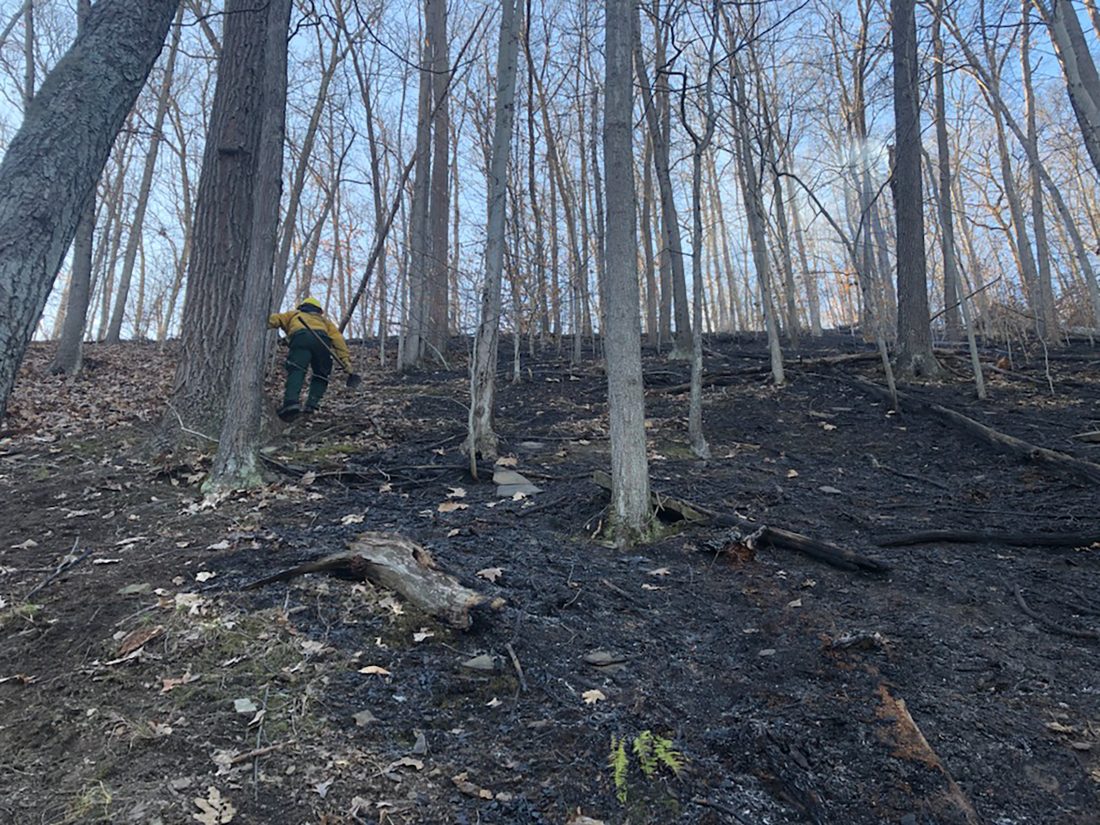
Photo courtesy of state Bureau of Forestry This spring has brought an uncharacteristically high number of wildfires in Warren County, such as this fire which occurred on March 14 on state gamelands near Tidioute.
A typical spring through March 24 would see two wildfires in Warren County burning, on average, 2.4 acres.
Data for 2021 through the same date shows 13 wildfires in the county burning 18.7 acres.
Unlike last year, county officials aren’t considering a burn ban at this stage but that doesn’t mean that the option is off the table.
The bottom line? People need to be careful — and responsible.
“We have experienced an earlier-than-usual and much more active spring fire season this year, in comparison to prior years,” said Cecile Stelter, district forester with the state Bureau of Forestry.
She explained that the Bureau of Forestry maintains wildfire data as far back as 1913 but not at the county level.
“Our local records don’t date back quite that far, but Warren County’s 10-year average of the number of fires occurring through March 24th is 2.0 fires burning an average of 2.4 acres,” she said. “In comparison, thus far in 2021, there have been 13 wildfires that have burned a total of 18.7 acres in Warren County.”
Stelter said, state-wide, 60 percent of 342 reported wildfires were attributed to debris burning — paper, trees, brush, leaves, grass, etc.
That rate is higher for the wildfires in the cunty.
“Our records indicate that debris burning has been the cause of 70% of the wildfires in Warren County this spring,” she said.
Unsurprisingly, people and the weather are causing the increase.
“In the spring, we often see strong, erratic and gusty winds — which is what occurred two weekends ago — and these winds not only carry embers to receptive fuels, like dry grasses and goldenrod fields, but they also can push a fire and cause it to grow in size very rapidly,” Stelter explained. “Last weekend, we also experienced very low relative humidity over several days. This allowed the fine fuels to dry out and catch on fire very easily and burn very quickly.
“We also have little to no snow cover, especially on the south facing slopes. These ‘weather factors’ are combined with the ‘human factors’ … that people are looking for opportunities to be outside — after being cooped-up due to the pandemic and the winter season. (T)hey want to enjoy the warm weather and clean up their yards. All of these factors contribute to an increase in fire activity.”
Last year, citing the COVID-19 pandemic and the downfall to bringing personnel together to respond to these incidents, the county commissioners issued a burning ban under the authority of the county’s pandemic disaster declaration.
County Commissioner Ben Kafferlin said the commissioners aren’t planning on instituting a ban again and Stelter said she does “not anticipate approaching” the county’s fire chiefs and county commissioners to recommend such a ban.
She explained that could change, though, “if weather and/or fire conditions persisted over a timeframe that the volunteer resources would be taxed beyond their capacity to safely respond to incidents.”
Should such a recommendation be made to the commissioners, Stelter would approach the county’s fire chiefs and at least 10 — or 50 percent — would need to concur with the recommendation. The decision would then fall to the county commissioners.
It’s no secret that the fire services have seen a continued decline in personnel, leaving fewer and fewer firefighters to combat these situations.
“Spring wildfire season adds yet another item to the list of emergencies that volunteers and departments already respond to year round and so it definitely adds stress, to an already stretched system,” Stelter said. As the volunteer numbers have decreased and fewer individuals are available to respond, it takes more departments to respond to each incident.”
While the system is stretched, she said there haven’t been any situations where there hasn’t been enough to respond “even when there are concurrent fires or incidents.
“But this reinforces the importance of our volunteers and the essential role that they play in our communities. It also highlights the need to address the trend of decreasing membership in our volunteer fire departments and emergency response entities.”
Local News

Bicyclist taken to hospital after mishap
Commissioners agenda includes 911 recognition
The Warren County Commissioners will meet at noon Wednesday in the Jackson Courtroom of the Warren County ...
Temporary signal installed on Scandia Road
The Pennsylvania Department of Transportation (PennDOT) is advising drivers to be alert for temporary traffic ...

Team efforts

Warren, McKean county businesses eligible for facade work