
Cherry Grove is the name, but oil was their game
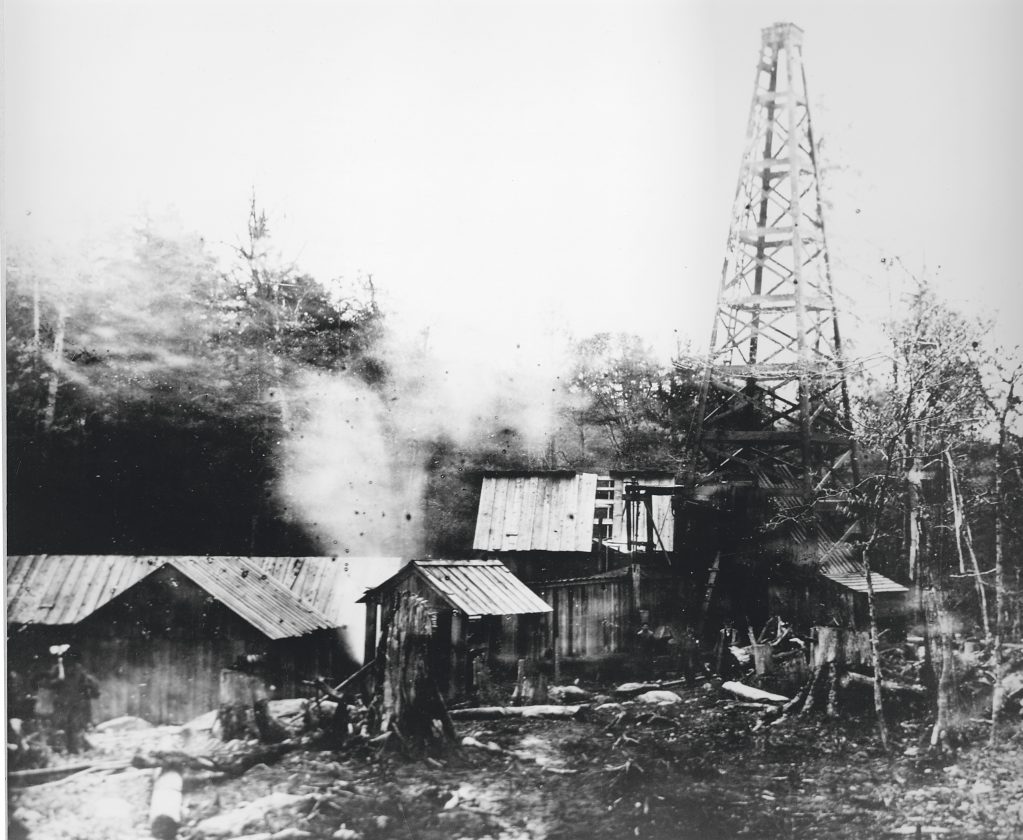
Photo submitted to Times Observer William T. Falconer and Frederock Morck owned leases in the township and sub-leased to George Dimick and Captain Peter Grace who operated as the Jamestown Oil Company.Early in January 1882, this firm started to drill a ‘wildcat’ well on map tract 646, miles from other productive territory.
It’s impossible to tell the story of Cherry Grove Township without talking about oil.
The name is easy enough – it stems from the abundance of cherry trees in the area and was established by order of the court on December 7, 1847.
But oil is what put Cherry Grove on the map ever so briefly.
Ernest Miller, a renowned local historian in the 1960s, tells the story.
Men by the name of William T. Falconer and Frederock Morck (Morck Park, maybe?) owned leases in the township and sub-leased to George Dimick and Captain Peter Grace who operated as the Jamestown Oil Company.
“Early in January 1882, this firm started to drill a ‘wildcat’ well on map tract 646, miles from other productive territory,” Miller wrote. “In March, watching oil scouts found the new well tightly boarded up and armed guards protecting it.”
“On March 29 the well made a large flow of oil but as sufficient tankage was not available, the well was plugged; finally, on May 17 the plug was removed and the drill went a bit deeper. The well commenced flowing wildly and by June 13 a conservative estimate placed its daily production at over 2,000 barrels.
According to the American Oil & Gas Historical Society, knowledge of the well’s production caused oil prices to take a steep dive.
“The well’s true – and at that time massive – oil production had been a closely guarded secret in a small, Warren County township. As the well’s owners quietly secured nearby leases, word finally spread about a secret May 17, 1882, discovery well that flowed with 1,000 barrels of oil per day.”
“The Buffalo Express proclaimed it as ‘The largest well on earth.'”
As market forces work, oil prices dropped as supply increased and “as oil men rushed to the region through Sheffield and North Clarendon,” Miller wrote. “Over six hundred wells were drilled in the Cherry Grove area and five different pipeline companies rushed into the field to handle the output. By September 1, 40,000 barrels of crude oil were moving from the field daily and this was its largest production.”
The AOGHS cited a sources that notes over 4,500,000 barrels of oil were sold in one day on exchanges in Titusville, Oil City and Bradford. That source said that “the Cherry Grove discovery demoralized the market and drove the price down to less than 50 cents per barrel. It brought an early financial crisis for the young U.S. petroleum industry.”
A pipeline battle between two companies – the Tidewater Pipe Line Company and United Pipe Lines (a subsidiary of Standard Oil) – through United Pipe Lines won out “and did the greatest business.”
That brings another place name into view – Vandergrift – that sprang up in Cherry Grove Township during the oil boom.
United Pipe Lines “installed huge boilers and pumps,” Miller wrote, “and created the largest crude oil pumping station in the world.”
Vandergrift, and Vandergrift Corners, was located at a crossroads at the exact center of the township.
It was named in honor of Captain Jacob Jay Vandergrift, a river steam boat captain.
John D. Rockefeller in 1874 purchased a 1/3rd stake in Vandergrift’s oil company
“During the great oil excitement in Cherry Grove township in 1882, the Standard erected eight huge boilers and three pumps in the Cherry Grove field, and one of these pumps was a Worthington-Duplex and at the time was the largest in the world. This pipe line station was called Vandergrift.”
Plank roads carried hundreds of teams of horses to the wells at their peak – a single team cost $.20 while a double team cost $.30.
“So many oil-seekers jammed about the “646” and in the surrounding forests that crowded quarters were the rule, not the exception,” Miller wrote.
At first tents served nobly, and later Farnsworth’s barn was packed with exhausted men, eager to have body space and an old blanket at 50 cents nightly. As the population increased, rough board shanties made their appearance and a town was born on the southeastern corner of tract 646.”
That brings us to two additional place names – Garfield and Farnsworth.
“Of them all, Garfield was the largest with a population in excess of 6,000 at the zenith of the excitement, and it was a well-behaved town frequented by the largest producers. Farnsworth had the doubtful reputation of being the favorite spot for toughs and disreputables as they gradually entered the area.”
By October, the wells were only yielding moderate amounts and water from many abandoned wells was “seeping through the field wrecking other wells,” Miller wrote.
“Real estate value collapsed, equipment was taken down and moved into Forest county where the Cooper Tract was the new oil excitement and gradually the area decreased in activity and production. By the end of 1883, the great 646 well was giving only 5/8ths of a barrel daily.”
The land has largely reclaimed evidence of several large towns and less than 250 people reside in the township today.
Local News
Tidioute News
The Tidioute Public Library will be having a Dinosaur Stuffies program for kids on July 27 and July 29. Kids ...
31 animals seized in Youngsville neglect case
Two Youngsville residents have been charged after 31 animals were seized from their home in late June. Christine ...
County Democrats to host candidate forum, picnic Saturday
Warren County Democratic Committee to host midterm candidate forum and summer picnic Residents will have an ...
RDA counters Marketplace proposal, negotiations continue
On the job
Investigation into shooting in UPMC Chautauqua emergency room parking lot is closed
The investigation into a shooting near UPMC Chautauqua on Wednesday afternoon revealed two people each died as the ...