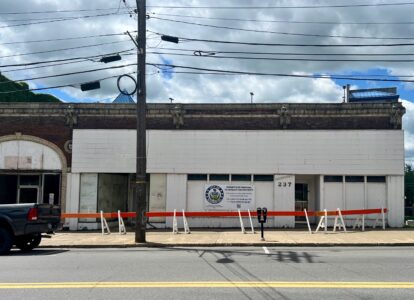
Research finds roundabouts cause less injuries, fatalities
We suspect just about everyone in Warren has an opinion about a potential roundabout at the intersection of Pennsylvania Ave. and Market St.
What does the research say?
In part, it depends on where you look.
But serious injury or fatal crashes do appear to occur less in roundabouts than signaled intersections, overall.
The Federal Highway Administration has concluded that signaled intersections converted to roundabouts – such as the downtown intersection in question – have yielded a 48 percent reduction in all crashes…”
And the FHWA also deduced that “roundabouts reduce the types of crashes where people are seriously hurt or killed by 78-82 percent when compared to conventional stop-controlled and signalized instructions… By reducing the number and severity of conflict points, and because of lower speeds of vehicles moving through the intersection, roundabouts are a significantly safer type of intersection.”
The FHWA also highlighted studies undertaken in by the states of Maryland and Minnesota that also show decreased crashes.
But the issue isn’t as one-sided as the FHWA may present.
According to a study conducted in Wisconsin, roundabouts did reduce fatal and injury crashes “when converted from other intersection control types.”
“However, the reduction comes at a cost because other crash types, such as single-vehicle collisions, may increase.”
An article from citylab.com also looking at roundabouts in Wisconsin determined a “38 percent drop in car deaths and injuries. At the same time, the total number of crashes jumped 12 percent. These additional accidents caused mainly property damage, and are thought to be a result of confused or unprepared drivers trying to navigate the unfamiliar roadway design.”
The Waterloo Region Record, an Ontario newspaper, conducted its own analysis between 2006 and 2010 of 472 roundabout collisions and 4,056 traffic signal collisions from available government data.
“You are 2.6 times more likely to collide at a roundabout than at a traffic signal,” the Record concluded. “A local roundabout will see 1.56 collisions per million entering vehicles; a traffic signal will see 0.61 collisions per million entering vehicles. This finding confirms that local roundabouts are plagued by fender benders.
The flip side?
From the Record: “You are three times more likely to be injured or killed at a traffic signal than at a roundabout. This is based on injury rates on regional roads. People are hurt or killed in 27.1 percent of collisions at traffic lights. In roundabouts, the injury rate is nine percent.
“This finding confirms it’s much harder to get hurt in a roundabout. No one has been killed in a roundabout but there have been four fatal collisions at comparable traffic signals. The number of injury-causing collisions is roughly the same for roundabouts and traffic signals, at just under one per intersection per year.”
The Insurance Institute for Highway Safety – IIHS – detailed several ways that roundabouts “promote safety.”
“At traditional intersections with stop signs or traffic signals, some of the most common types of crashes are right-angle, left-turn, and head-on collisions. These types of collisions can be severe because vehicles may be traveling through the intersection at high speeds,” the IIHS concluded. “With roundabouts, these types of potentially serious crashes essentially are eliminated because vehicles travel in the same direction and at low speeds — generally less than 20 mph in urban areas and less than 30-35 mph in rural areas.
“Studies of intersections in the United States converted from traffic signals or stop signs to roundabouts have found reductions in injury crashes of 72-80 percent and reductions in all crashes of 35-47 percent. A study of 19 higher-speed rural intersections (speed limits of 40 mph or higher) that originally had stop signs on the minor approaches and were converted to roundabouts found a 62 percent reduction in all crashes and an 85 percent reduction in injury crashes… Based on the results of a 2004 Institute study, it is estimated that the conversion of 10 percent of the signalized intersections in the United States to roundabouts would have prevented approximately 52,000 crashes in 2015, including 229 fatal crashes…”
The IIHS also made several conclusions about the nature of crashes that do occur at roundabouts.
“Despite the demonstrated safety benefits of roundabouts, some crashes still occur. An Institute study of crashes at 38 roundabouts in Maryland found that four crash types (run-off-road, rear-end, sideswipe, and entering-circulating) accounted for almost all crashes,” the IIHS found. “A common crash type at both single-lane and two-lane roundabouts involved vehicles colliding with the central island. These crashes, which often involved unsafe speeds, accounted for almost half of all single-vehicle run-off-road crashes. Collisions occurred more frequently at entrances to roundabouts than within the circulatory roadway or at exits. About three-quarters of the crashes involved property damage only. There were no right-angle or head-on collisions, potentially severe crash types that commonly occur at traditional intersections.
“The researchers concluded that unsafe speeds were an important crash factor. Some drivers may not have seen the roundabout in time to slow down sufficiently.”
The IIHS also concluded that “initial construction cost of a roundabout varies site by site, its maintenance usually is cheaper than for intersections with signals. The service life of a roundabout is significantly longer, approximately 25 years, compared with 10 years for a typical signal.”
Local News
‘Let Freedom Sing’ set for Saturday at Struthers
“Exactly what we needed”
C.A.R Pool opens Monday as summer programs begin
Two super PACs plan to spend $33M on ads in Pennsylvania congressional races
With the primaries now in the rearview mirror for Pennsylvania, the focus has shifted to Nov. 3 general election ...
Local Civil Air Patrol Squadron recruiting
Civil Air Patrol is the official auxiliary of the U.S. Air Force and the Warren County Composite Squadron invites ...