
What faces Andrews while Hodge confession and retraction plays out?
Trending
So I understand that it might be difficult to feel much sympathy for a convicted murderer.
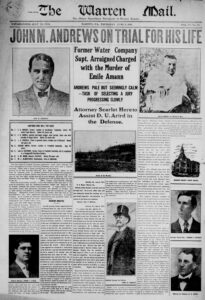
John M. Andrews was convicted in county court for the killing of Emile Amann in Jan. 1911 at the city's water reservoir up Liberty St.
He received the death penalty -- death by hanging -- the following September.
But what is he supposed to think when a woman makes a confession in the killing and then recants that confession weeks later?
Sure, he was still convicted; but doesn't the whole Stella Hodge saga call into question the validity of that verdict?
While it might look like a coincidence, a motion for a new trial was filed in the wake of the Hodge confession.
"Many of the points are based upon alleged errors of the court," the Evening Mirror reported in the July 12 edition. "Several refer to the discovery of new substantiated evidence and, although the confession of Stella Hodge is given as one of the points in support of a new trial, it is not accorded as much consideration as many believed it would."
The paper published all 49 arguments put forth -- I won't repeat that here -- but the most interesting is a claim that a third person was an eyewitness to the shooting.
The Mail -- which also published the whole thing -- said the arguments "occasioned not a whole lot of surprise.
"What the Commonwealth will produce in an effort to sidetrack the granting of this new trial for Andrews will perhaps be awarded more eagerly as a result of constant rumors of a sensational nature."
Given the sensation this case evidently had in Warren, the dueling newspapers couldn't pass up any opportunity to write about the case.
To be clear, Andrews had not been sentenced yet but there's no doubt he knew what the sentence was going to be.
The Mail published an article on July 20 with the headline "ANDREWS IS NOT THE GUILTY MAN" but it wasn't what it sounds.
It was, instead, the view of the Pennsylvania State Police superintendent who sent someone here to investigate in response to a report received that Andrews "had been shadowed day and night, from place to place, in such a manner as to make life unbearable" before he was arrested and subsequently tried.
That edition also included what they described as a "number of spicy letters" regarding business operations with the Warren Water Company which, if you recall, were at the heart of what the papers speculated might be a motive for the killing. They reported in this edition supposed "evidence" of a $4,000 pipe shortage.
They talked to Andrews for a third story in that edition where he told them that, if he goes to the gallows, he will do so with courtage of a man who has a clean and clear conscience.
"Referring to the Hodge woman," the article said, "Andrews says he does not know of her many alleged confessions."
The Evening Mirror jumped into another affidavit Andrews' signed that had to do with coverage of the case. Substantively, we'll get to that later but they offer a look at the man as he dealt with these conflicting emotions.
"Mr. Andrews appears in good health, despite a paleness that would naturally be looked for from one who has spent several weary months in jail," they concluded. "His step was vigorous and he advanced rapidly to the seat that he had occupied throughout his trial and he shook hands with his attorneys and greeted them with smiles.
"Andrews was steady as a clock when he grasped the pen and signed… (the) affidavit that had been prepared for him by his attorneys. Before signing he looked the paper carefully over and as he held it in his hands there was not one sign of quiver and apparently he was one of the most composed and cool persons in the whole court room.
"Mr. Andrews has borne the strain in a wonderful manner and shows little effects of worry."
------
I've made mention of it a couple times but I really don't understand how an impartial jury was seated in this case given all the details, rumors and innuendo that were brandished about in the town's newspapers.
Was it yellow journalism, intentionally designed to be sensational and exaggerated? I don't know.
Do we cover these cases differently today? Absolutely. Are there times when we're writing about a case and the thought of tainting a jury pool creeps into my mind? Yes. That's why we stick to public record filings and open court hearings.
The two local newspapers covering this case did not, by any means, show that type of restraint.
And I'm not the only one that has made those observations.
The Evening Mirror on July 15, 1911, felt the need to respond in what reads much like an editorial to a criticism from a local minister who claimed that "our news and editorial columns partiality has been shown on behalf of John M. Andrews" and said he was going to say it from the pulpit.
Drummond refused to meet with the paper's editors directly.
"Since the murder of Emile Amann," the editorial states, "the Mirror has been first to give the news. As we have said we reiterate that we are not endeavoring to mould public opinion by editorial comment."
That seems like a stretch but they claimed the paper's role is to "publish news as complete as it can obtain it and so give to John M. Andrews the benefit of every scintilla of doubt until he expiates the crime to meet the ends of justice or is liberated without the stain of guilt as the slayer of Emile Amann."
And in yet another example that belies their assertion, the editors state that "John M. Andrews stands convicted entirely upon circumstantial evidence and if there is a possible doubt it belongs to him. That is law."
I've covered cases where I thought that but never would in a million years consider actually publishing a statement to that effect.
The Evening Mirror also covered an argument that July where a defense attorney raised two articles -- one local and one out of a Buffalo paper -- that might be in contempt of court.
"I would be wrong if I did not call attention to these articles because there is no other county in the commonwealth of Pennsylvania and there is no other edition that would dare do it without being called to account for by the court," the attorney argued. "Nowhere in this broad commonwealth of Pennsylvania will such articles as these pass unnoticed as being a direct attempt to besmirch this court."