
Early days of World War II included guards at the Glade Bridge
Trending
"Yesterday, December 7, 1941 – a date which will live in infamy – the United States of America was suddenly and deliberately attacked by naval and air forces of the empire of Japan."
The Warren Times Mirror ran the entirety of that speech in the Dec. 8 edition, which, outside of the radio, would have been the first way that county residents learned of the attack on Pearl Harbor.
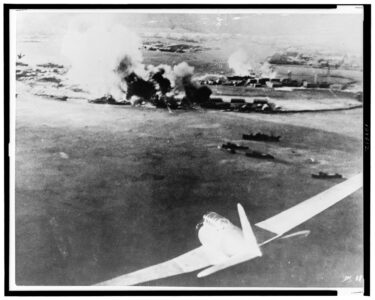
That assault, which undoubtedly changed the nation in a myriad of ways, occurred 81 years ago this week.
The editors with the Times Mirror realized quickly that this was a momentous occasion. The entirety of Roosevelt's speech was published, not normal protocol, and the main headline got to the point: CONGRESS DECLARES WAR ON JAPAN.
"President's Request for Action Granted in Record Time" one headline notes while another claims "Loss of Two Warships and 3,000 Dead and Wounded Admitted in Dawn Attack." (The number of casualties was only slightly inflated. The effect on warships, though, turned out to be nearly 10 times too low.)
"Congress voted a formal declaration of war against Japan today after President Roosevelt requested immediate action as an answer to Japan's "unprovoked and dastardly attack" on Hawaii." (As a brief aside, I can't fathom what the reporter pounding out that lede must have been thinking. The momentous weight of what the report said surely couldn't have been lost.)
The article continues: "A united congress acted swiftly after the president had disclosed that American forces lost two warships and 3,000 dead and wounded in the surprise dawn attack yesterday. As congress was acting, Japan claimed she had won naval supremacy over the United States in the Pacific. The Japanese claimed in reports broadcast by the official radio in Tokyo that they had destroyed four American battleships and one aircraft carrier and had damaged four other battleships and six cruisers."
A story on that front page details the nature of the attack as it was known at the time: Wave after wave of enemy planes streamed over Oahu island for one hour and 15 minutes. Witnesses said they counted at least 50 planes in the initial attack which the army said started at 8:10 a. m. Honolulu time, 10:40 a.m. (Pacific standard time). The attack ended at 9:25 a.m. A censorship was clamped down on outgoing reports soon after the first telephoned reports…. What the toil was so far in American lives, ships and property remained undisclosed under the strict censorship."
By the day after, it was already clear that young men were flocking to military recruiters.
"Japan's declaration of war against the United States brought throngs of boys and men into the navy and army recruiting stations today – all ready to start their military careers within the next 24 hours," a wire report out of Pittsburgh detailed.
"To many of them, it made no difference whether they joined the army or navy. It was joining up that counted."
Not all of the response in the wake of the attack was helpful, though. The lead story on Dec. 9 was how New York City experienced its first air raid alarm. In hindsight we know the Axis didn't have that kind of capacity – and, even if they did, never acted on it – but that didn't matter in the moment.
The alarm was "prompted by unconfirmed reports of hostile planes on the east coast."
There was however, something valid in keeping a wary eye to the west.
"Japanese warplanes reconnoitering over the San Francisco Bay area and reports that other Japanese forces were off the Aleutian Islands, in the narrow Bering Strait between Alaska and Siberia, stirred new alarms today in the three-day old battle of the Pacific," one account explained.
But what about life here locally? Warren County was – and remains – a low-threat target (Kinzua Dam as the possible exception) due to its geographic isolation.
There were, however, visible elements of the stirring conflict thousands of miles away.
For one, members of the state Reserve Corps were sent to Warren to guard… the Glade Bridge.
"Seriousness of the war with Japan was brought home to Warren residents this morning when nine members of Company C, 3rd Regiment, Pennsylvania Reserve Corps, arrived here to go on guard duty at the Glade bridge," the Times Mirror reported. "The squad went on duty at 7:35 a.m. and will remain on 24-hour patrol until further notice. It was learned Corp. Owen Richardson is in charge."
The imagery had to have been jarring for residents.
"Armed with rifles with fixed bayonets, the home guardsmen are located at each end of the bridge," the paper reported. "It was learned today that a similar squad has been assigned to guard the bridge over the Allegheny river at Tionesta. While no special guards have been assigned as yet to other bridges in this immediate vicinity, officers of the state motor police have been instructed to keep them under strict surveillance."
Entities in the infrastructure and manufacturing spaces also took steps to enhance security.
"As a result of the entrance of this country into the war, extra guards have been placed on duty at local defense manufacturing plants and special precautions are being taken by the Pennsylvania Railroad to protect bridges and other property."
The county was, within a couple days of the attack, also asked to raise funds to help the effort as part of a $50 million Red Cross effort.
"In a telegram received here late yesterday, the Warren County Red Cross Chapter was called upon to raise $20,000 as its share of a huge emergency fund being raised throughout the country for the work which is necessary during the war emergency," the paper reported.
"Clare J. Crary, chairman of the Warren County Chapter of the American Red Cross, has called a special meeting of the executive board this afternoon to consider acceptance of the assigned quota in a new nationwide drive to raise funds to carry on the organization's work among the armed forces of our country."
Crary told the Times Mirror he had a telegraph from the head of the Red Cross that allotted "to the local unit its quota in the new drive for $50,000,000, established immediately upon the congressional declaration of war with Japan.
"It is anticipated that the local board will accept the figure assigned as its share of the cast project and the extremely successful enrollment just completed throughout Warren county gives every indication that workers and members will respond in a manner that will assure the success of the undertaking."
What would follow was four years of world war and hundreds of thousands of American fatalities.
But this is how it started.