
Times Mirror tracks status of refugee ship
Warren Times Mirror, June 17, 1939.
“ANTWERP – Refugee German Jews aboard the liner St. Louis, reaching their Antwerp haven today after a fruitless voyage to Cuba, said they had been compelled to form an anti-suicide committee to partrol the decks to prevent despondent passengers from leaping overboard.”
One of the first ways that Jewish persecution in Germany entered the American consciousness was with the St. Louis.
The ship’s itinerary was Hamburg to Havana, Cuba. Nearly all of the 937 passengers were Jewish refugees.
“After the St. Louis arrived in Havana, the passengers learned that the Cuban government had canceled their landing permits,” an article from the United States Holocaust Memorial Museum exlpained (USHMM).
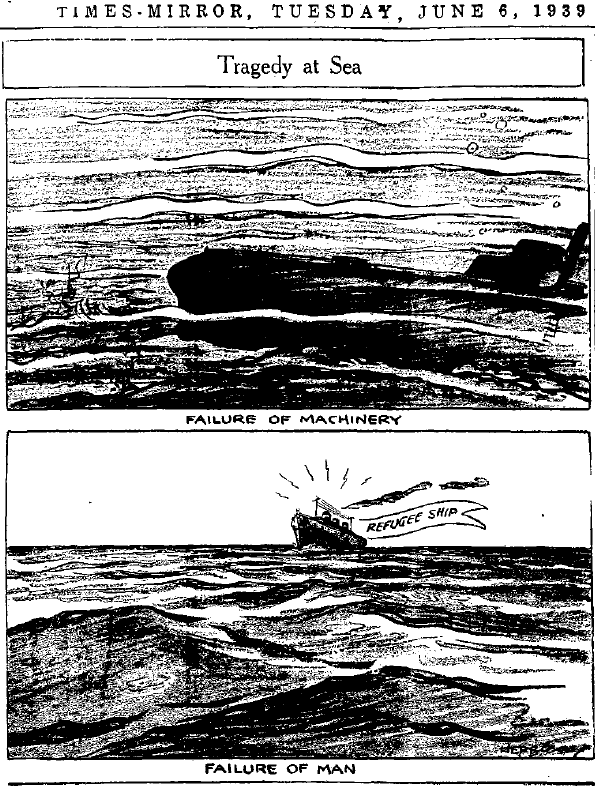
Photo from the Warren Times Mirror A scathing editorial cartoon comparing responses to submarines and the St. Louis, which carried over 900 mostly Jewish refugees, on a heart-wrenching voyage in 1939.
“When the St. Louis arrived in Havana harbor on May 27, the Cuban government admitted 28 passengers: 22 of them were Jewish and had valid US visas; the remaining six–four Spanish citizens and two Cuban nationals–had valid entry documents,” per the USHMM. “One further passenger, after attempting to commit suicide, was evacuated to a hospital in Havana. The remaining 908 passengers… including one non-refugee, a Hungarian Jewish businessman–had been awaiting entry visas and carried only Cuban transit visas issued by Gonzalez. 743 had been waiting to receive US visas.”
There had been substantial protests in Cuba, including one particularly large anti-semitic rally. By the time the refugees arrived, the Cuban government had charged course and refused to admit the refugees.
That’s where I could first find the Times Mirror picking up the story with an article on June 2, 1939 headlined “REFUGEES MAY HAVE TO RETURN.”
There were then two sub-headlines: “Hamburg-Amerika Line Notifies Captain of St. Louis at Havana to Sail Back to Germany With Shipload of Jewish Emigrants if They Can Not Be Landed Promptly, After Protests Had Been Made to Cuban Government” and “COMPANY OFFICIALS REPORTED INDIGNANT.”
“The immigration department today said entry permits had been denied 104 Jewish refugees from Europe who arrived at Vera Cruz yesterday after being refused permission to land in Cuba,” the story started.
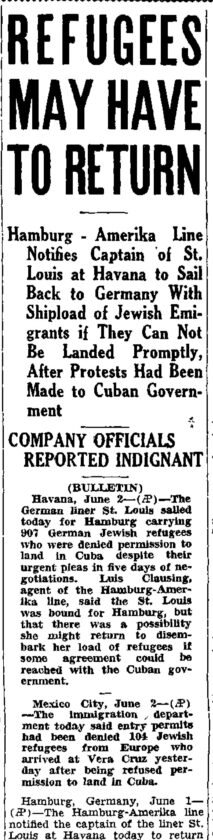
Photos from the Warren Times Mirror Headlines from the front page of the Warren Times Mirror’s coverage of the St. Louis.
“The Hamburg-Amerika line notified the captain of the liner St. Louis at Havana today to return to Germany with his shipload of Jewish emigrants if they could not be landed promptly,” the article continued. “Earlier it had protested to the Cuban government against orders forbidding the landing of the 917 refugees.”
“It was stated at the company’s headquarters that the captain was instructed not to try to land at any other port unless the Jewish passengers themselves managed to get permission to disembark…. Officials of the company were particularly indignant over a decree that the liner St. Louis clear territorial waters today or be towed out by a Cuban gunboat.”
The liner left Cuba on June 2 and that brought the story even closer to the American public.
“Although the ship sailed near the Florida coast, the US government did not allow the passengers to land, since they did not have US immigration visas and had not passed a security screening,” per the USHMM. “The majority of the Jewish passengers had applied for US visas, and had planned to stay in Cuba only until they could enter the United States.”
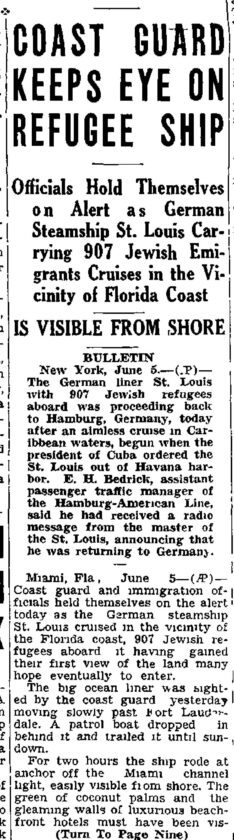
The Times-Mirror reported on June 5 that the Coast Guard spotted the ship as it traveled north and was “VISIBLE FROM SHORE.”
“Coast guard and immigration officials held themselves on the alert today as the German steamship St. Louis cruised in the vicinity of the Florida coast, 907 Jewish refugees aboard at having gained their first view of the land many hope eventually to enter,” the Associated Press story detailed.
“The big ocean liner was sighted by the coast guard yesterday moving slowly past Fort Lauderdale. A patrol boat dropped in behind it and trailed it until sundown.”
The account said that the refugees could see “the gleaming walls of luxurious (beaches and) hotels” but were “denied entry there.”
“Then the St. Louis hoisted its anchor and, barely making headway, moved southeastward last night it was reported about 10 miles at sea off the Florida keys. Early today, however, a large steamer halted off Miami Beach for more than an hour before it cruised slowly northward. Although its lights were visible from shore and watchers speculated the vessel was the refugee ship it could not be identified in the darkness.”
The next day, county residents learned that the ship was “reported by officials of the line today to be enroute back to Hamburg.”
Multiple issues factor into the lack of admission by the United States.
There were issues relative to public opinion.
According to the Smithsonian, President Roosevelt said the following at press conference: “Not all of them are voluntary spies. It is rather a horrible story, but in some of the other countries that refugees out of Germany have gone to, especially Jewish refugees, they found a number of definitely proven spies.”
That article includes an excerpt from a 1944 Treasury Department which struck back at that assertion: “I am convinced on the basis of the information which is available to me that certain officials in our State Department, which is charged with carrying out this policy, have been guilty not only of gross procrastination and wilful failure to act, but even of wilful attempts to prevent action from being taken to rescue Jews from Hitler.”
But it wasn’t just an executive branch problem.
Congressionally-imposed quotas “established in the US Immigration and Nationality Act of 1924 strictly limited the number of immigrants who could be admitted to the United States each year. In 1939, the annual combined German-Austrian immigration quota was 27,370 and was quickly filled,” According to the USHMM.
The Times Mirror then circled back to the story on June 17 when the St. Louis arrived in Antwerp, Belgium with some details that are just chilling.
“ANTWERP – Refugee German Jews aboard the liner St. Louis, reaching their Antwerp haven today after a fruitless voyage to Cuba, said they had been compelled to form an anti-suicide committee to partrol the decks to prevent despondent passengers from leaping overboard.”
The report concluded that one passenger committed suicide on the voyage – “He was a man who slashed his wrists and leaped into the harbor at Havana afer the group was denied a haven there.”
There are elements of the reporting during this period that I’ll include without commentary and this is one of those:
Refugees said that after they were barred from Cuba more than 200 of them formed a mass suicide pact, agreeing to leap overboard rather than return to Germany.
During these darkest days of the 6,000-mile voyage, the anti-suicide committee kept a 24-hour vigil on all decks. The men required a closer watch than the women, the passengers reported. Some of them had just left concentration camps and others vowed equal determination not to return to Germany.
Those in the suicide pact made their agreement by word of mouth among the passengers.
With tears in their eyes, passengers told of their great relief when they finally learned that temporary haven has been found for them. The governments of Great Britain, France, Belgium and The Netherlands agreed only this week, as the liner neared Europe, each to take about one-fourth of the group.
It’s frankly impossible for us living where we do to understand this level of desperation.
According to the USHMM, Great Britain agreed to permit entry to 288 passengers. An additional 224 went to France, 214 to Belgium and the remaining 181 to the Netherlands.
This is one of those instances where awareness of our hindsight matters. When the refugees were entered into those nations they were, in fact, out of Germany. They had good reason to suspect that they had slid out of Hitler’s grasp.
That great relief, though, would prove to be a temporary condition.
The following May, Hitler invaded three of the countries that took in the refugees – France, Belgium and the Netherlands.
The net they thought they had escaped had returned.
287 of the 288 granted entry into Great Britain survived the war, per the USHMM. One was killed during an air raid in 1940.
“Of the 620 passengers who returned to the continent, 87 managed to emigrate before the German invasion of western Europe in May 1940,” according to the USHMM.
The remaining number were caught behind Hitler’s Nazi curtain.
“Just over half, 278 survived the Holocaust. 254 died: 84 who had been in Belgium; 84 who had found refuge in Holland, and 86 who had been admitted to France.”
Per the USHMM: “After Cuba denied entry to the passengers on the St. Louis, the press throughout Europe and the Americas, including the United States, brought the story to millions of readers throughout the world. Though US newspapers generally portrayed the plight of the passengers with great sympathy, only a few journalists and editors suggested that the refugees be admitted into the United States.”
-
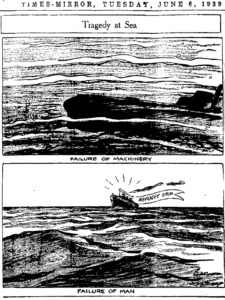
- Photo from the Warren Times Mirror A scathing editorial cartoon comparing responses to submarines and the St. Louis, which carried over 900 mostly Jewish refugees, on a heart-wrenching voyage in 1939.
-
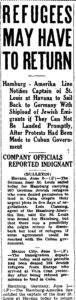
- Photos from the Warren Times Mirror Headlines from the front page of the Warren Times Mirror’s coverage of the St. Louis.