
Reunited: Two county veterans meet at Historical Society
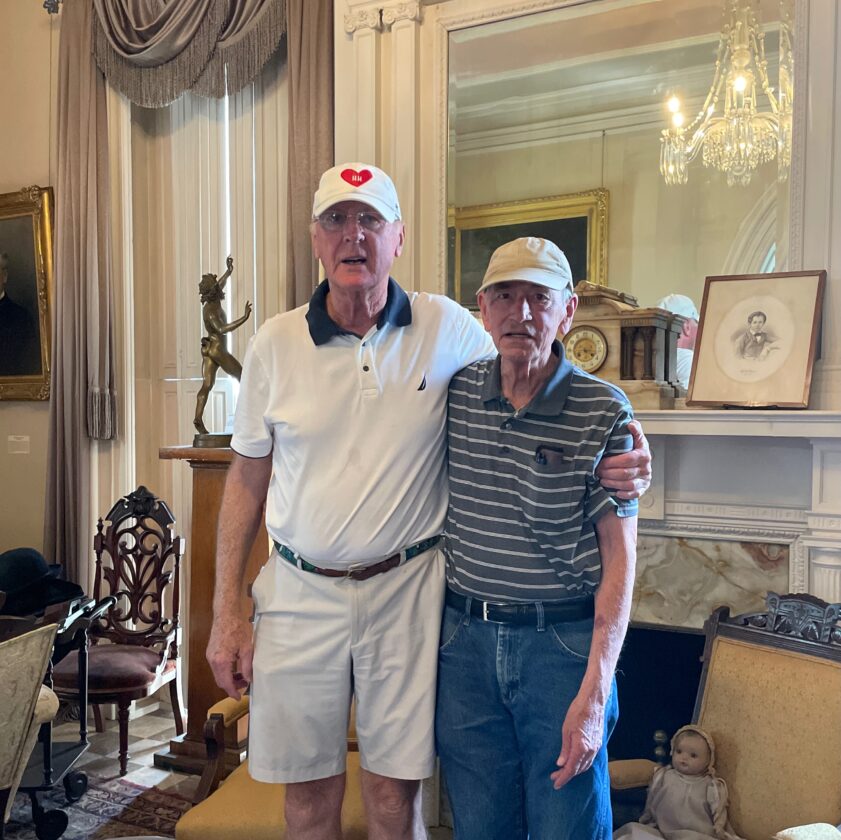
Photo provided to the Times Observer Mike Cashman, left, and Robert Duffy entered the service on the same day in July 1966. They recently met at the Warren County Historical Society.
-
- Photo provided to the Times Observer Mike Cashman, left, and Robert Duffy entered the service on the same day in July 1966. They recently met at the Warren County Historical Society.
-
- Photo provided to the Times Observer Pictured is Mike Cashman in Vietnam.
Mike Cashman and Robert Duffy met at the Warren County Historical Society, according to Managing Director Michelle Gray.
“Mike is the son of local physician and historian Dr. William Cashman, in town to visit with family and donate his father’s precious journals to the historical society for safekeeping,” Gray said. “Robert Duffy serves as the Treasurer for the Warren County Historical Society and was the 2023 Volunteer of the Year recognized on the floor of the Pennsylvania State Senate for his military and community service.”
The men reported to Buffalo for induction on July 5, 1966. They shared a bus ride from Warren to Buffalo that day.
“The two men have been anticipating a reunion and were thoroughly pleased to see each other and catch up on what’s been happening over the past half-century, or so,” Gray said.
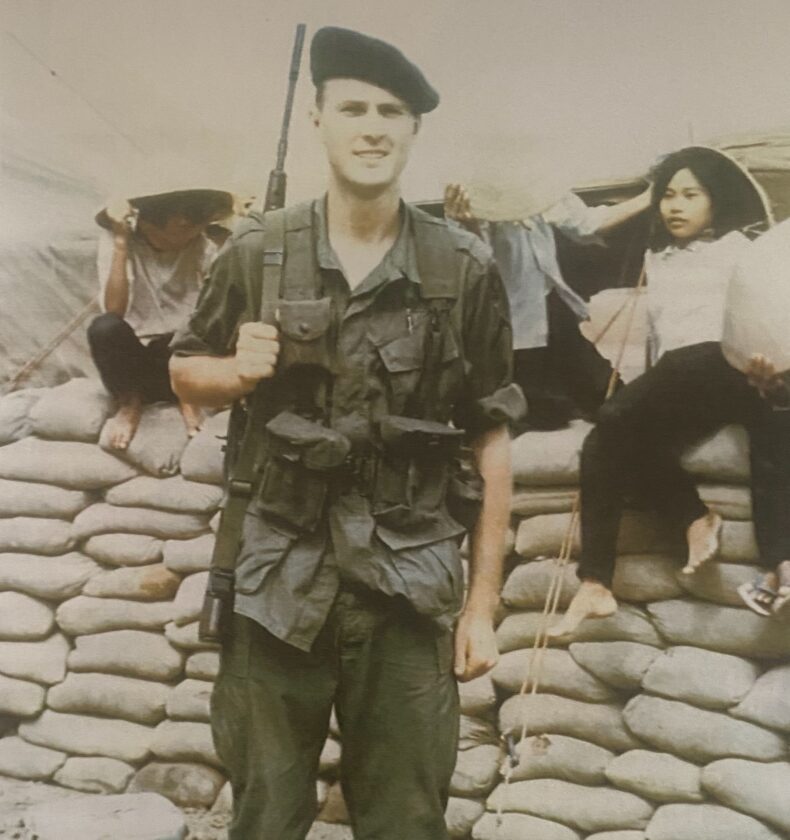
Photo provided to the Times Observer Pictured is Mike Cashman in Vietnam.
Cashman would go on to serve 13 months in Vietnam while Duffy would serve in the Armed Forces for 24 years.
“The Warren County Historical Society is conducting interviews of local veterans to upload to the organization’s YouTube channel at Warren History, PA,” Gray said. “The goal is to launch the project online in time for Veterans Day on November 11. Norm Chamberlain, a local veteran, has been spearheading the project as well as providing transportation to those in need.”
But back to Cashman. Former Warren Mayor Maurice Cashman gave the Times Observer a document Mike prepared outlining his time in the service.
Cashman wasn’t in favor of the war.
“My dad suggested I apply for a medical exemption given my previously broken left ankle but I declined thinking it a bit cowardly and not an honorable thing to do,” Cashman wrote. “For the next several weeks I partied hard in Warren and remembered seeing a lot of (friends).”
After induction in Buffalo, he was transferred for training at Ft. Dix and then to Alabama.
“I was currently in a unit that was being trained for overseas deployment and it was rumored that when the orders came down we were headed for Germany,” Cahsman wrote.
If not Germany, then maybe Korea.
But, ultimately, it was Vietnam.
“It was a ‘shock’ but what can you do but be resigned to it. At that point in the war, Cu Chi was a hot spot of fighting along the southern border with Cambodia in South Vietnam. With my new orders I got leave in early February and went back to Warren and saw family and friends and prepared to become a warrior in Vietnam along with hundreds of thousands of other American boys.”
He said his parents drove him to the Jamestown airport, acknowledging it was “a bit emotional as we said our goodbyes.”
He arrived in Vietnam on March 1, 1967, landing in the country in the middle of the night.
“Obviously our anxiety level was high as one of us knew what to expect being in a war zone for the first time in our lives,” he said.
Cashman was assigned to the 199th Infantry Brigade and went to work in a payroll office.
But there was still training required to be ready to fight.
“Before I joined the payroll office, I had to go through several training days at a unit called Red Catcher that oriented fresh troops to life in a war zone,” he wrote. “I was issued an M-16 and was impressed with its lightweight and firepower…. At one point we were driven to a nearby mock Vietnam village to learn about the way that “Charlie” went about trying to kill us and what to look for.”
From there, he appears to have settled into a fairly typical work routine.
“One thing I carried in my pocket was a pinecone taken from an Austrian Pine on Yankee Bush which I considered my good luck piece. Dad around 1952 bought many Austrian Pine seedlings,” he said. “The cone still gave off an aroma of pine that brought me closer to home in those anxious days.”
I settled into the routine at the finance office and made every effort to get along and do a good job. I was grateful that I was not out in the rice paddies chasing ‘Charlie.'”
As he started processing troops coming into and out of Vietnam, he was confronted with processing men who had been killed in action.
“I read somewhere that for every grunt in the field chasing Charlie there were seven soldiers in support,” he said. “I was one of them and had to consider myself lucky…. To live among so many men of diverse backgrounds were a real education and a lesson on how lucky for most part my life had been.”
The workload went up as American involvement in Vietnam escalated. A promotion to sergeant saw his pay jump “to the princely sum of $90 a month.”
Given the opportunity to extend his time in Vietnam, he took it, knowing it would mean he would be discharged as soon as he got home.
That saw him still in Vietnam on Jan. 30, 1968 – the start of the Tet Offensive.
“All hell broke loose and there were massive explosions all around our camp. The TET offensive had started and we were taking in 122mm rocket rounds along with 61 mm mortar rounds and I heard machine gun fire close by,” he wrote. “My first reaction was this is for real and why… the hell did I extend?
“As I lay on the ground bullets were whizzing over my head and snapping into the sandbagged bunker. I knew I had to stay as low as possible to them as some of the fire was only a couple of feet above me.
“None of us had a clear view of the enemy and we held our fire… Shortly before 8 a.m. I was back in the bunker and chatting with some of my colleagues when a massive blast with shock waves blew me across the bunker and into a 4×8 inch support beam resulting in a big bloody gas in my forehead. Ignoring the injury we all raced out to see an unbelievable sight.”
The North Vietnamese had exploded several ammunition bunkers.
“I felt lucky to be alive and did not think the gash in my head warranted any attention,” he said.
“It was an intense several days that all of us there would never forget.”
In the wake of the North Vietnamese assault, Cashman was ordered to help bury NVA and Viet Cong soldiers killed north of their compound.
“We wore gas masks and gloves and the scene was almost beyond horrific,” he wrote. “Many of the bodies were beyond recognition burned by the napalm dropped on them. That afternoon was seared in my memory all my life.”
He returned to Warren on April 12 – San Francisco to Cleveland then a flight to Bradford.
“On a beautiful spring morning as the plane landed in Bradford, I could see a group of people holding up a large sign that said “WELCOME HOME MICHAEL.” There in the outside waiting area were my wonderful family members,” he wrote. “It was a very emotional moment for all of us.”
He spent some time reflecting on lessons learned from his time in Vietnam.
“I learned to be a little more adaptive and probably calculating. Challenges later in my life were not as threatening or as big (of a) deal after you have lived in a war zone for thirteen months,” he wrote. “I also learned something about power and why people seek it.
“When you do not have power, you are usually not in charge of your own destiny…. I was just a cog in their machine and very expensable. You also learn in a war zone how life is fragile and easily expensable.”