
If a deer is to be called ‘America’s Deer’ …
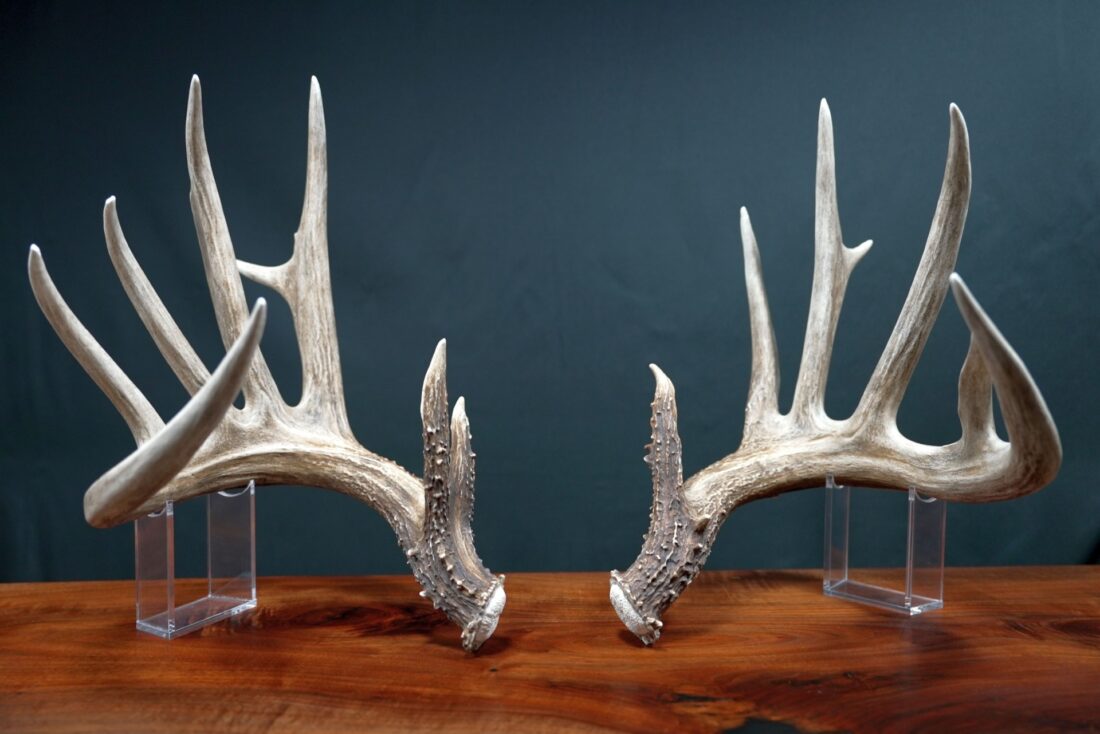
Photo courtesy of Josh Duncan These antlers are replicas of the shed antlers found in 1959 and became the biggest and longest running deer story ever.
Photo courtesy of Josh Duncan These antlers are replicas of the shed antlers found in 1959 and became the biggest and longest running deer story ever.
Trending
Can any deer be called "America's Deer"?
That question has been on my mind since the editor of Deer and Deer Hunting magazine asked me six months ago to pick up an old story that had some brand-new and unexpected twists.
The story is not so much about a certain buck as it is about a certain buck's antlers. The buck was born in central Nebraska in the early 1950s and in 1958 grew an impossibly big rack. In the spring of '59 a rancher found that matched set of shed antlers in his pasture. In '61, someone else found another shed antler from the buck, and in '64 a third lucky person found another matched set. None of these people ever learned about the other two, but together they provided pieces to the puzzle. No one put it together until last year, 66 years after the 1959 antlers were found.
Dick Idol introduced these antlers to the world in the December 1995 issue of North American Whitetail magazine, 36 years after they were found. Up to that time only a handful of people knew about them. Hunters are inclined to give deer names, a shorthand way of referring to them, and Idol called the deer that grew these antlers "The General." It was a big story then because no buck had ever grown bigger typical antlers (that's still true), and when the '61 and '64 antlers came to light in 2025, the story got even bigger.
Space doesn't permit retelling the whole story here, and I've already done that in the June 2026 issue of Deer and Deer Hunting magazine. A few people have called this buck "America's Deer," so I'm making that case by offering seven clear standards a deer would have to meet to be called "America's Deer."
The first standard: If a deer is to be called "America's Deer," it should be a deer that no hunter killed, and no hunter's name is attached to. In other words, it shouldn't be "The (insert your name here) Buck." The General meets that standard because no hunter ever killed it. That's one of those proverbial negatives no one can prove, but if some hunter did harvest it, his name is lost, it's unlikely he knew what he did, it wasn't publicized, and if such information someday surfaces it would be almost impossible to verify.
The second standard: If a deer is to be called "America's Deer," it should be a deer everyone can celebrate. Both non-hunters and hunters should be able to celebrate it because America's deer are for everyone, even including anti-hunters. People who oppose hunting would never be satisfied that a hunter killed "America's Deer." I respectfully suggest they don't know much about what they're against, but that's beside the point. The point is that everyone can celebrate this deer without celebrating any hunter, and that's good.
The third standard: If a deer is to be called "America's Deer," it should be a white-tailed deer. The whitetail is the default deer of all North American deer species. Moose, elk and caribou are far less widespread than whitetails, and many people have never seen them. Mule deer and blacktail deer are limited to the West. Sika deer, fallow deer, and axis deer are not native to the Americas. No other species from anywhere in the world is as ubiquitous or as accessible as America's white-tailed deer. They live and thrive from sea to shining sea.
The fourth standard: If a deer is to be called "America's Deer," it should be a wild deer and it should be big. It should not come from a deer farm. It should not be genetically curated. It should not be a designer deer bred for big antlers. But it should be an example of what a wild white-tailed deer can become without any of that.
The fifth standard: If a deer is to be called "America's Deer," it should come from the heartland of America. America's heartland is not a point on a map, but Nebraska is well within America's heartland.
The sixth standard: If a deer is to be called "America's Deer," it should be a prototype, something close to the idealized deer in Plato's Theory of Forms. When we see a white-tailed deer anywhere we go, we know that this (the realized deer we see) is like that (the idealized deer or the "form" of the deer we see with our mind's eye--unique, big, breathtaking). While there is space between any real buck and Plato's perfect idealized and theoretical form, the General is a reality that's not far off.
The seventh standard: If a deer is to be called "America's Deer," it should be understood, valued, and available as some form of artwork. After all, the real creatures we see every day are God's handiwork, his artwork. God's artwork is not only the bald eagle you love to see flying overhead. It's also the skunk raiding your garbage. God's artwork is not only the fox kits playing in the back corner of your yard. It's also the woodchuck devouring your garden. God's artwork is not only the buck you see in your headlights. It's also the deer that becomes an insurance claim because it occupied the space you were trying to occupy with your car.
The natural sounds you hear and the natural sights you see, it's all God's artwork. God's artwork is limitless, but humans try to capture it and sometimes even do a pretty good job. The General, or America's Deer, is God's artwork. He rose out of mid-20 century America, he still lives today in our minds, and his image can also live forever in our homes.
Should The General be known as "America's Deer"? Other deer might meet some of the standards, but The General meets all seven. You can probably identify more standards, but the question is this: What other deer meets these, or any standards by which we can call it "America's Deer"?
American hunters love deer stories, but "America's Deer" is a deer and a story for everyone. It began in 1959, and it's still the biggest and longest running deer story ever.
-- -- --
When "The Everyday Hunter" isn't hunting, he's thinking about hunting, talking about hunting, dreaming about hunting, writing about hunting, or wishing he were hunting. If you want to tell Steve exactly where your favorite hunting spot is, contact him through his website, www.EverydayHunter.com. He writes for top outdoor magazines, and won the 2015, 2018, and 2023 national "Pinnacle Award" for outdoor writing.