Shephard makes the cut
Warren woman heading to STIHL championships
-
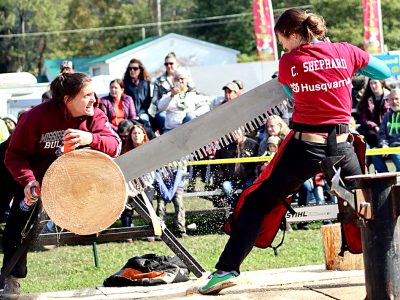
- Submitted Photo Collin Shephard is pictured at a recent Johnny Appleseed Festival lumberjack event in Sheffield.
-
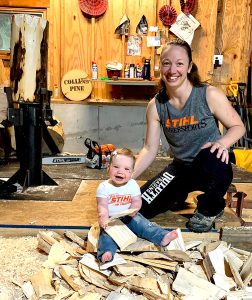
- Submitted Photo Collin Shephard with her future lumberjill, Fiona.
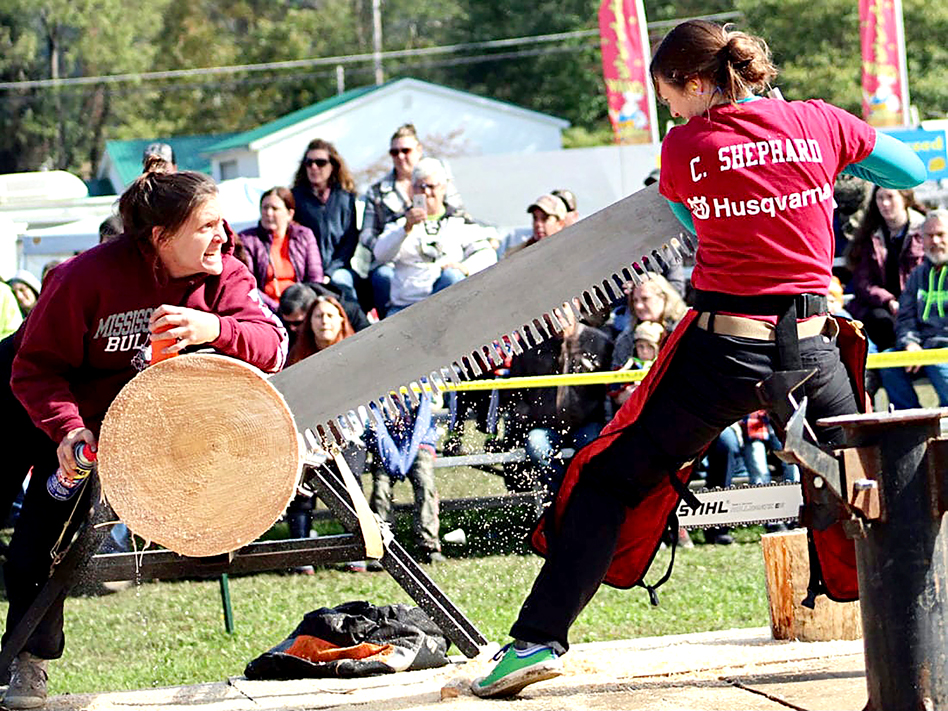
Submitted Photo Collin Shephard is pictured at a recent Johnny Appleseed Festival lumberjack event in Sheffield.
“Best. Decision. Ever.”
STIHL TIMBERSPORTS® features the nation’s best lumberjack sports athletes. And that includes Warren’s own Collin Shephard.
An ecologist for Allegheny National Forest, she’s also a pro with an axe, literally. Her performance at the STIHL Timbersports Northeast Qualifier has advanced her to the STIHL U.S. Championships July 23-25 in Little Rock, Arkansas.
“My family has a long history of volunteering with the New York State Woodsmen’s Field Days in Boonville, New York, so I was exposed to lumberjack sports from day one,” said Shephard, “but didn’t consider competing myself. That was until my junior year of college when I transferred to the SUNY College of Environmental Science & Forestry. I signed up for the woodsmen’s team at one of those new student orientation events and, after finding the courage to actually show up at the first practice — I was ridiculously nervous and spent most of the day talking myself in and out of going — I haven’t looked back since.”
That’s an understatement.
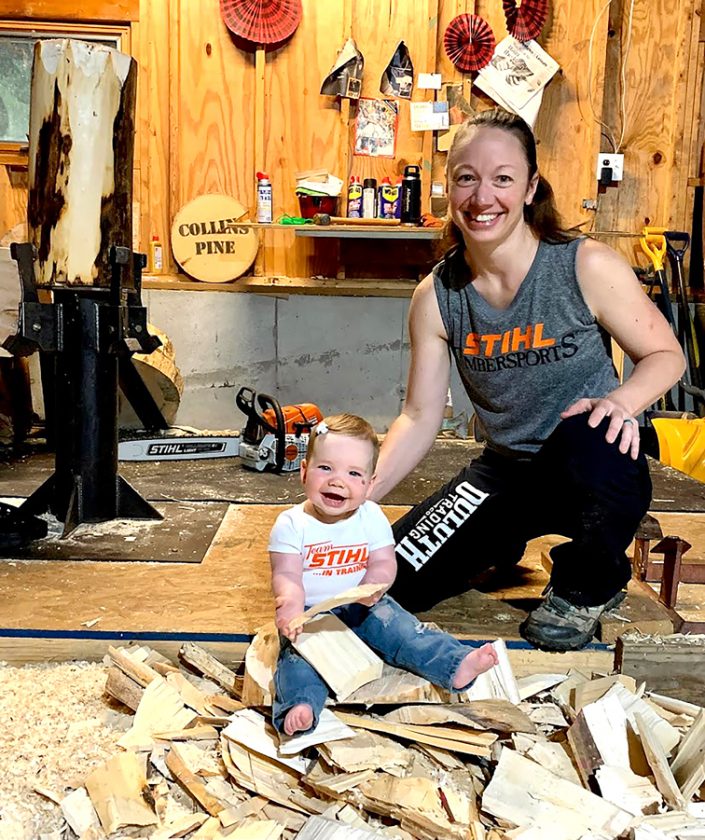
Submitted Photo Collin Shephard with her future lumberjill, Fiona.
“My goal is to compete as well as, or better, than I did at my qualifier in all four disciplines,” said Shephard of this opportunity. “All disciplines are based on time, and the wood in the finals will be the same size and species, so it will be easy to compare and know whether or not I improved upon my qualifying performance.
“There’s usually a lot of energy and hype with the finals of the STIHL Timbersports Series,” she said. “It typically gets filmed and will be this year with television shows produced for CBS. That’s a unique aspect of the Series as the extent of the exposure at other events, beyond those who attend the event in-person, might include a live stream on Facebook. I don’t know if or how the energy and hype will be different this year, though, given the finals are expected to be held without public attendance due to COVID. That said, this is the first year I’ve made it out of the qualifying rounds, so the finals in Little Rock will be a new experience for me altogether, and I don’t quite know what to expect. It may be beneficial that I don’t have any pre-COVID finals experience in that I really don’t have any expectations.”
There are four disciplines women complete for the STIHL Timbersports Series — stock saw, standing block chop, single buck (or one-person crosscut), and underhand chop. Wood from the same source and the same chainsaws were shipped to all qualifier locations to ensure fairness.
The top three women from each pool advanced to the finals, but Shephard didn’t find out who moved on until all qualifiers were completed and the results combined. In fact, the day of her qualifier in Cherry Valley, New York she didn’t even know her times.
“It was really nice, actually,” she said. “A common saying is, ‘one event at a time.’ I found that not knowing my times or how I performed compared to others made that saying possible and competing even more fun than usual.”
The last qualifier was held in Hayward, Wisconsin, over the weekend of June 26 and 27. After a few days of anticipation, athletes were provided the results. Shephard was second in her pool.
Shephard’s sport, or better said, lifestyle, isn’t easy. Even as she’s progressed, “time” and balancing the sport with life has always been challenging.
“Something I’ve always found appealing about this sport is that it’s all on you and what you put into it. There’s no coach to tell you whether you get to play or sit the bench,” said Shephard. “In that way, making the Series finals feels like reaching a milestone that is very rewarding and validating. That, yes, being patient and working hard does pay off.
And it’s not as if she’s not able to handle adversity.
“There are a few challenges that come with the sport that are probably common to many athletes – gear, training wood, and time,” said Shephard. “Gear — axes and crosscut saws — is not cheap, especially good gear, and in the case of crosscut saws, it can take several years to get one from the time it was ordered. Also, ideally, I’d have two sets of gear – one for training and one for competition, but that’s just not my reality, at least not when it comes to crosscut saws. Maybe someday.
“From a personal perspective, let me tell ya, I was not a natural with an axe back in college,” said Shephard. “I’d pick up an axe for splitting one minute like I was left-handed, the next minute like I was right-handed. It takes a village to train and support a lumberjill, at least it has to train and support this one. That, and a lot of blood, sweat, and tears – this should be taken quite literally – and patience … not a strength of mine, at least when it comes to myself and learning new things.
“I can’t think about the pitfalls and adversity without acknowledging all the support I’ve had along the way,” she said. “I didn’t do all this on my own. As I said before, it takes a village to train and support a lumberjill, at least it has to train and support this one. The support of my husband Jim, my biggest fan, has never wavered. You name it, he’s helped me do it without question. He knows how much the sport means to me and is always more supportive of me than I am of myself.”
Shephard also credited Howe’s True Value, which “came through” for her in a big way when she needed a STIHL MS 661 chainsaw to practice with; help from other athletes, who have provided technique and training advice; and the local community, which has helped with providing leftover competition wood.
Her future and past are eventful.
“I’d have to say my best memories come from all the travel to Australia I’ve been fortunate to be able to do as part of the U.S. National Lumberjill Relay Team,” said Shephard. “I lived and worked in Western Australia in 2006 for about five months, but didn’t do any wood chopping. I was able to go back a few times — to Sydney in 2009 and 2017, and Adelaide in 2016 — as part of the relay team at the Sydney Royal Easter Show and the Royal Adelaide show; these huge agricultural fairs that include multi-day woodchopping competitions. When you compete in college, you do so, for the most part, as part of a team. There isn’t as much of that in the professional ranks. I really enjoyed being able to compete as part of a team again. Plus, Australia will always have a big chunk of my heart; it’s a beautiful land and there’s so much more of it I want to see.”
Shephard competes less than she did when she first started professionally in 2007 — six to eight competitions a year instead of up to 20.
Less competitions in 2020 due to COVID restrictions “freed up a lot of time to go camping and hiking with my husband (Jim), three step-kids (AJ, Jack, and Lilly), and dog (Marley), get a bunch of painting done in my house, and prep for baby. I found that all to be one of the silver linings of 2020.”
Shephard’s come a long way and so have all women in the sport.
“One time, years ago, I was out to dinner with a few other lumberjills after a competition,” said Shephard. “A young girl, probably 9 or maybe 10, stopped by our table. She had seen us earlier that day at the competition and asked for our autographs on her shirt. Those are really some of the best moments – when a group of little kids come over to me at a competition and ask if I’d sign their cookie, one of the round wood disks we make with a crosscut or chainsaw. Such a small act makes them so happy and puts a big smile on my face no matter how well I’m performing that day. I think this speaks to a point to remember – people are watching, young eyes are watching. It’s important for myself to keep in mind that athletes in this sport are more than just individuals competing against each other. On the surface, it’s a hobby or the way to make a living for a few, but there’s a deeper aspect to remember that we may be role models to some and we need to carry ourselves accordingly.”
Local Sports

Former Tarp Skunk is winning pitcher at CWS
To be or not to be broken
Gerry prepares for 81st rodeo in August
Marlins take down Pirates 8-3
PITTSBURGH (AP) — Owen Caissie had a two-run double to cap a four-run seventh inning and the Miami Marlins beat ...

Bemus Point 3-On-3 scheduled for July 18-19