
Editor’s corner: Pennsylvania’s business reputation keeps rising
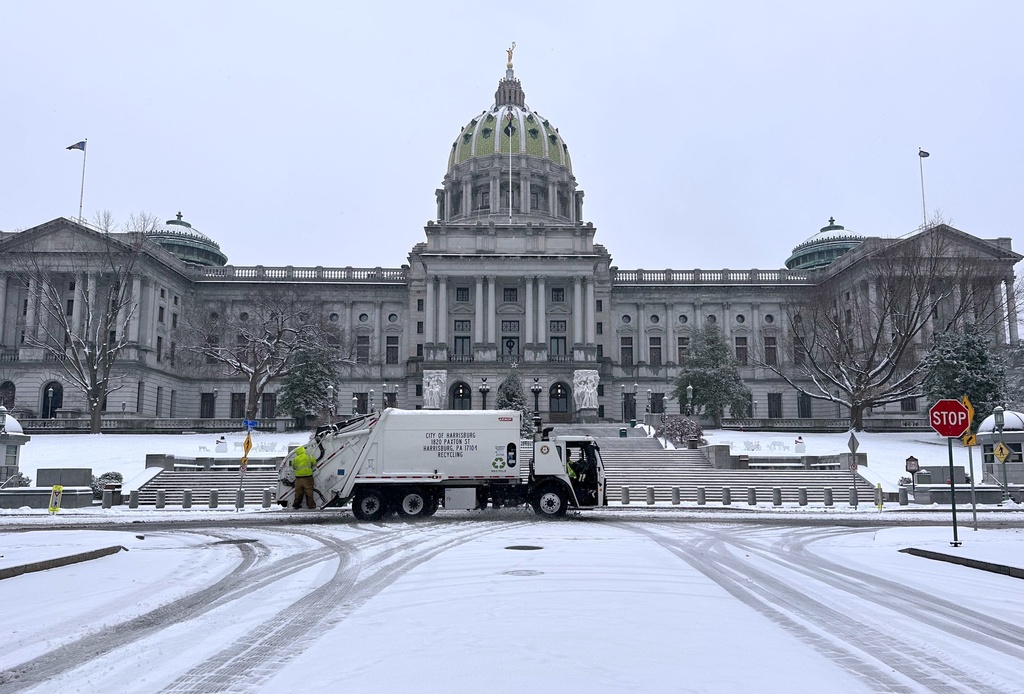
AP photo Even in the December cold of Harrisburg, the economy is hot in Pennsylvania by many measures.
Pennsylvania seems to be revving its economic engine, according to a recent report.
Site Selection Magazine recently noted the state has the 11th best business climate in the nation this year and the top business climate in the Northeast. Pennsylvania also claimed the eighth spot for most Inc. 5000 companies — the fastest-growing private companies in America.
“This new ranking from Site Selection Magazine underscores that our 10-year economic development strategy is producing real results and new opportunities for Pennsylvanians,” said Rick Siger, Department of Economic and Community Development secretary. “Under Governor (Josh) Shapiro’s leadership we are competing again by investing in our economy, strengthening communities, and making government more efficient, and we will continue to find new ways to make Pennsylvania the best state in the nation for businesses to grow.”
The Site Selection Magazine ranking was less than a month after new analysis from Moody’s Analytics Chief Economist Mark Zandi confirmed Pennsylvania is the only state in the Northeast with a growing economy. That report also found Pennsylvania is among just 16 states nationwide where the economy continues to expand.
With the state’s economy buzzing, it also speaks to the problem of growing the workforce in this county. With accolades coming that have helped attract nearly $31.6 billion in private-sector investment and create more than 16,700 new jobs across the Commonwealth, Warren County and its businesses seeking new employees continue to face challenges when it comes to seeking out new workers. It is a double-edged sword: good problem, bad dilemma.
Across the border to the north, things are not as rosy. There, New Yorkers understand what is holding back the Empire State from prosperity, but they also are having a tough time breaking away from it.
So noted a poll commissioned by the Invest in Our New York Campaign that was done by the Siena Research Institute and released the week of the November election. Its findings: a decisive 78% of New Yorkers — including majorities across party lines — support raising taxes on large corporations and the wealthiest 5% of earners to address the likely funding cuts that are expected to take place starting in January.
“New Yorkers have delivered a clear mandate to Gov. (Kathy) Hochul and state legislators: make the wealthy pay their fair share rather than cutting the schools, hospitals, and housing programs our communities depend on,” said Maria Duarte, campaign organizer for Invest in Our New York. “With the federal government stripping billions from our state budget, Albany can either protect billionaires’ tax breaks or stand with working-class families. This poll shows voters know which choice is right. Lawmakers need to listen to their constituents and act accordingly.”
To set the record straight, Invest in Our New York is far from an objective organization when it comes to the state’s wellbeing. It is a coalition of community organizations, labor unions, and advocacy groups working to create a more equitable tax system — in their eyes.
Frankly speaking, it is a collaboration that already heavily relies on tax dollars — but can never get enough. At the moment, their target is the top 5% of earners, including New Yorkers who generate wealth through passive income, and highly profitable corporations.
Based on demographics alone, we know a small slice of that population may be evident in Western New York. But it is prevalent in far greater numbers downstate in Manhattan and Long Island — or the location where 11.2 million of the 19.9 million of the state’s population reside.
Median household gross income from the U.S. Census reinforce that case. For instance, Chautauqua County stands at around $57,000 per year. In Westchester County, just to the north of New York City, it is $114,000 — double the amount here.
That being said, the Siena Research Institute poll of 1,010 registered voters conducted in October revealed broad and growing public support for progressive taxation, with 86% of Democrats, 63% of independents, and 53% of Republicans backing increased taxes on the wealthy to fund universal childcare, affordable housing, and public transportation. Support extends across all regions of the state, including 65% upstate.
That speaks to a troubling reality. New Yorkers, through years of decline, are resigned to the sense there is no hope for growth here. The only way, in their eyes, to fix the current problems is to pile on more penalties for those who have the means as well as big business.
This attitude has been prevalent for decades that has led to a five-decade exodus, especially in Western New York and Chautauqua County. Lack of investment from industry and the private sector increases a region’s rate of poverty. That makes those connected to the high-tax system — in government and schools — some of the highest-paid individuals locally.
According to seethroughny.net, there are 451 employees in the county’s schools and governments compensated more than $100,000 at the moment. Compared to 2020, when the number was 155, those earning six figures have increased by 291% — all funded through taxes.
Those generous public-sector jobs stunt growth. Here at home, with the city budget for 2026 decreasing when compared to this year, those warning signals are not evident at this time.
John D’Agostino is editor of the Times Observer, The Post-Journal and OBSERVER in Dunkirk, N.Y. Send comments to jdagostino@observertoday.com or call 814-723-8200, ext. 253.