Thompson questions Magill in hearing that led to Penn president’s ouster
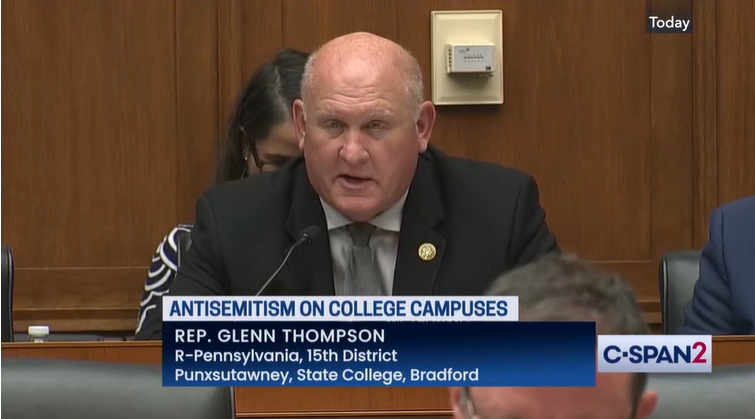
Photo from C-SPAN Rep. Glenn Thompson questions Penn President Elizabeth Magill during the now-viral hearing that prompted Magill’s resignation from the university.
Testimony offered at a Congressional hearing has promoted an Ivy League university president to resign.
The scene unfolded in a House Education and Workforce Hearing on Dec. 5 which heard testimony from presidents from Harvard, MIT and the University of Pennsylvania about anti-Semitism on college campuses.
Prior to the viral portion of the hearing where Rep. Elise Stefanik grills the presidents over whether calls for genocide of the Jewish people would violate their conduct policies, Congressman Glenn Thompson questioned then-Penn President Elizabeth Magill about the Philadelphia campus that she led.
Magill resigned over the weekend in the wake of her testimony.
“As we have all seen in recent weeks, there has been a sharp rise in anti-Semitic words, actions and attacks online and around the world,” Thompson said in video of the hearing broadcast by C-SPAN, “and, unfortunately, right here at home.”
Thompson added that “nowhere in the United States have these hateful and divisive ideas been more prevalent or found a safer home than on college campuses.”
According to an Associated Press report, universities across the country have been “accused of failing to protect Jewish students amid rising fears of antisemitism worldwide and fallout from Israel’s intensifying war in Gaza, which faces heightened criticism for the mounting Palestinian death toll. The three presidents were called before the committee to answer those accusations.”
“It is up to all of us to call out these actions and protect Jewish faculty, students, staff at these institutions,” Thompson said during the hearing. “Unfortunately, many of our university leaders have not met this moment and have allowed anti-Semitism to continue to grow and to rear its ugly head.”
Thompson then asked Magill if Penn has policies to ensure that students are educated on the history of anti-Semitism, its impacts and reporting procedures.
Magill said the university is “in the midst” of making sure “all anti-bigotry efforts ensure education about anti-Semitism.”
She said that some parts of the programs already do while “some need enhanced.”
“I wonder if that type of education would have been in place at all of our college campuses before this,” Thompson responded, “whether we would have seen the massive reactions that we have that are just hard to describe and justify in terms of the demonstration and just the hate.”
Thompson then asked whether those on campuses that are arrested by university police during protests have requirements for additional education regarding anti-Semitic behavior.
“We’re very committed to make sure everyone understands” the scope of anti-Semitic behavior, she responded, suggesting that future education would be “certainly consistent with my perspective.”
Thompson then shifted to the “Boycott, Divestment and Sanctions (BDS) initiative, a Palestinian-led effort that promotes – as the name implies – boycotts, divestments and sanctions against Israel.
He said that it was “impossible for a faculty member to support BDS and treat Israeli academics fairly. Can you tell this committee unequivocally that no such discrimination has taken place?”
Magill said the university “strongly oppose(s)” BDS as “contrary to academic freedom.”
She cited the “many academic collaborations with universities in Israel” that Penn has.
Local News

Dynamic Duo: Roots Rising Series brings Queens pair to Warren Saturday
Council tables mid-block crosswalk proposal
City officials are taking a closer look at a proposal to remove a mid-block crosswalk on Pennsylvania Avenue after ...

Russell UMC Daycare to host fundraiser

Prescribed burn underway in Allegheny National Forest

PennDOT plans Tidioute bridge project