Warren native shares struggles after life-saving transplant
-
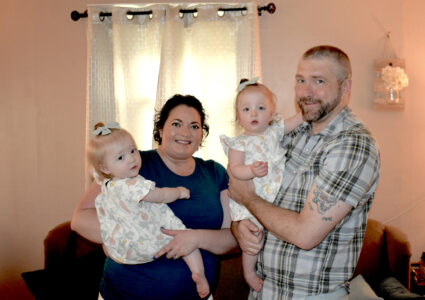
- Photos by Eric Tichy Christi and Dan Carson are pictured with their twin daughters, Isla and Arabella, inside their Jamestown home. In March, Christi underwent a successful heart transplant and just recently came home after a lengthy recovery in Pittsburgh.
-
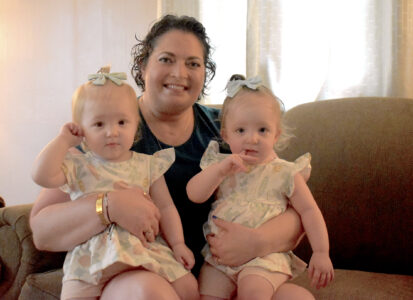
- Christi Carson is pictured with her twin daughters. Carson was an emergency room nurse at UPMC Chautauqua prior to learning she needed a new heart.
-
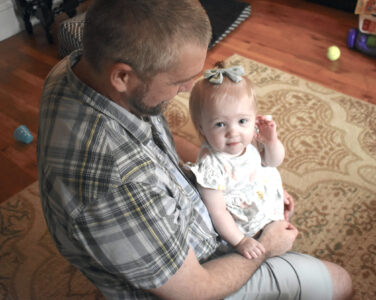
- Dan Carson is pictured with his daughter, Isla.
-
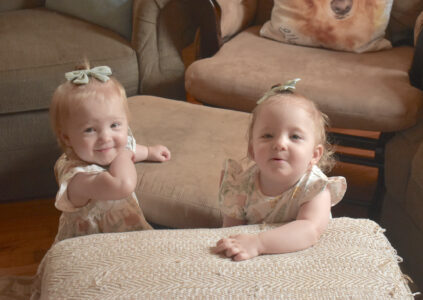
- Isla, left, and Arabella are all smiles at home with their parents.
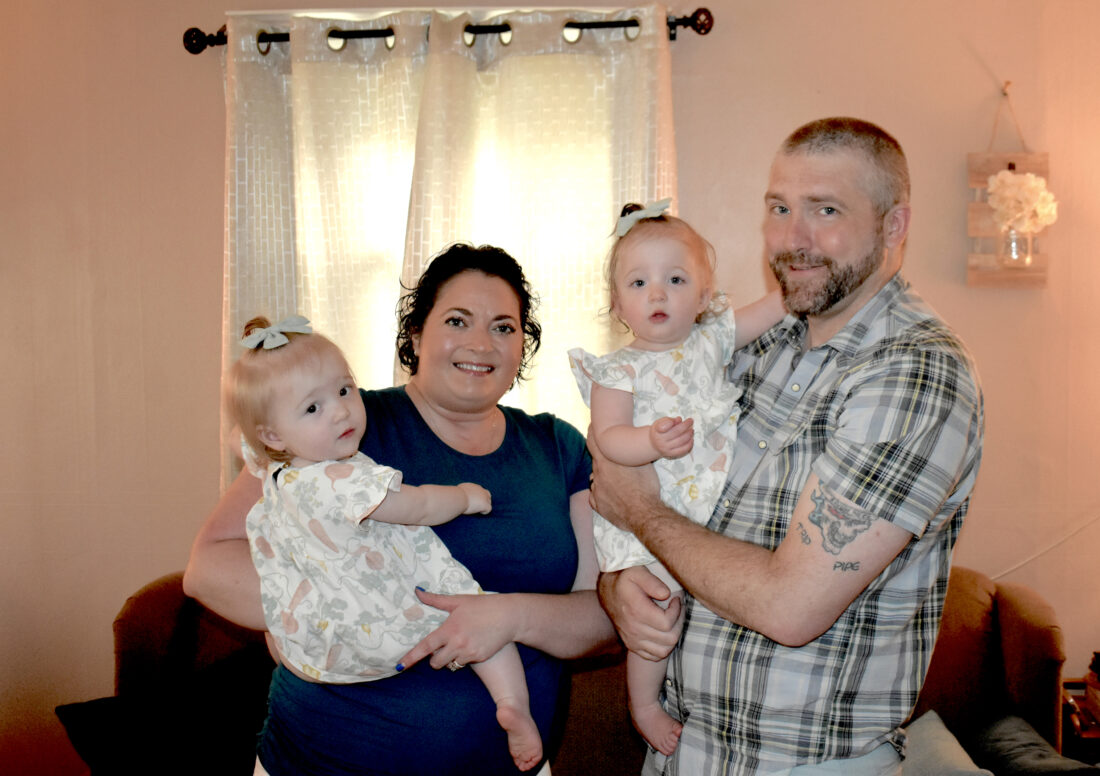
Photos by Eric Tichy Christi and Dan Carson are pictured with their twin daughters, Isla and Arabella, inside their Jamestown home. In March, Christi underwent a successful heart transplant and just recently came home after a lengthy recovery in Pittsburgh.
Christi Carson has overcome the longest of odds, the slimmest of chances, the remotest of possibilities.
She’s a case study in the power of modern medicine to the human body.
Despite an indebtedness to the countless nurses and doctors who saved her life leading up to a successful heart transplant this spring, the 39-year-old Warren County native admits she struggles at times adjusting to a world outside the operating rooms and hospital beds to which she’s become so accustomed.
“I had this unreal expectation that once I got a heart, I would be fixed and I would be brand new and be able to step back into the life that I had,” Carson told The Post-Journal. “And in reality, that’s not the case at all. This is something that I’m going to have to deal with for the rest of my life.”
Fourteen months after delivering twins by emergency caesarean section, and four months after undergoing a life-saving transplant, Carson is finally back home in Jamestown.
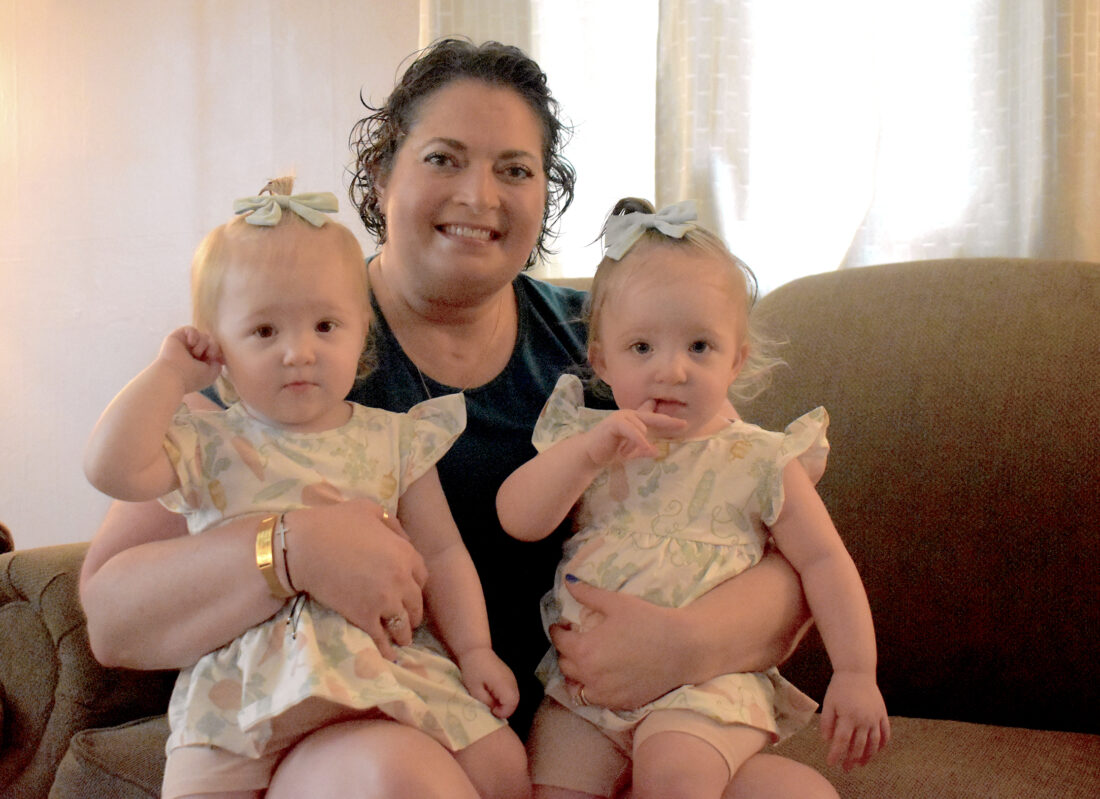
Christi Carson is pictured with her twin daughters. Carson was an emergency room nurse at UPMC Chautauqua prior to learning she needed a new heart.
To be sure, she’s grateful to be alive — to be with her daughters, her doting husband and a family that’s been by her side through one setback after another.
Carson also is eternally grateful to the donor who provided her a new lease on life.
She knows very little about the person whose heart she received. “They said it was somebody young, and they said it was a sudden death,” she said.
It will be up to the donor’s family if she ever learns the whole story.
In a lengthy interview, the 2002 Warren Area High School graduate opened up about her life-altering medical journey that arrived so suddenly last year and to the adjustments she’s still making as a new mom.
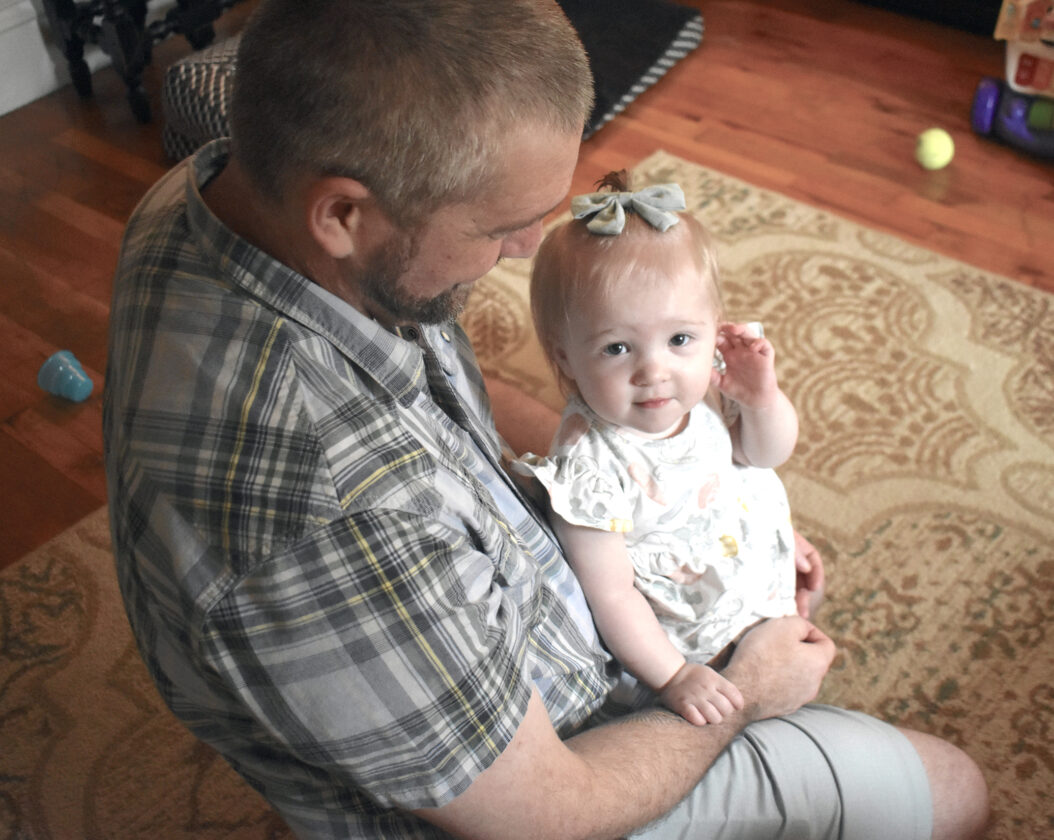
Dan Carson is pictured with his daughter, Isla.
“I’m grateful but I’m also struggling, you know,” she said. “The two can exist together.”
A CHANGE OF PLANS
Carson was well into her pregnancy when she first suspected something was amiss. She began experiencing shortness of breath, a symptom that came to a head following a 12-hour shift as an emergency room nurse at UPMC Chautauqua. An echocardiogram — a procedure in which sound waves are used to create pictures of the heart — found that her heart was not pumping enough blood.
In an instant, Carson went from nurse to patient. The diagnosis: peripartum cardiomyopathy — the weakening of the heart muscle that leads to heart failure.
“Nothing prepares you for actually being the patient in the hospital who is completely and fully reliant upon the nursing staff and the aides,” she said.
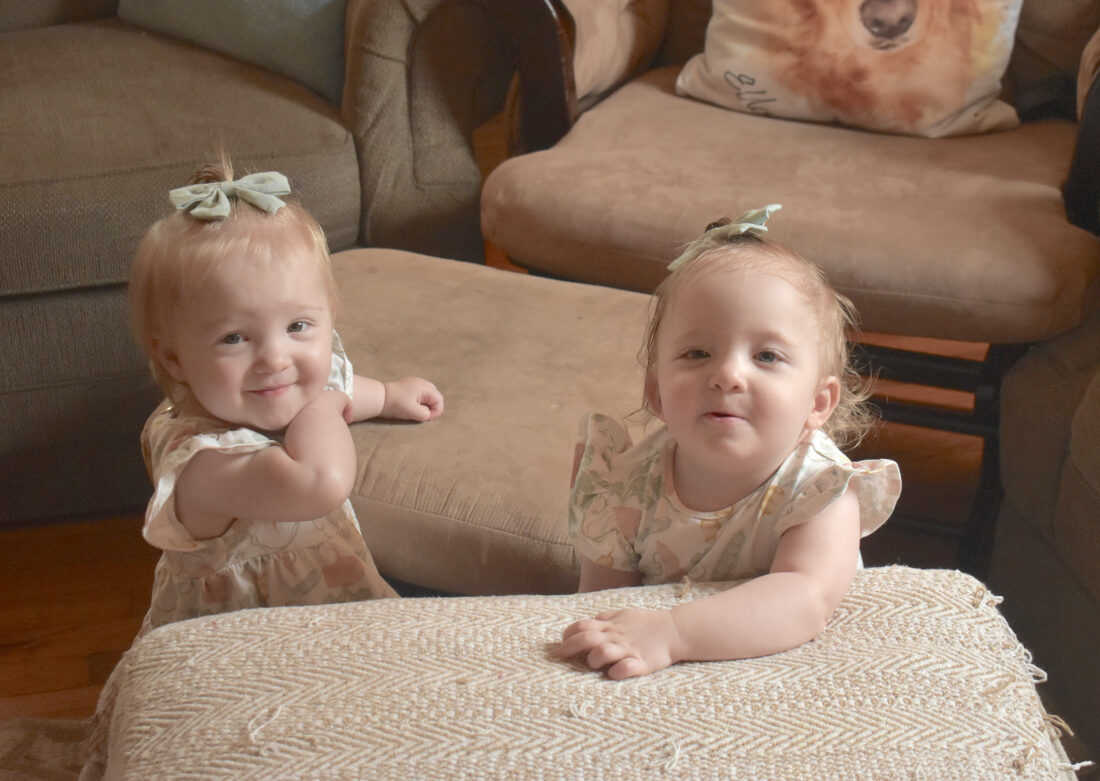
Isla, left, and Arabella are all smiles at home with their parents.
Carson was transported by helicopter to UPMC Magee-Womens Hospital in Pittsburgh, a trip that took just 20 minutes. Once there, she received an emergency C-section to deliver her twins, Isla and Arabella, much earlier than anticipated.
She then went into cardiac arrest.
With a team of doctors in tow, Carson was transported to UPMC Presbyterian and underwent another emergency surgery where an Impella heart pump was installed. “That is actually what kept me alive,” she said.
Afterward, Carson was induced into a coma for about six weeks. During that time, she nearly died from a septic fungal infection. That was followed by a bowel obstruction.
“And I almost died from that,” she said.
After learning the results of her echocardiogram, Carson knew she would need a new heart. She recalls routinely being surrounded in her hospital bed by dozens of doctors, nurses, specialists and even medical students. Any time her condition changed, such as a bump in her temperature, she would be inundated by hospital staff asking a variety of questions.
Carson’s condition began to worsen, and tests confirmed she was in right heart failure. Doctors told her she needed ECMO — extracorporeal membrane oxygenation — in which blood is pumped outside of the body to a heart-lung machine that removes carbon dioxide. It then sends the oxygen-filled blood back to tissues in the body.
In the back of Carson’s mind was her sister, who in 2020 died of a hear attack seven months after giving birth to her daughter. Her sister, who also went into heart failure, died before ECMO could be set up.
“Before I could blink, they were like, ‘You’re in right sided heart failure. You’re going to need ECMO.’ And I’m like, ‘Wait, wait, wait, stop. Somebody needs to call my husband. Somebody needs to call my mom. And they let me have one phone call — I called my mom. She was at home in Warren.”
Once she was well enough, Carson underwent another surgery to have two battery-operated devices installed. Known as an LVAD, the equipment helped her left ventricle pump blood to the rest of her body.
While in a medically induced coma, Carson recalled a dream in which she was being held captive.
“When I started waking up off of the sedation I was, in my mind, fighting for my life — fighting for my life on multiple fronts,” she said. “In my mind, I’m begging my nurses, who I thought were my captors, begging them, telling them you’ve got the wrong person.”
LIFE-SAVER
Carson has rare antibodies and two very rare protein strands in her bloodstream. She needed a heart with the same antibodies and protein strands; without them, her body would reject any new heart.
Carson and her husband were informed that the chances of finding a perfect match were slim.
“The doctor sat us down to have a conversation and said, ‘Look, the chances of us finding you a heart are one in a million.’ ”
She was told to go home and spend time with her newborn twins. Due to her daughters being premature, and with her ongoing medical problems, Carson did not meet them for the first two months of their lives.
“There is nothing to describe that feeling of total heartbreak, just a sense of hopelessness,” she said of her condition. “I felt the need to prepare for my death. So I wrote my girls letters, just in case, for them to read when they were older and wanted them to know me.”
Carson said she did as the doctors told her. She went home to Jamestown and spent time with her family.
While she admits her reprieve from the hospital felt like she was “going through the motions,” she also refused to accept that she wasn’t going to receive a new heart.
“You know, I had a lot of difficult conversations with God, going through all of this stuff,” she said.
In March of this year, Carson was informed a heart had been found. The news came two days before her husband’s birthday.
“Her surgeon said he had never seen a more perfect match,” her stepfather, Mark Woody, told The Post-Journal at the time.
Surgery started at 3:30 p.m. that afternoon. “At 10:30 that night the surgeon came out and told us that the heart was beating on its own and that she would be going to the recovery room and then up to the cardiothoracic ICU,” Woody said.
‘I’M TAKING STEPS’
Carson is adjusting to her new life at home. Not that long ago she was in a similar position, ditching her longtime career as an insurance broker living in Baltimore to becoming an emergency room nurse in Jamestown. She also got married to a wonderful and supportive husband.
“I feel like my life has taken so many different turns and I’ve done so many different things,” she said. “When I was younger, I really struggled with depression and anxiety, like, crippling depression. And I always was, like, ‘Why?’ like, ‘Why am I going through this? Why can’t I be like everybody else, and why can’t I be normal, and just be able to love life and experience things.’ And I lost a lot of friends through this depression, because it was so crippling.”
She’s had no problems with her new heart. However, during the heart transplant her phrenic nerve was damaged, leaving her diaphragm paralyzed. She carries a ventilator around to help her breathe, and it’s unclear whether the nerve damage will heal on its own.
She has her good days, but she’s also reminded of her limitations. She had to learn how to walk again, and she still struggles when going up the stairs.
“I let myself feel what I’m feeling — the anger, the disappointment, the jealousy of other people. You know, I mean, a lot of people are like, ‘Oh, I’m so strong and I don’t ever feel these feelings.’ I absolutely felt them.
“And yeah I have horrible, bad days. And sometimes I do swallow that bitter pill and I’m mad at God and I’m mad at everyone. … I’m mad that it just happened to me. But, you know, life. I worked in emergency medicine. I know that from one day to the next, you’re not promised anything, and even then I was still caught off guard.”
Carson can’t thank enough the doctors and nurses who cared for her and continue to assist her on her recovery. Among those she wanted to highlight: Dr. Chad Spencer, Dr. Raj Ramanan, Dr. David Kaczorowski, Dr. Holt Murray, Tammy Brinker and Ed Horn, as well as the entire team at UPMC Heart and Vascular Institute.
A GoFundMe drive (https://gofund.me/9a354455 ) has been established to assist the family with ongoing costs and lost expenses. In addition to the GoFundMe, those who wish to assist can make a donation to Christi and Dan Carson at any Northwest Bank branch.
Local News
Recent gifts made to Warren Public Library
The following gifts have been made recently to the Warren Public Library: - In honor of Sharon Aldrich and ...
35 Years of Laughs
Nonprofits want legislators to keep skill games legal
Northwest Bank property included in new reassessment decreases
Another $3,454,677 is set to come off Warren County’s newly reassessed tax rolls as that latest round of ...
Four charged in two separate drug investigations
Four county residents face drug charges after two investigations into alleged drug trafficking in Youngsville and ...