District FAQ details reconfiguration process
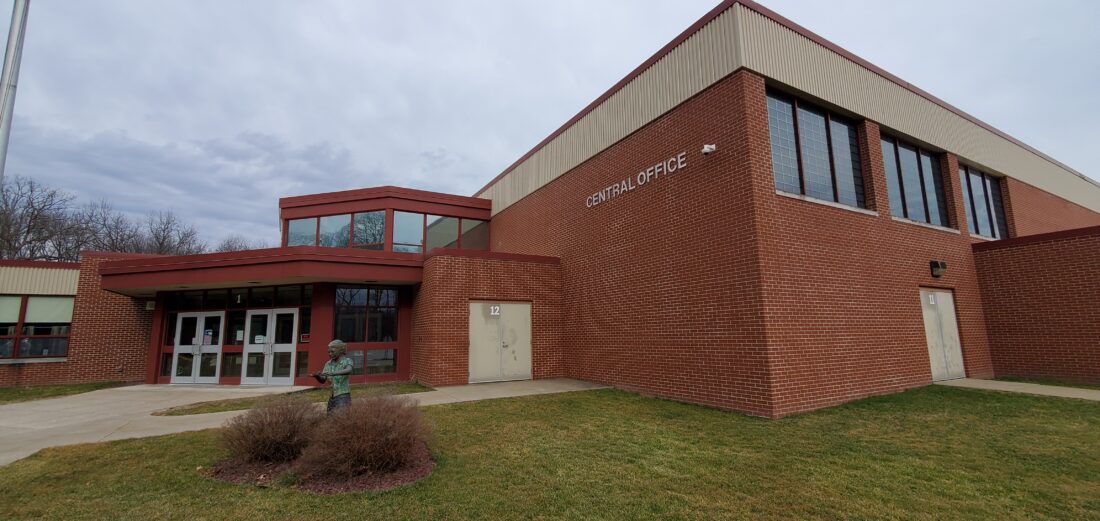
Times Observer photo by Brian Ferry Warren County School District will hold a public input session regarding possible school reconfiguration at 6 p.m. Wednesday, March 8, at the central office building on Route 62 in Russell.
The Warren County School District has published answers to some frequently asked questions regarding its reconfiguration efforts.
The document includes upcoming dates, answers regarding public participation, current and historic enrollment figures, class offerings, athletics offerings, the board’s actions in terms of reconfiguration since 1966, and other historical information about the district.
The current process of digging into the district’s master facilities plan has been underway since a demographic study in 2018. That study, a facilities assessment, and a facilities capacity and usage study have been completed. The next stage is a look into reconfiguration that started in January.
The timeline for that process has moved through three steps — two board work session and board and administration interviews.
Next up is an in-person public work session at 6 p.m. Wednesday, March 8, in the gymnasium at the district’s central office in Russell.
According to the FAQ, the meeting will not be accessible remotely. “The district wants to have a larger room for in-person participation,” according to the FAQ. “The larger room does not have audio capabilities to support a Zoom format.”
The board and the district have been through master facilities plans, consolidations, and reconfigurations several times since the district was formed in 1966. At that time, there were 32 school buildings in the district.
Eight of those had closed by 1984 and four more in 1988 and 1989.
From 2000 to 2005, another 10 were closed.
Five more elementary schools — Sheffield, South Street, Sugar Grove, Russell, and Allegheny Valley — were closed between 2013 and 2015.
Declining enrollment is one of the main drivers behind the reconfiguration discussion.
On the FAQ, the district’s high-school enrollment from 1979-1980 is compared to the current populations of the four high schools.
For the 1979 school year, there were nearly 2,900 students in grades 9 through 12 in the four high schools that remain in the district today — counting almost 350 ninth-graders in the central attendance area who attended Beaty Junior High School at that time. That ninth-grade class at Beaty had more students in it than the entire high-school enrollment at any of the district’s current high schools other than Warren Area.
The district’s current enrollment in grades 6 through 12 is 2,204. Grades 6, 7, and 8 attend the same schools as grades 9 through 12 at Eisenhower, Sheffield, and Youngsville.
The 9 through 12 district-wide enrollment is 1,275.
Comparing the 1979-1980 and current enrollments in grades 9-through-12 shows:
¯ Eisenhower — 550 to 251, a reduction of 54 percent;
¯ Sheffield — 414 to 134, a reduction of 68 percent;
¯ Warren — 1,435 to 692, a reduction of 52 percent; and
¯ Youngsville — 500 to 198, a reduction of 60 percent.
The district’s enrollments continue to shrink, with most of the early elementary grades having smaller classes than the corresponding senior classes, according to the FAQ.
With fewer students comes fewer course offerings.
According to the district, courses outside of the core content areas are only offered if at least 12 students are enrolled. The number of courses available to secondary students varies widely among the district’s schools. More courses are available at schools with larger student populations. “If a student wants to take a course that is not offered at their home school, board policy allows the student to take the course at another school, or the student can choose to take the course virtually,” according to the FAQ.
While there are fewer options for students at smaller schools, teachers at those schools have to prepare for more different classes every day.
School board members have been discussing the importance of teacher ‘preps’ at recent meetings.
According to the FAQ:
“In a large high school, which we do not have in Warren County, one high school English teacher might teach English 10 CP and English 10 Honors, repeatedly throughout one day over six or seven periods. That teacher would have two preps, one for each unique course taught (English 10 CP and English 10 Honors). In medium and small high schools, there oftentimes aren’t enough students to fill several sections of the same course, so teachers have schedules that require the teaching of many different courses. In a smaller high school, one high school English teacher might teach English 10 CP, English 10, English 9 CP, English 9 and English 12. In this example, the teacher has five preps because they are teaching five different courses. Preparation time for the creation of strategic and engaging lessons is time-consuming and an important part of the teaching process. The more preparations a high school teacher has, the more difficult the workload.”
According to a list of teacher preps by school provided in the FAQ, there is one high school math teacher at Sheffield. That teacher has six preps. There are three other math classes being taught to high school students. A librarian teaches one and a special education teacher the remaining two.
At Youngsville, there are two high school math teachers — one with five preps per day and the other with six.
The situation is better for most teachers at Warren, but all are still preparing for several classes every day. There are five math teachers — two have three preps, one four, one four with an additional virtual class, and one has five.
Local News

Forest Service monitoring Rainbow Family gathering
Observers hope election will turn up heat on budget process
Pennsylvania counties last year lost millions of dollars and domestic violence programs in the state laid off ...
‘Gas station heroin’ ban passes House
Council approves liquor license transfer for restaurant
The City Council has unanimously approved a resolution supporting the transfer of a liquor license for a new ...

Learning opportunity