‘People are getting out’ as high turnout reported
-
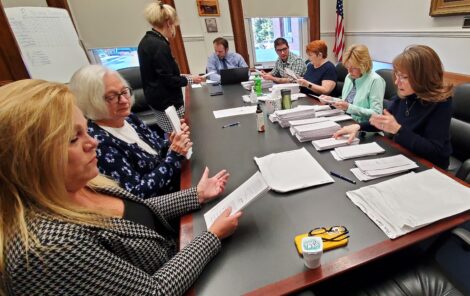
- Times Observer photo by Brian Ferry Warren County Elections officials (from left) Elke Elder, Sally Beckerink, Commissioner Tricia Durbin, Solicitor Nathaniel Schmidt, Zachary Foster, Pam Matve, Judy Smith, and Linda Swanson prepare mail-in ballots for counting Tuesday morning.
-
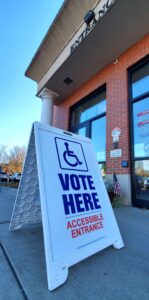
- Times Observer photo by Brian Ferry Voter turn-out was high Tuesday morning as Warren County’s registered voters visited polling locations throughout the county including the Warren Central site at Warren County Courthouse.
-
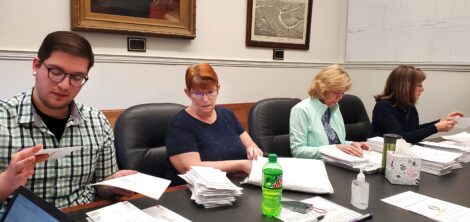
- Times Observer photo by Brian Ferry Warren County Election Assistants (from left) Zachary Foster, Pam Matve, Judy Smith, and Linda Swanson, inspect and open mail-in ballot envelopes Tuesday morning.
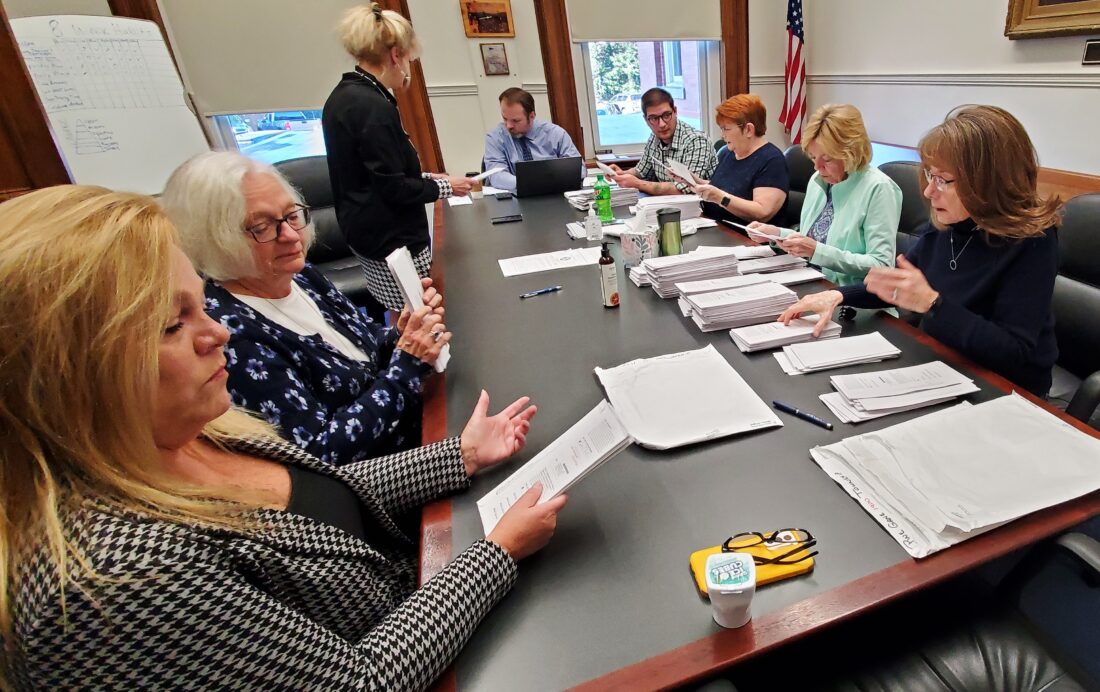
Times Observer photo by Brian Ferry Warren County Elections officials (from left) Elke Elder, Sally Beckerink, Commissioner Tricia Durbin, Solicitor Nathaniel Schmidt, Zachary Foster, Pam Matve, Judy Smith, and Linda Swanson prepare mail-in ballots for counting Tuesday morning.
Election Day got off to a smooth, but busy, start in Warren County.
“We are doing great,” Director of Elections Krystle Ransom said at 11 a.m. “Everything is going as it should.”
Turnout was reportedly high. “A lot more inactive voters are voting,” Ransom said. “The people are getting out.”
She said there was a timing issue with some of the voting machines related to Daylight Savings Time, but that it “doesn’t affect anything.”
In addition to relatively high turnout at the polling places, there was plenty of work being handled across the courthouse hall from Ransom’s office in the Commissioners Conference Room.
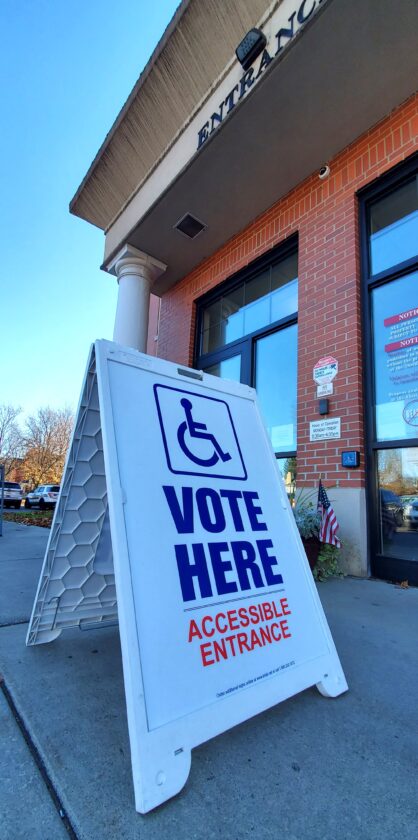
Times Observer photo by Brian Ferry Voter turn-out was high Tuesday morning as Warren County’s registered voters visited polling locations throughout the county including the Warren Central site at Warren County Courthouse.
A group of elections assistants at Warren County Courthouse began checking, then opening, checking, and opening mail-in ballots at 9 a.m.
The assistants — Zachary Foster, Pam Matve — county chief clerk, Judy Smith, Linda Swanson, Sally Beckerink, and Elke Elder — with Solicitor Nathaniel Schmidt and Commissioner and Elections Board Member Tricia Durbin, worked on pre-canvassing through the afternoon. Canvassing is the actual counting of the ballots.
According to Ransom, there were more than 3,100 ballots mailed in to the county.
The group of assistants, working in pairs, and under the eyes of Poll Watcher Kathy Kemp-Jensen, was in charge of preparing the mailed ballots to be fed through the counting machine. Before they were finished, they handled each ballot several times.
They picked up packets of mail-in and absentee ballots. The packets were organized by the precincts from which they were mailed. The assistants checked each outer envelope for a signature matching the name on the affixed sticker and a valid date. The date could not be prior to Sept. 19, 2022 — when Ransom first mailed out ballots — nor after Nov. 8, 2022 — Election Day.
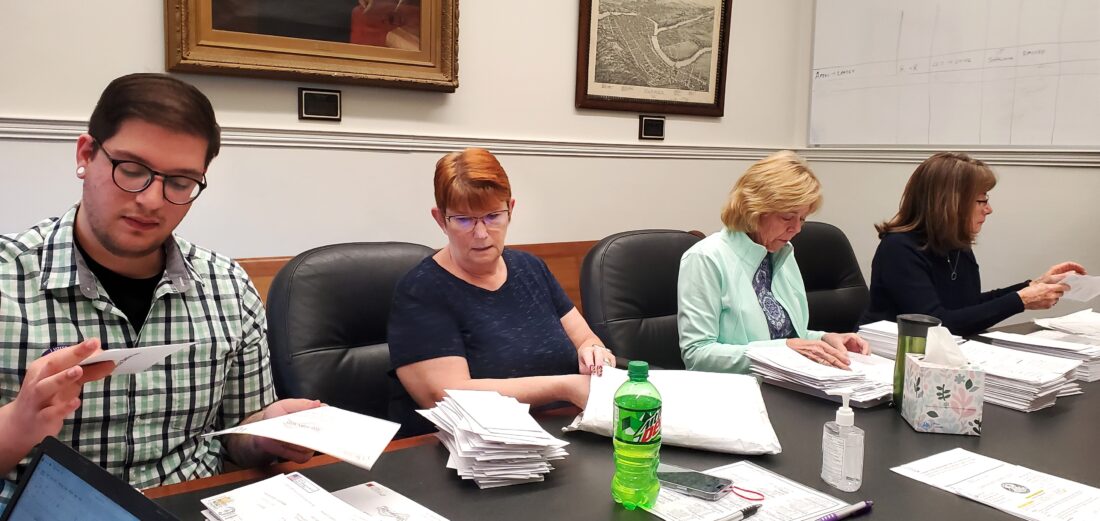
Times Observer photo by Brian Ferry Warren County Election Assistants (from left) Zachary Foster, Pam Matve, Judy Smith, and Linda Swanson, inspect and open mail-in ballot envelopes Tuesday morning.
Envelopes that had the required information were fed through an opening machine.
The assistants took another look at the outer envelopes, and confirmed that there was a sealed secrecy envelope within each, before pulling out the secrecy envelopes.
Envelopes with problems — a lack of the required information or a “naked” ballot without a secrecy envelope — were given to Schmidt. He logged each of those ballots in a spreadsheet and segregated them from the other ballots.
As of 11 a.m., there were 20 ballots — about 3 percent of the total — in the segregated pile.
Included in that number were several for which the only problem was an unsealed security envelope. “The approach that we’re taking at this point is, if the security envelope is not sealed, that’s a requirement in the Election Code,” Schmidt said.
Keeping the ballots segregated and logged would allow them to be counted if the rules are changed through appeals to previous court decisions.
The assistants bagged the opened outer envelopes, then took the sealed secrecy envelopes to the opener.
Back at their seats, they pulled the ballots out of the secrecy envelopes, checked for damage from the opening process, and smoothed them out a little — ready for the ballot reader.
In at least one case, multiple pieces of paper were enclosed in a secrecy envelope. Although two ballots in one envelope would have resulted in not counting any of them, the one envelope had a ballot and a mail-in ballot application. The application was set aside and the ballot allowed to count.
Another secrecy envelope had writing on it. That ballot was segregated along with the others in Schmidt’s pile.
Durbin took on the job of checking each secrecy envelope that was set aside by the assistants after they had removed the enclosed ballots. She made sure every envelope was empty before throwing them away.
When a pair of assistants finished the ballots from a packet, they went across the hall to Ransom’s office and handed the ballots and envelopes to Ransom or Assistant Director of Elections Margia Hansen.
Ransom put the ballots on the ballot-counting machine and ran them as a batch. If a physical problem — usually a cut from the opening process — with a ballot stopped the counting, she removed that ballot, set it aside for the board of elections and started the whole batch over.
The board of elections was tasked with examining and ruling on all questionable situations. They also were in charge of copying, by hand, the votes on all of the ballots damaged during the opening process.
“We will have the Board of Elections gather an issue an official ruling,” Schmidt said.
The elections office has received about double the usual number of Right-to-Know requests related to the election, Schmidt said.
In most past elections, there have been up to five requests, Matve and Schmidt said. Related to this election, there have been about 10.
The subjects of the requests are “wide-ranging… anything they can think of,” he said.
“Access to election records is controlled by a specific part of the Election Code,” he said. “We have parties requesting information that they are not entitled to.”
For example, while access to some information is allowed, it cannot be physically or electronically sent to the requester. Some information may only be viewed “in person, under the supervision of an election official,” he said.
Local News
Brush with greatness
Lineup has marching orders for Fourth parade
Warren County’s Fourth of July Celebration has filled people with anticipation for the festivities over the years ...
McCormick tours Warren, discusses riverfront

Gas prices drop to $4 ahead of holiday
History award recipients are named