
County-based land speed racers take part in trials
-

- Members of Team Urgently Todd Woodin (left) and Lane Wiggers wear their coveted 200-MPH Club hats earned last week at the at the Loring (Maine) Timing Association’s Land Speed Trials.
-
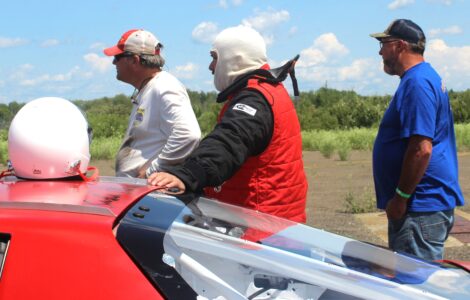
- Members of Team Urgently (from left) Lane Wiggers, Todd Woodin — in firesuit, and Kevin Shippee, prepare for a record run at the Loring (Maine) Timing Association’s Land Speed Trials.
-
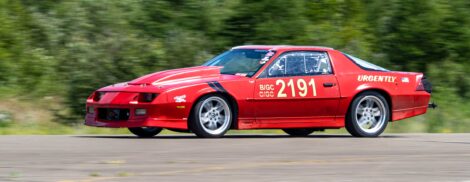
- Photos submitted to Times Observer Urgently races down the track at the Loring (Maine) Timing Association’s Land Speed Trials last week.
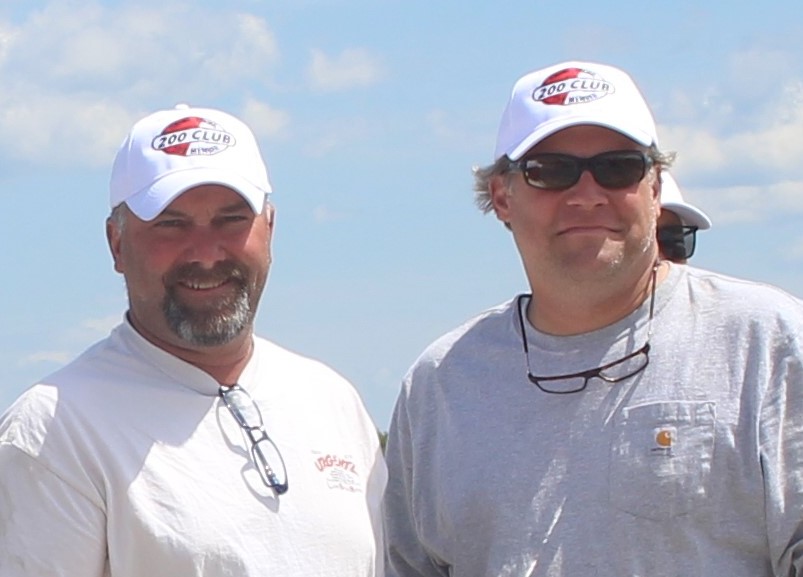
Members of Team Urgently Todd Woodin (left) and Lane Wiggers wear their coveted 200-MPH Club hats earned last week at the at the Loring (Maine) Timing Association’s Land Speed Trials.
Team Urgently has added some accolades — and hats — to its high-speed endeavors.
The Warren County-based land speed racing team traveled to Maine for the Loring Timing Association’s Land Speed Trials.
Team Members Lane Wiggers and Todd Woodin were inducted into the prestigious 200-mile-per-hour Club and Kevin Shippee made some required rookie passes, all in the team’s Camaro — Urgently.
The event was held from July 13 through 16 and featured mile and mile-and-a-half times on a 10,000-foot runway at the former Air Force base.
Team Urgently has made runs on mile/mile-and-a-half events before and has run at Bonneville Salt Flats.
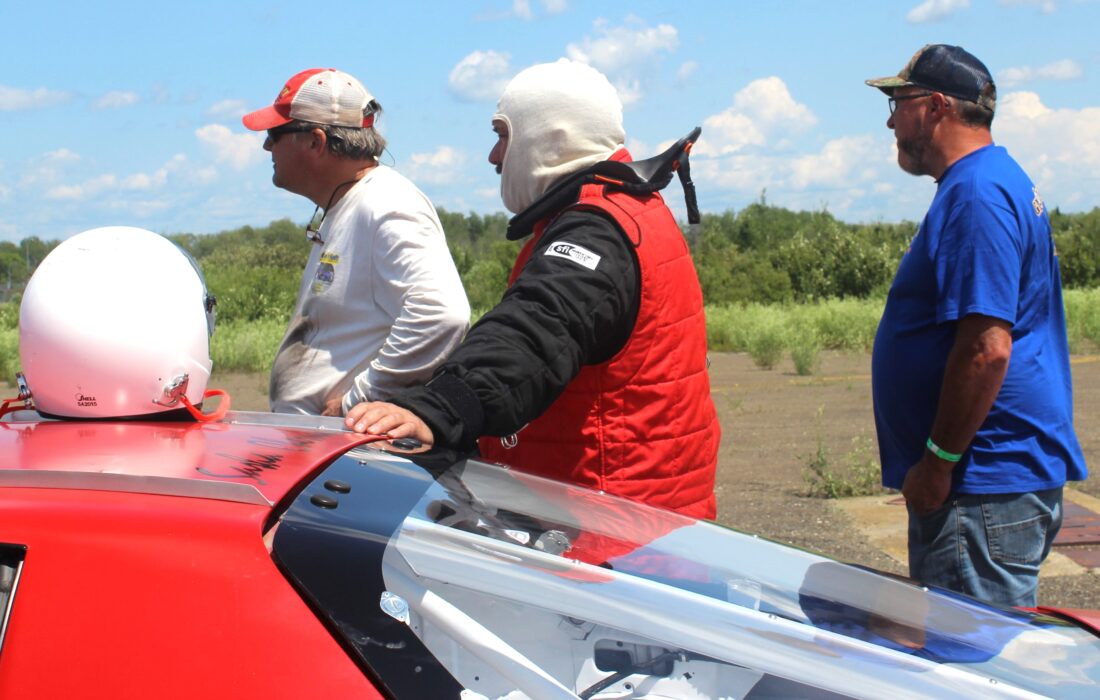
Members of Team Urgently (from left) Lane Wiggers, Todd Woodin — in firesuit, and Kevin Shippee, prepare for a record run at the Loring (Maine) Timing Association’s Land Speed Trials.
At Bonneville, times are based on a ‘flying mile,’ according to Woodin. Racers get up to speed and are timed between two points along the course. It’s about keeping a sustained speed. That can happen at Bonneville due to the length of the tracks — at least 5 miles long.
On a runway less than 2 miles long, there is no opportunity to spend a mile getting up to speed, then being timed for the next mile or more.
“A standing mile (or mile and 1/2) event is more of a sprint from a dead stop,” Woodin said. “How fast can I make it go from a dead stop to a mile and a mile-and-a-half?”
“It is on a prepared concrete surface — airstrip — and is timed at the one-mile and one-and-a-half mile,” he said.
Compared to Bonneville, which is a low-traction environment, “Loring, or other standing mile events, are more about acceleration and traction.”

Photos submitted to Times Observer Urgently races down the track at the Loring (Maine) Timing Association’s Land Speed Trials last week.
Urgently qualified as a GC/A for the competition. The Camaro is a gas coupe. Its LS 427 engine puts it in the A motor classification and generates about 850 horsepower.
“There are a plethora of classes, each with its own sub-classes for engine size,” Woodin said. “In Loring, it is permissible to ‘up-class’ or run for a record in a higher class and/or sub-class, thus enabling a racer to run for multiple records.”
The team members decided to do that. They competed in GC/A and in the higher-horsepower, larger-displacement GC/AA category.
Wiggers ran to a record in GC/AA at 202.277 miles per hour at a mile-and-a-half. “Lane made his record run on July 15 and was inducted (into the LTA 200 MPH Club) that evening,” Woodin said.
Induction has to be done by an existing member.
Woodin’s record attempt on July 15 faced the challenge of a headwind. He set a record of about 183 mph in the mile, but failed to make 200 in the 1.5 mile, missing by one mile per hour.
“I refused any record recognition on the 15th as I intended to run again Saturday the 16th to hopefully improve,” Woodin said. “On Saturday morning, I ran again and broke the one-mile record again as well as the one-and-a-half-mile record.”
His GC/A records were 184.829 at one mile and 203.91 at one-and-a-half.
“Since we broke records and did so at over 200 mph, we were both inducted into the Loring Timing Association’s 200 mph Club,” he said. “This entitled us to the much-coveted hat.”
Because Wiggers was an existing member, he was able to enshrine Woodin.
“I was admitted into the Club by new 200 mph Club member, my teammate, and best friend for 35 years, Lane Wiggers, a very special moment,” he said. “Once a member, you remain a member for life even if the record is later broken.”
New teammate Shippee did not set any records nor hit the 200-mph mark, but he ran Urgently at about 180 mph.
Just before one of his runs, Woodin noticed a problem.
“While on the line as the next to race in about 30 seconds, I absentmindedly glanced into the gap between the cowl induction hood and the windshield,” he said. “In this gap I could see the top of the air-cleaner on the running motor with the wing-nut holding it down.”
“I noticed that the wing-nut was rattling loose and spinning slightly with the vibrating LS 427 engine beneath seconds before a 200-plus-mph pass,” he said. “That seemed like a bad idea.”
Woodin was strapped in, so he needed to get the attention of a teammate. “I powered off the motor,” he said.
That worked.
“One popped hood, a few turns of the wing-nut and I was off to break a record,” Woodin said. “The track official, Joe, was rather amused.”
Non-Driver Teammate Elizabeth Feronti, who is married to Woodin, “has attended most of our races and served as our media tech, photographer and biggest cheerleader.”
The races are about going fast. But, it’s also important to slow down.
“The danger in a standing mile is limited distance to slow down and stop,” Woodin said. “As soon as a racer passes the finish line, he or she needs to work on getting slowed down before running out of real estate.”
He knew that getting from 200 to 0 with less than a half-mile of runway remaining would be a serious challenge.
“In order to give myself the best chance of slowing down I had deployed my chute about a heartbeat before the car crossed the line as the chute would not blossom until after the car passed the timing light,” he said. “This technique is known as ‘driving into the chute.'”
It helped, but not enough. Woodin had to use more than the 300-foot-wide runway to slow down.
“I was still at about 100 mph with the parachute deployed when I had to make a sweeping turn off the track to avoid running off the end of the runway,” he said.
Team Urgently has a Facebook page — The Speed Ranch — where photos, links, in-car videos, and other material is posted.
Local News
Tour of Irvine-Newbold estate is Wednesday

Officers keeping close tabs on Gathering
Corry man faces charge in dog’s death
A Corry man faces charges after allegedly abandoning his sick dog in Freehold Township. Daniel R. Kinnear, 20, ...

School district’s Art Department shines

Big picture
Energy future a defining issue in gubernatorial race
Pennsylvania’s energy future is emerging as a defining issue in the 2026 governor’s race, and both Democratic ...