
Russia-related bills pass House
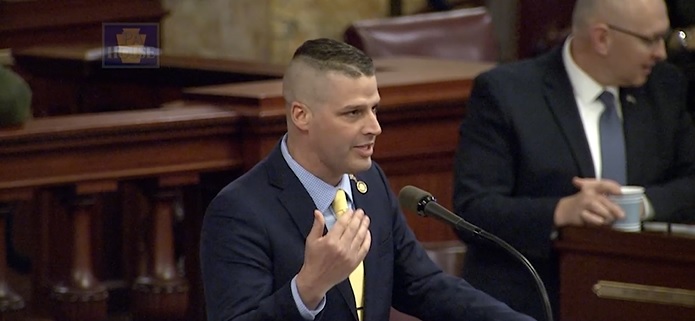
Rep. Clint Owlett urges support for his proposal to end a Wolf administration moratorium on subsurface leases under state land.
-
- Rep. Clint Owlett urges support for his proposal to end a Wolf administration moratorium on subsurface leases under state land.
-
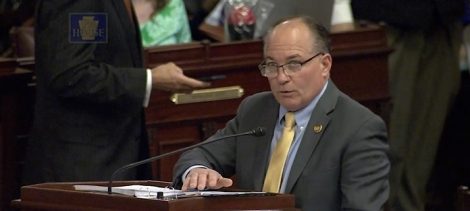
- The Pennsylvania House of Representatives Monday passed legislation sponsored by House Majority Leader Kerry Benninghoff that would divest the Commonwealth from Russian and Belarusian financial assets and prohibit future investment of Commonwealth funds in financial assets of those countries. Benninghoff is pictured speaking about the legislation on the House floor.
On Monday, the Pennsylvania House of Representatives passed five natural gas-related pieces of legislation, four of which legislators pushed using international politics as reasons for passage.
“Pennsylvania has the ability and resources to invest in freedom by contributing to American-led energy independence for ourselves and our allies by increasing natural gas production and transmission capabilities to help end Russia’s energy dominance in Europe and other parts of the world,” said Rep. Kerry Benninghoff, R-Centre/Mifflin.
Bills include:
¯ House Bill 2450, sponsored by Rep. Jonathan Fritz, R-Wayne/Susquehanna, which amends the Delaware River Basin Compact to reapportion the voting rights within the DRBC based on the amount of the basin territory that is within each state. Pennsylvania would have six votes under this plan, New Jersey would have three votes, New York would have two votes, Delaware would have one vote, and the federal government would have one vote. Rep. Kathy Rapp voted in favor of the bill.
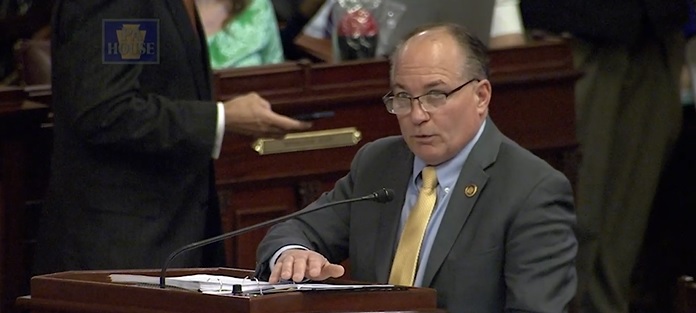
The Pennsylvania House of Representatives Monday passed legislation sponsored by House Majority Leader Kerry Benninghoff that would divest the Commonwealth from Russian and Belarusian financial assets and prohibit future investment of Commonwealth funds in financial assets of those countries. Benninghoff is pictured speaking about the legislation on the House floor.
¯ House Bill 2451, sponsored by Fritz, amending the Delaware River Basin Compact to make it clear that it is not within the DRBC’s authority to ban fracking. Rapp voted in favor of the legislation.
¯ House Bill 2461, sponsored by Rep. Clint Owlett, R-Tioga/Potter/Bradford, to require the Department of Conservation and Natural Resources to establish a program to lease the subsurface rights under state lands for oil and gas development. Rapp voted in favor of the bill.
“One of the key ways that we can do so is to allow for the extraction of our oil and gas resources underneath our state lands, which unfortunately has not been possible based on the governor’s moratorium on new leases,” Owlett wrote in his legislative memorandum. “We can do this in a way that preserves our state lands the way they are now in an environmentally conscious manner by requiring that the surface well site be placed outside of state property. The revenue generated from leasing the subsurface rights will create a vital, continuous source of money that will be used to promote and protect our environment in Pennsylvania, but most importantly put us on a path where we as a country are not relying on Russian gas.”
The house also passed legislation House Bill 604, sponsored by Fritz, to establish a permitting framework at the Department of Environmental Protection (DEP) to ensure that decisions on permits are rendered reliably and in a timely manner and House Bill 637, sponsored Rep. Jim Struzzi, R-Indiana, to require legislative approval before Pennsylvania could enter into a multi-state carbon tax program like RGGI.
Pennsylvania is the third-largest net supplier of total energy to other states, after Wyoming and Texas, according to the U.S. Energy Information Administration. Pennsylvania’s marketed natural gas production, primarily from the Marcellus Shale, reached a record 7.1 trillion cubic feet in 2020, and the state is the nation’s second-largest natural gas producer after Texas. More than half of Pennsylvania households use natural gas as their primary home heating fuel, and the state’s 49 underground gas storage sites-the most for any state-help meet regional heating demand in winter.
“Forty percent of the Russian government’s budget comes from its oil and gas industry, meaning the more petroleum products Russia exports, the more it can wage war and finance its pursuit of regional and global influence. Currently, the world buys between $5 billion and $7 billion worth of Russian oil and gas per week. While the United States recently banned the import of Russian petroleum products, European countries — currently receiving over 40% of their natural gas from Russia — have been unable to do so,” Benninghoff said. “Increasing Pennsylvania energy production and transmission capacity can increase supply and exports to help our allies make the decision to join us in ending their reliance on Russian petroleum products.”
Also passing the House of Representatives on Monday is legislation Benninghoff introduced divesting Pennsylvania from Russian and Belarusian financial assets and prohibit future investment of Commonwealth funds in financial assets of those countries.
House Bill 2447 passed the House unanimously.
“Simply put: Divesting commonwealth investments from Russian and Belarusian financial assets is the right thing to do,” Benninghoff said. “As the Russian and Belarusian governments continue their unprovoked military atrocity and human rights catastrophe against the people and the government of Ukraine, Pennsylvania is speaking with one voice against this ongoing crisis and is joining with the rest of the free world in taking steps that substantively marginalize Vladimir Putin and his domestic and geopolitical allies.”
Local News

Area resident donates great-grandfather’s silent film to Library of Congress

Tops promotes district manager

Lawmaker supports Shapiro’s $30M for firefighters and EMS
Duo’s projects are big for Whirley, clients

Water donations pour in for park
Commissioners: no changes for May primary election
A representative of the League of Women Voters of Warren County addressed county officials Wednesday, voicing ...