County’s first telegraph was ‘the wonder of the age’

Photo from the March 13, 1849 Warren Allegheny Times This article certainly appears to capture a sense of excitement that the community felt with the connection of its first telegraph line.
-
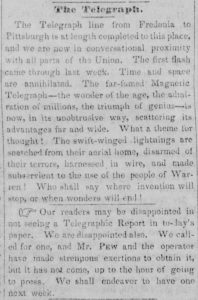
- Photo from the March 13, 1849 Warren Allegheny Times This article certainly appears to capture a sense of excitement that the community felt with the connection of its first telegraph line.
-
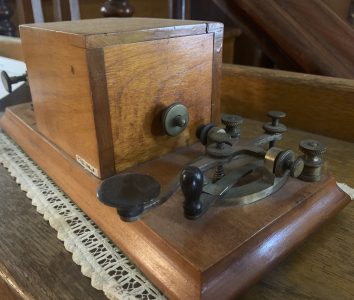
- Times Observer photo by Josh Cotton This is a photo of a telegraph relay key in the collection of the Warren County Historical Society. It was designed to pick up and amplify weak telegraph signals. The Tidewater Pipe Company – operating an oil pipeline in the late 1800s – used this device. The first telegraph hit Warren County in 1849.
When those were the sole means of reaching Warren County back in the 1840s, this really must have felt like an isolated place to live, especially for those who came here from more populated and closely connected metropolitan areas.
But there was a technology on the horizon that could change all that – a technology that could take the weeks it might take to correspond with someone, say, in New York City and communicate with them nearly instantaneously.
Alexander Graham Bell was decades in the future so the technology I’m referring to isn’t the telephone but rather the form of communication the telephone put out of business – the telegraph.
Rumors of a telegraph line from Fredonia to Pittsburgh were circulating months before the project came to fruition.
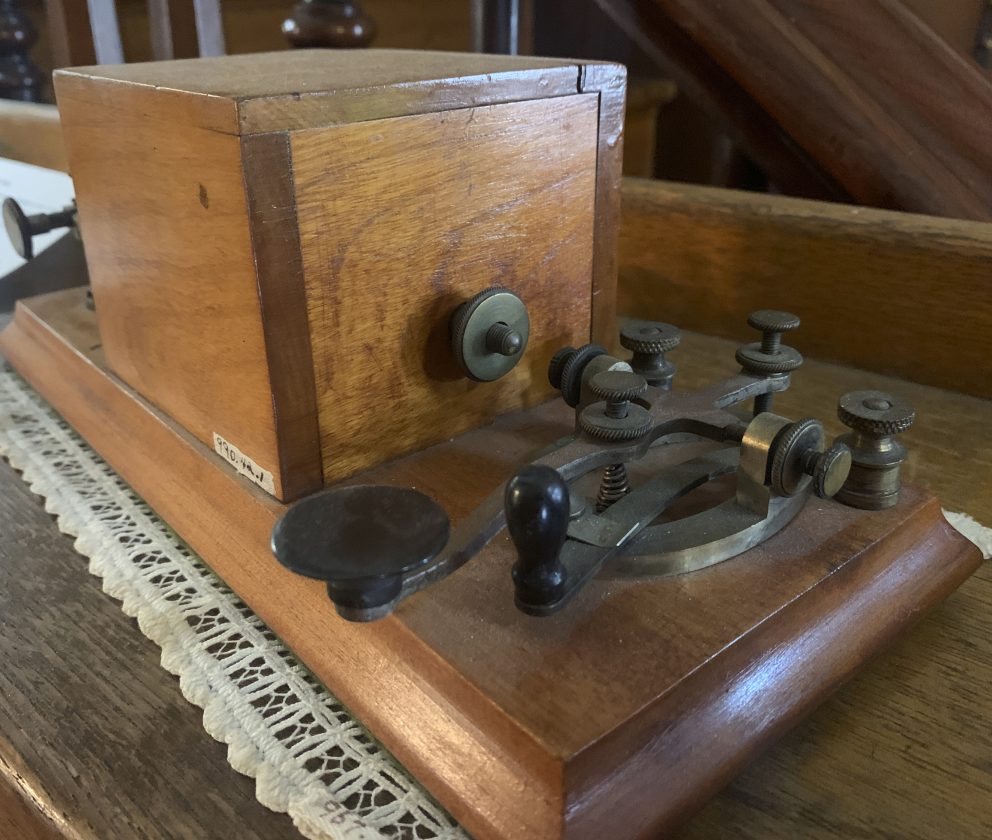
Times Observer photo by Josh Cotton This is a photo of a telegraph relay key in the collection of the Warren County Historical Society. It was designed to pick up and amplify weak telegraph signals. The Tidewater Pipe Company - operating an oil pipeline in the late 1800s - used this device. The first telegraph hit Warren County in 1849.
“The work of setting the posts is mostly contracted to this place, and we are informed by Mr. Pew, the contractor, that the line will be completed thus far in four weeks,” the Warren Allegheny Mail newspaper reported on Dec. 5, 1848,.
“We are to have a station, and shall then of course be in conversational proximity with New Orleans, St. Louis, Chicago, Boston, Washington and other neighboring cities!”
There was much rejoicing – and a substantial amount of hyperbole – in that same paper the following March when the line went live.
From the March 13, 1849 edition: “The Telegraph line from Fredonia to Pittsburgh is at length completed to this place, and we are now in conversational proximity with all parts of the Union. The first flash came through last week.
Here’s the hyperbole: “Time and space are annihilated. The far-famed Magnetic Telegraph – the wonder of the age, the admiration of millions, the triumph of genius – is now, in its unobtrusive way, scattering its advantages far and wide. What a theme for thought! The swift-winged lightnings are snatched from their aerial home, disarmed of their terror, harnessed in wire and made subservient to the use of the people of Warren! Who shall say where invention will stop, or when wonders will end!”
I sincerely hope that if I ever write anything similar that my editors will strike the delete key hard!
While the language is certainly flowery, the significance of the line connecting Warren County was certainly incredibly significant to people living in the county at that time. Interest was so high that the paper endeavored to have a weekly “Telegraphic Report.”
With Warren connected, there’s evidence that other Warren County communities aimed to get a station in the ensuing months and years.
The Warren Allegheny Mail reported on a meeting held in Sept. 1849 in Columbus where the organizer – a W.P. Pew – heard from a committee in Columbus that found their community “eminently deserving the consideration and patronage of the citizens of this village and vicinity and in the opinion of your committee such a line of Telegraph would, when completed, be of great public utility.”
That committee resolved that the telegraph as a technology “is one which can no longer be called a doubtful one.”
The line – called the “Allegheny & Erie Telegraph” i9n a Nov. 6, 1851 Warren Mail – was reported to continue to expand.
“We doubt not this will be found advantageous to our citizens, who have business in the latter place. It can be done cheaper and quicker than before,” they reported.
While this line may have been first, Schenck’s History of Warren County details that it was a total commercial flop.
Just shy of five years, the Mail said the line “is certainly in a very bad condition, especially between this place and Jamestown. Whether this line is at work north of Jamestown or not, we are unable to state. If the line can be kept in repair, in future, we think it can be made to pay something more than the expenses.”
That evidently proved not to be the reality on the ground.
“It was a poor investment for the stockholders, however, since every dollar invested was lost,” Schenck wrote in the 1880s. “The following year the line was completed through to Pittsburgh ; and this was only five or six years after the electric telegraph had been first brought into use in the United States–on an experimental wire stretched from Baltimore to Washington, D. C.”
But that doesn’t mean that the technology didn’t play a prominent role in the development of the nation into the 1940s because it certainly did.
“The travel time from New York City to Cleveland in 1800 was two weeks, with another four weeks necessary to reach Chicago. By 1830, those travel times had fallen in half, and by 1860 it took only two days to reach Chicago from New York City,” according to an article from the Economic History Association. “However, by use of the telegraph, news could travel between those two cities almost instantaneously. This section examines three instances where the telegraph affected economic growth: railroads, high throughput firms, and financial markets.”
They write that the telegraph and the railroad “were natural partners in commerce. The telegraph needed the right of way that the railroads provided and the railroads needed the telegraph to coordinate the arrival and departure of trains.”
Ultimately, the telephone would kill off the telegraph.
“The telegraph flourished in the 1920s, but the Great Depression hit the industry hard, and it never recovered to its previous position,” according to that article. “In 1938, AT&T had 18%, Postal 15% and Western Union 64% of telegraph traffic. In 1945, 236 million domestic messages were sent, generating $182 million in revenues. This was the most messages sent in a year over the telegraph network in the United States. By that time, Western Union had incorporated over 540 telegraph and cable companies into its system.”
They detail the significant role that the telegraph played in a holistic sense.
“The telegraph accelerated the speed of business transactions during the late nineteenth century and contributed to the industrialization of the United States. Like most industries, it faced new competition that ultimately proved its downfall. The telephone was easier and faster to use, and the telegraph ultimately lost its cost-advantages. In 1988, Western Union divested itself of its telegraph infrastructure and focused on financial services, such as money orders. A Western Union telegram is still available, currently costing $9.95 for 250 words.”
Local News
Improvements to begin at Point Park
The City Parks, Recreation and Landscape Commission met for their monthly meeting on Tuesday morning. City ...

‘Impressive’ results
Pennsylvania jobless rate remains 4.2%
The Pennsylvania Department of Labor & Industry released its preliminary employment situation report for March. ...

Visitors Bureau promotes summer events
Paving project to start on Route 62
A $2.5 million resurfacing project that will give motorists a smoother ride on more than 4 miles of Route 62 in ...