
Winter scavenging comes from air, ground
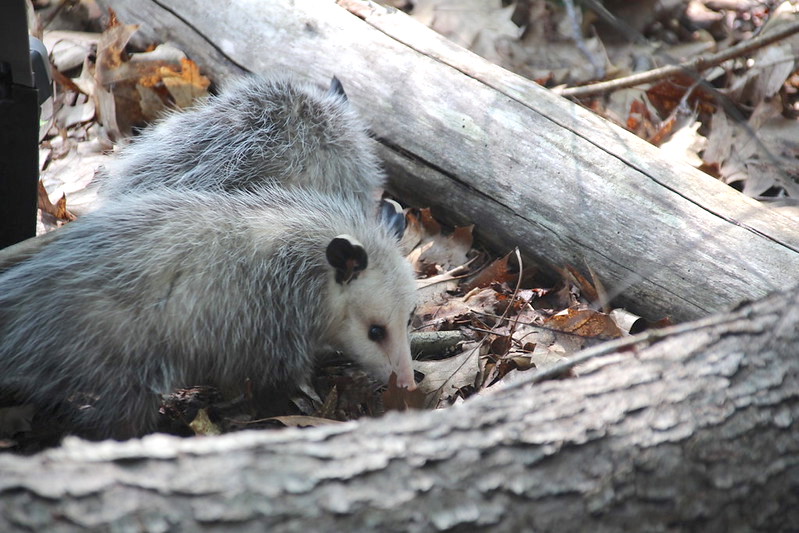
Opossums are one of nature’s misunderstood animals, but they play an important role in the ecosystem.
-
- Opossums are one of nature’s misunderstood animals, but they play an important role in the ecosystem.
-
- Eagles and most birds of prey—not just vultures—will act as scavengers and eat dead animals.
It’s quite likely that not everyone devotes any significant amount of thought to the idea of what happens to dead plants, animals, and other organisms. However, ecological cycles and systems are some of my favorite topics, and the decomposition and breakdown of dead things play heavily into a few of those cycles. This process can be gross, but it is important to all living things, including humans, from both a biological and aesthetic standpoint.
Nature provides its own cleanup crew, and dead organisms are taken care of by a mix of decomposers and scavengers. Decomposers are classified as those organisms, usually certain fungi, bacteria, and invertebrates, that break down dead organisms and release those nutrients back into the environment. In the warmer months, decomposers make short work of dead animals. Adult bear remains can be taken down to fur and bones in less than a week in the right conditions.
In the winter, the decomposition process is significantly slower since some of the usual decomposers aren’t active in the cold, and those that are, move a lot slower. Luckily there is another group of animals that assist the process. Scavengers are animals who also eat other dead animals, but unlike decomposers, they are not responsible for recycling those consumed nutrients back into directly available elements, like carbon and nitrogen. They do break those dead organisms into simpler forms through their digestive system though, moving the decomposition process along.
Along with crows, vultures are a well-known example of a scavenger. This species migrates south for the winter, but they are spotted in western NY starting in early spring and all the way through late fall. You might see them circling above on the thermals or congregating on the side of the road over a dead animal, much like the crows of winter currently are.
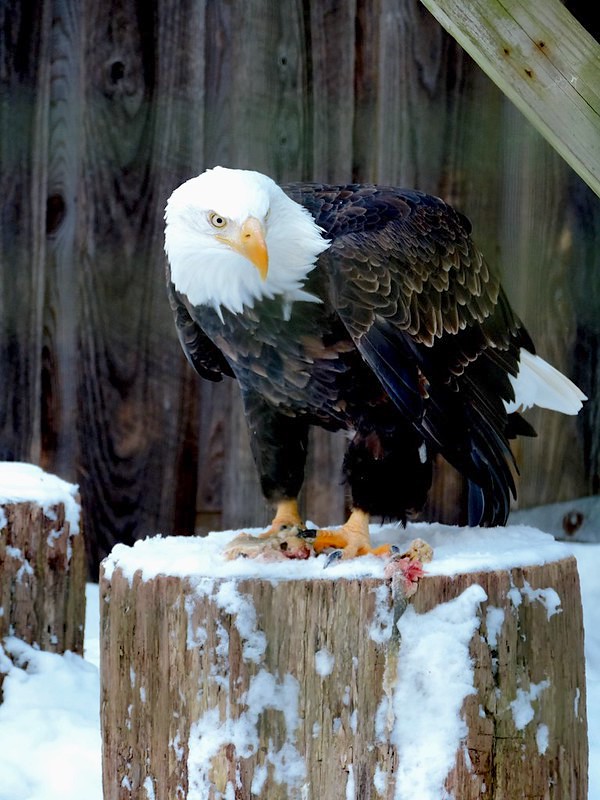
Eagles and most birds of prey—not just vultures—will act as scavengers and eat dead animals.
Few animals are obligate scavengers, meaning they primarily feed on carrion, but vultures are one of those few. Many more animals are opportunistic scavengers and will eat carrion when they happen to come across it.
In the winter, with the longer nights, even larger animals like deer find themselves in the path of a car as they move between the forests and fields. Sometimes these deer get hit by a car and don’t die on impact, so they end up running into the woods. One such dead deer was recently found at ACNC, and with the below-freezing temperatures, decomposers were not able to do their work as efficiently. A frozen carcass gives scavengers a longer window to get at the dead deer, since the meat isn’t being rapidly consumed and broken down by decomposers, and the freezing keeps it from rotting. With the game camera set up over the dead deer, we were able to see what animals were scavenging food during this frigid weather, and it turns out there was a varied crew taking turns eating from it.
In the winter, frozen carcasses mean that even more animals have an opportunity to feed on dead organisms. One animal spotted on the game camera, and another opportunistic feeder, was an opossum. Opossums are generalists and will eat whatever food they can get their hands on, whether that is plant matter, carrion, or a person’s trash. They are one of nature’s best clean-up crew members.
The opossum was eventually followed by a fox. Foxes are mesocarnivores, so they primarily eat other animals but also eat fruit or other plant matter to survive. In the winter, live prey animals are harder to find, so coming across a dead deer is an important reservoir of food.
Fishers are commonly found eating animal remains at any temperature. They are primarily meat-eaters, and incredibly proficient predators. However, they are also willing to enjoy a free meal where they don’t have to chase their prey.
Although it’s not the most joyful topic, in the winter these dead animals are an important food source as many of the usual prey animals have gone underground. Eventually every organism out there will die for one reason or another, and their nutrients will continue to cycle through the ecosystem, providing sustenance and energy for other organisms, large and small. The decomposers recycle nutrients directly back into the immediate vicinity, but scavengers help to broaden that reach, and move the energy and nutrients further afield. Both are necessary to keep our habitats healthy.
Audubon Community Nature Center builds and nurtures connections between people and nature. ACNC is located just east of Route 62 between Warren and Jamestown. The trails are open from dawn to dusk and birds of prey can be viewed anytime the trails are open. The Nature Center is open from 10 a.m. until 4:30 p.m. daily except Sunday when it opens at 1 p.m. More information can be found online at auduboncnc.org or by calling (716) 569-2345.
Community
Youngsville Life
Shrove Tuesday pancake supper scheduled Editor’s Note: Please email community news to Colette Nelson at ...
Winter scavenging comes from air, ground
Briefs
Allegheny Outdoor Club to hike, ski Sunday On Sunday, Feb. 8, members of the Allegheny Outdoor Club will hike ...
Warren library announces February events
The Warren Public Library has several upcoming events for community members of all ages. Trivia Night will take ...
Why we get so much snow
Briefs
Outdoor Club To Hike, Ski At Audubon On Sunday, Feb. 1, members of the Allegheny Outdoor Club will hike or ...