
Trolley 93 presentation gives look at by-gone mode of transportation
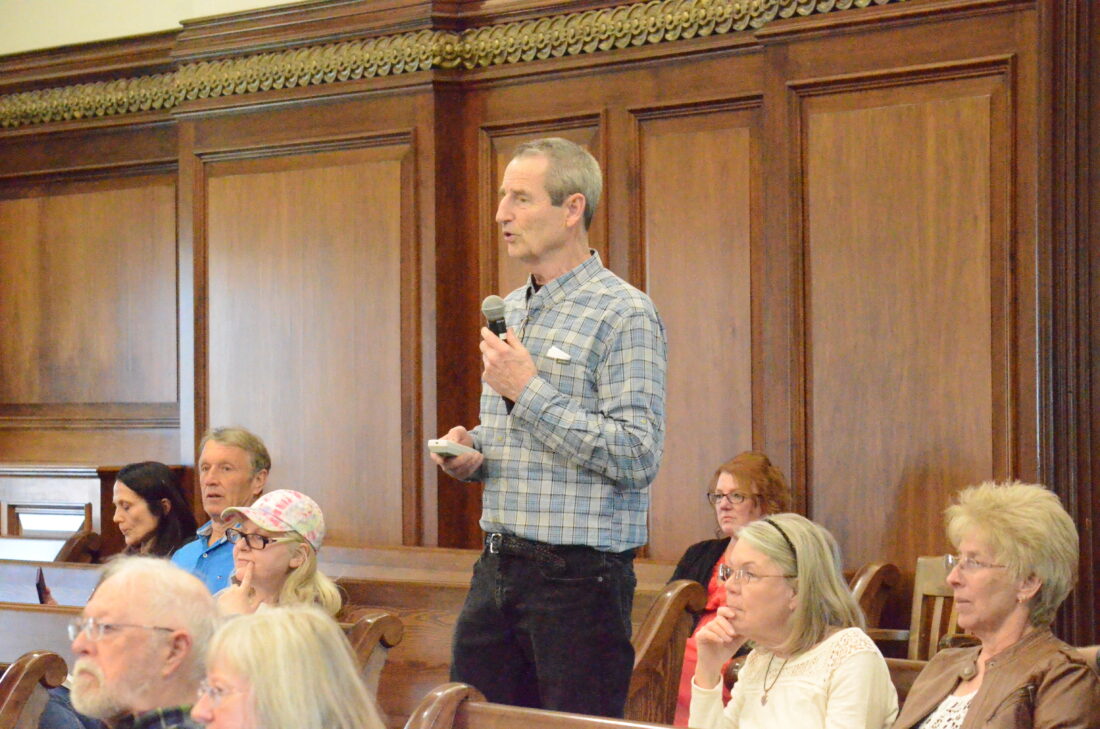
Times Observer photo by Josh Cotton The founder of the project, Bob Johnston, speaks during a Warren County Historical Society talk on the project held this week.
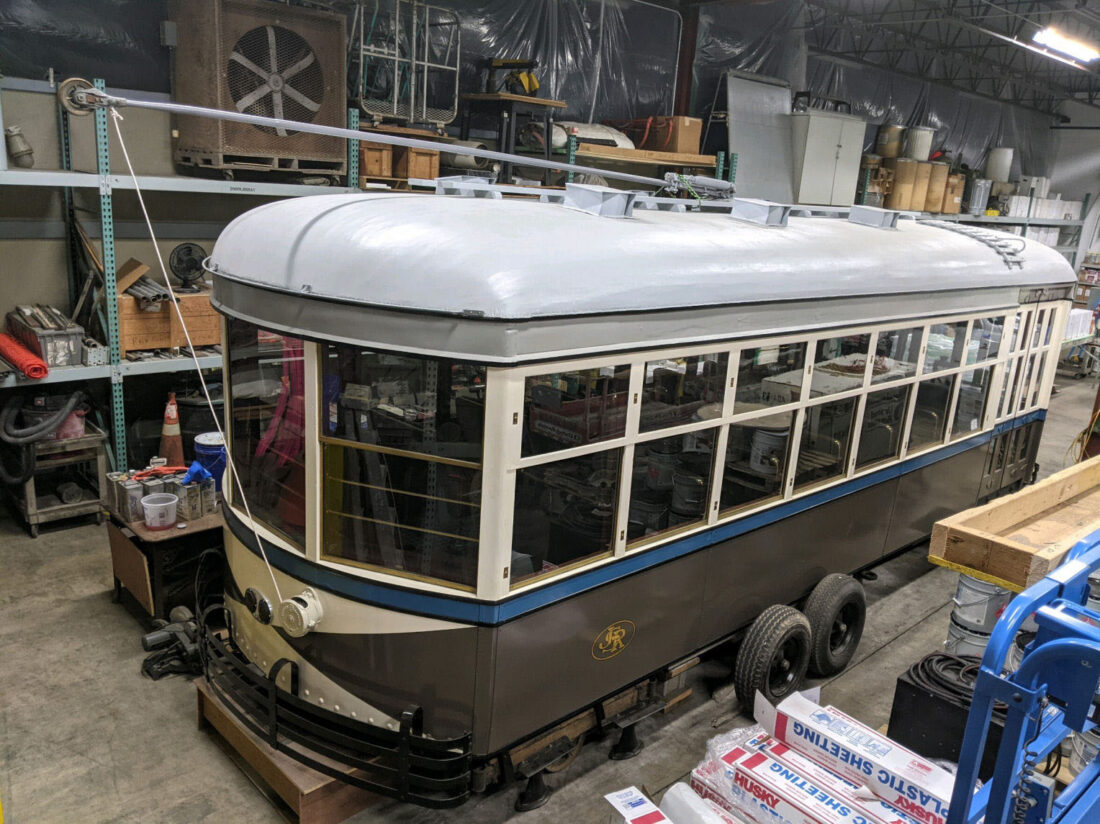
Photo provided to the Times Observer This is Jamestown Trolley No. 93. The historic trolley car project is nearly complete after decades of restoration work. Preliminary plans to display the historic trolley in the community are ongoing.
Times Observer photo by Josh Cotton The founder of the project, Bob Johnston, speaks during a Warren County Historical Society talk on the project held this week.
Photo provided to the Times Observer This is Jamestown Trolley No. 93. The historic trolley car project is nearly complete after decades of restoration work. Preliminary plans to display the historic trolley in the community are ongoing.
Trending
There have been many forms of transportation that advancements in technology made obsolete.
The trolley car is one of them.
But the legacy remains alive in the form of Jamestown Trolley Car 93, which a dedicated group of volunteers have been restoring for years.
Bob Johnston, the founder of the project, was the speaker at a Warren County Historical Society even this week.
The trolley car was born out of the street car. Johnston explained that the first street car company in Chautauqua County started in 1866, obviously pulled by horsepower.
Johnston said the first street cars in Warren operated in 1893 on an east-west route along what we now know as Pennsylvania Ave. Four years later a line was added that went up Liberty St. and along what is now the Bike-Hike Trail into North Warren.
That line initially went right up S. State St. before moving to the edge of Rt. 62.
As electricity developed, that paved the way for the trolley car – a vehicle powered by electricity and contact with an overhead electric cable. That reliance on electricity is the distinction.
"All trolley cars are street cars but not all street cars are trolley cars," he explained.
He said there were five street car companies in Chautauqua County, one of which came down to Warren – the Warren & Jamestown Street Railway. That line opened Sept. 2, 1905 and operated until 1929.
His presentation included a snippet from the Sept. 5, 1905 Jamestown Evening Journal that describes the cars: "The exterior of the car is finished in a rich dark green with gold lettering and the interior has a light blue ceiling. The cars accommodate up to 56 people in upholstered green plush seats, with an enclosed smoking compartment so not to annoy other passengers."
Johnston said the trip from Warren to Jamestown cost $.75.
"Initially, the cars couldn't go into Jamestown and couldn't go into Warren," he said, because of the high levels of alternating current required to operate the cars. A dual system that used direct current allowed the cars to safely traverse the populated areas.
Warren to Jamestown is roughly a 20 mile trip but Johnston said there were 53 total stops on the Warren to Jamestown line.
"An average trip would only make about 15," he said. "That was the beauty of the trolley over the train." It didn't need as much space to stop and start. "The trolley was much more sympathetic to the needs of the individuals at various places.
The line to Jamestown followed Rt. 62 into Frewsburg and then took a hard Left to Jamestown.
Part of the line in Jamestown proper is where the trolley restoration originates.
Johnston said that the Jamestown Street Railway Company made its last purchase of trolley cars – cars 91 through 98 in 1926.
Trolley 93 was designed to compete with the bus and didn't have the "frills" that the older cars did, he said. The cars on the Jamestown-Warren line, bought in 1904, would have been "much fancier."
"The writing was on the wall in 1926," he said. "(They) bought the trolleys to compete with the buses that didn't need a track. Buses came in and pushed them out.
"Unfortunately, these cars did not survive the scrap heap," he added, noting that the company "burned them up and scrapped the metal."
The trolley industry in the region was completely dead by 1938.
"Fortunately some of the wood bodies were sold and used for cottages on Chautauqua Lake," Johnston said.
Trolley 93 eventually wound up in the woods as a hunting camp. It cost him $400 to haul it out in 1996.
Work on the restoration began in earnest in 2014 and it amounted to essentially a total rebuild. Roof wood had to be shaped, beams had to be replaced, a litany of steel, bronze and glass had to be recreated. The trolley needed new seats. The floor "was a real issue."
Johnston noted throughout his presentation that many of the items were donated by local businesses.
All the wood was donated and they traveled to a trolley museum to get a better look at the design for the doors.
Johnston said they held a seat sponsorship fundraiser to be able to cover the cost of new seats and "within two weeks we had every one of them sold."
He said the next major project is to strengthen a set of wheels that were once on another trolley.
He "started with the idea" that the Trolley 93 might be used as a trolley again but also discussed possibilities that have been reviewed for where the trolley might be able to go on display.
People interested in checking it out
"Anybody that wants to see the trolley, it's in Falconer," he said.